What to Eat in Sicily: The Dishes That Matter, and When to Order Them
 Daniele Bellia · 8 min read
- The one rule that matters most — granita and brioche is breakfast, not dessert
- Dishes belong to cities — Norma is Catania’s, pesto alla trapanese is Trapani’s, sfincione is Palermo’s
- Arancino or arancina? — both are correct; the ending changes at roughly the middle of the island
- Cannoli — should be filled in front of you, never sitting pre-filled in the display case
- Seasonal only — pasta con le sarde in spring, tenerumi in high summer, frutta martorana around 2 November, cassata at Easter
- If you only do one food thing — a market in the morning, not a restaurant at night
Sicilian menus tell you almost nothing useful. They list thirty dishes, most of which the kitchen makes because tourists expect them, and the four or five that place actually does well are not marked in any way.
The information nobody hands you is that Sicilian food is regional and seasonal to a degree that surprises even other Italians. A dish that is a point of civic pride in one city is a mediocre import ninety minutes away. Half the famous sweets exist for one week of the religious calendar. And the single most common ordering mistake visitors make is not a bad dish — it’s the right dish at completely the wrong time of day.
Start with the one that will mark you out
Granita with brioche is breakfast.
Not dessert, not an afternoon treat, not something to have after dinner. In summer, across eastern Sicily especially, this is what people eat at 8am: a semi-frozen granita — lemon, almond, coffee, mulberry, pistachio — with a brioche col tuppo, the soft bun with a topknot, which you tear and dip.
Order it at 10pm after a fish dinner and nobody will refuse you. They will just quietly know.
The other half of this rule: granita is not a slushie and it is not sorbet. Properly made, it has no ice crystals you can crunch — it should be smooth and just barely holding its shape. Almond granita in particular is made from real almond paste, not syrup, and the difference is immediately obvious.
The dishes that belong to a specific city
This is the part that saves the most meals. Sicily’s famous dishes are not island-wide; they’re municipal, and each one is best where it comes from.
- Pasta alla Norma — Catania. Tomato, fried aubergine, basil, salted ricotta. Named after Bellini’s opera; Bellini was Catanese, and the city has never let anyone forget it. Our recipe for the original has the detail that matters most: the aubergine is fried separately and added at the end, never stewed into the sauce.
- Pesto alla trapanese — Trapani. Almonds, raw tomato, garlic, basil, on busiate. It exists because Genoese ships stopped at Trapani; it’s Ligurian pesto rebuilt with what western Sicily actually grows. How it’s made.
- Sfincione — Palermo. A thick, soft, spongy focaccia-pizza with onion, anchovy, breadcrumbs and caciocavallo. Bought from a van or a market stall, not ordered in a pizzeria. Recipe here.
- Pasta con le sarde — Palermo. Sardines, wild fennel, pine nuts, raisins, saffron. Genuinely one of the great pastas of Italy, and genuinely seasonal — see below.
- Chocolate — Modica. Made cold, ground with sugar that never dissolves, so it’s grainy on purpose. It is not “bad chocolate”; it’s a completely different technique, Aztec in origin via the Spanish. More on it.
Ordering Norma in Palermo is not an offence. It’s just that you’re ordering Catania’s dish from a kitchen that has no particular reason to care about it.
Arancino or arancina — the argument is real, and both sides are right
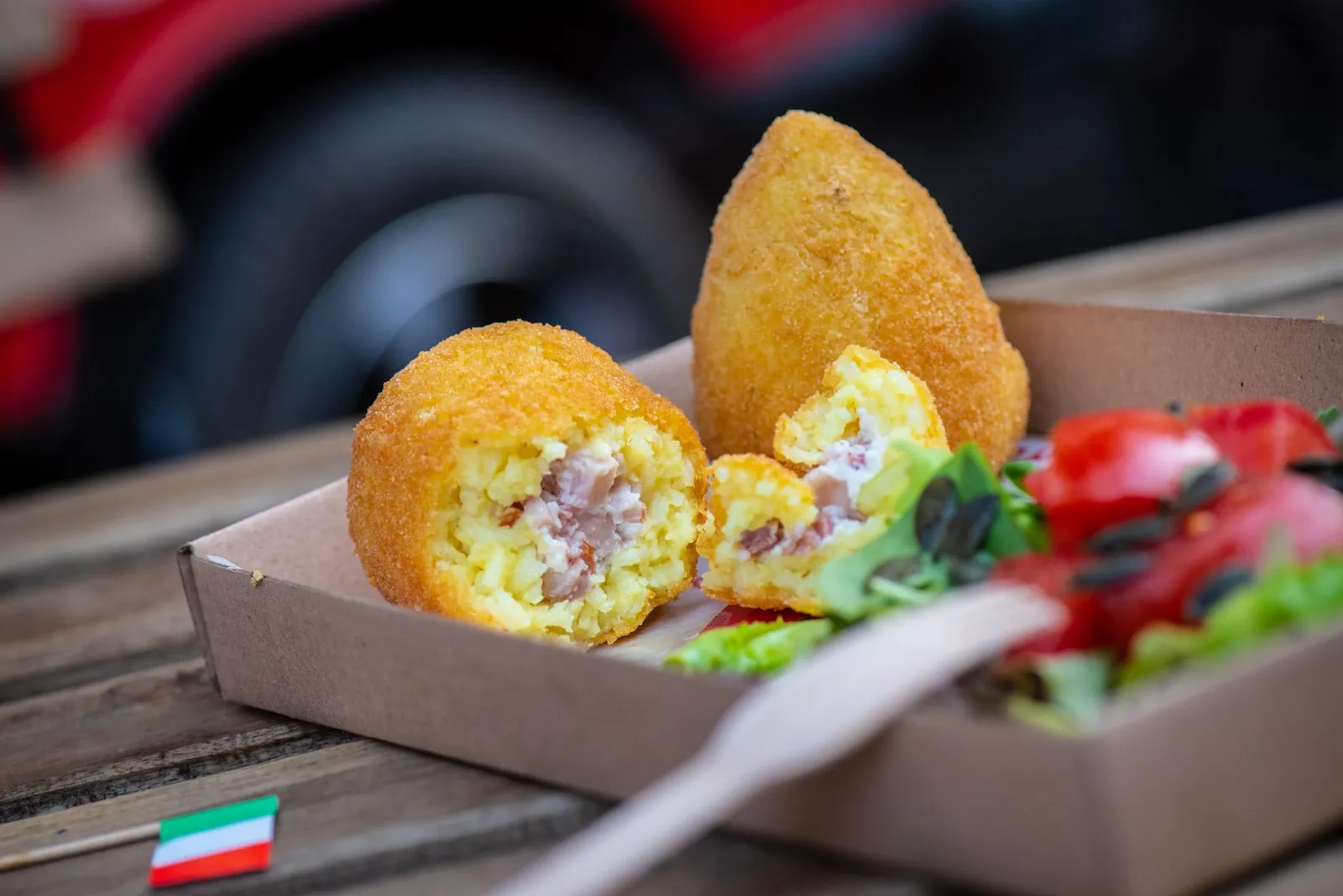 Photo: Peter Benedetti, via Pexels
In Catania and eastern Sicily it’s arancino, masculine, and traditionally shaped like a cone — the story on the ground is that it echoes Etna. In Palermo and the west it’s arancina, feminine, and round like the orange it’s named after.
People will argue about this with real feeling. The Accademia della Crusca, Italy’s language authority, has looked at it and concluded that both are correct, as geographically differentiated usage: the Sicilian word for orange is aranciu, masculine, which supports arancino, while arancina appears in print in a work by the Catanese writer Federico De Roberto in 1894 and entered Italian lexicography from there.
So the safe move is to use whichever word the sign in front of you uses. The unsafe move is to have an opinion.
Fillings: al ragù (meat, peas, tomato) and al burro (béchamel and ham) are the two classics. In the east you’ll also find alla norma and, around 13 December, al pistacchio and other variants for Santa Lucia.
Street food, which is where Palermo is genuinely world-class
Palermo’s street food is not a tourist construction — it’s a working-class eating culture that predates tourism by centuries, and it’s still cheapest and best in the markets: Ballarò, Capo, Vucciria. We’ve written about Ballarò specifically, which is the one that still functions as a market rather than a nightlife strip.
What to actually order:
- Panelle — chickpea-flour fritters, usually in a bun. Vegetarian, and the entry-level item everyone likes. Recipe.
- Crocchè — potato croquettes, ordered alongside the panelle in the same sandwich.
- Stigghiola — lamb or goat intestine wound around a spring onion and grilled over charcoal. You will smell it before you see it. This is the real thing.
- Pani ca meusa — a bun filled with veal spleen and lung, boiled then fried in lard. Ask for it schietta (plain) or maritata (“married”, with ricotta and caciocavallo). This is the item that separates the curious from the polite.
- Sfincione, as above.
If you’d rather have someone walk you through it and do the ordering, there’s a small-group street food tour with a local in Palermo (affiliate link — booking through it costs you nothing extra and helps support this site). Worth it mainly for the offal items, which are hard to approach cold.
The sweets, and the calendar they actually run on
Sicilian pastry is not a year-round menu. Much of it is religious, and it appears and disappears.
- Cannoli — available all year, but the shell must be filled to order. A pre-filled cannolo has been absorbing moisture from the ricotta for hours and the shell is soft. If a bar has a tray of them ready-made, that tells you what you need to know. Recipe.
- Cassata — ricotta, sponge, marzipan, candied fruit. Historically an Easter cake; you can find it year-round now in tourist areas, but its season is spring. Recipe.
- Frutta martorana — marzipan sculpted and painted to look like real fruit, made for 2 November, the Day of the Dead, when children traditionally wake to a basket said to be left by dead relatives. Invented, by tradition, by the nuns of Palermo’s Martorana convent. Shops sell it in the weeks around then and at Christmas.
- Gelo di melone — a set watermelon pudding with jasmine and chocolate chips, and a high-summer thing only. Recipe.
The seasonal savoury dishes worth timing a trip around
- Pasta con le sarde needs finocchietto selvatico, wild fennel, which grows in spring. Restaurants make it year-round with preserved or frozen fennel and it is simply not the same dish. March to May is when to order it.
- Pasta e tenerumi uses the leaves of the long cucuzza squash and exists in July and August, essentially only. It’s a soupy, plain, deeply domestic Catanese dish that almost never appears on tourist menus. Recipe.
- Frittedda — artichokes, broad beans and peas stewed together, a spring Palermitan dish that vanishes by June. Recipe.
- Blood oranges are a December to April fruit. The famous orange and fennel salad is a winter dish, not a summer one.
Practical tips for eating in Sicily
- Lunch is roughly 13:00–15:00, dinner from 20:00. A restaurant serving at 18:30 is serving tourists. Kitchens in smaller towns close between services entirely — see our opening hours guide.
- Expect a coperto. A per-person cover charge of roughly €1.50–3 is normal and legal, and it isn’t a tip. We cover how it works and what isn’t legal in the tourist scams article.
- Read the fish price by weight. Fresh fish is often priced al kg, and the bill can surprise you. Ask what the piece weighs before agreeing.
- Vegetarians do fine here. Sicilian cooking is historically poor-people’s cooking, so caponata, panelle, parmigiana, frittedda, pasta alla Norma, maccu di fave and most of the street-food fritters contain no meat. Confirm the Norma’s ricotta salata and that nothing arrives with anchovy.
- A market in the morning beats a restaurant at night if you only have one food experience in you. Prices are real, the produce tells you what’s in season, and everything is cooked in front of you.
- Avoid restaurants with photographs on the menu and anyone standing outside inviting you in. This is the single most reliable filter in Sicily, and it costs nothing to apply. Our restaurant guide has city-by-city picks.
What I’d actually tell a friend
Eat breakfast the local way for one morning — granita and brioche, sitting down, before it gets hot. Do one market properly. Order the dish that belongs to the city you’re standing in, and ignore the one you came in wanting.
And if you’re here in spring and see pasta con le sarde on a handwritten board rather than a printed menu, order it. That’s the version made with fennel someone actually went and picked.
Planning meals around a route? Our interactive map of Sicily marks markets, food towns and the cities each of these dishes belongs to — more at sicily-insider.com.