Ballarò Market: Palermo's 1,000-Year-Old Street Market, Still Run the Same Way
 Daniele Bellia · 4 min read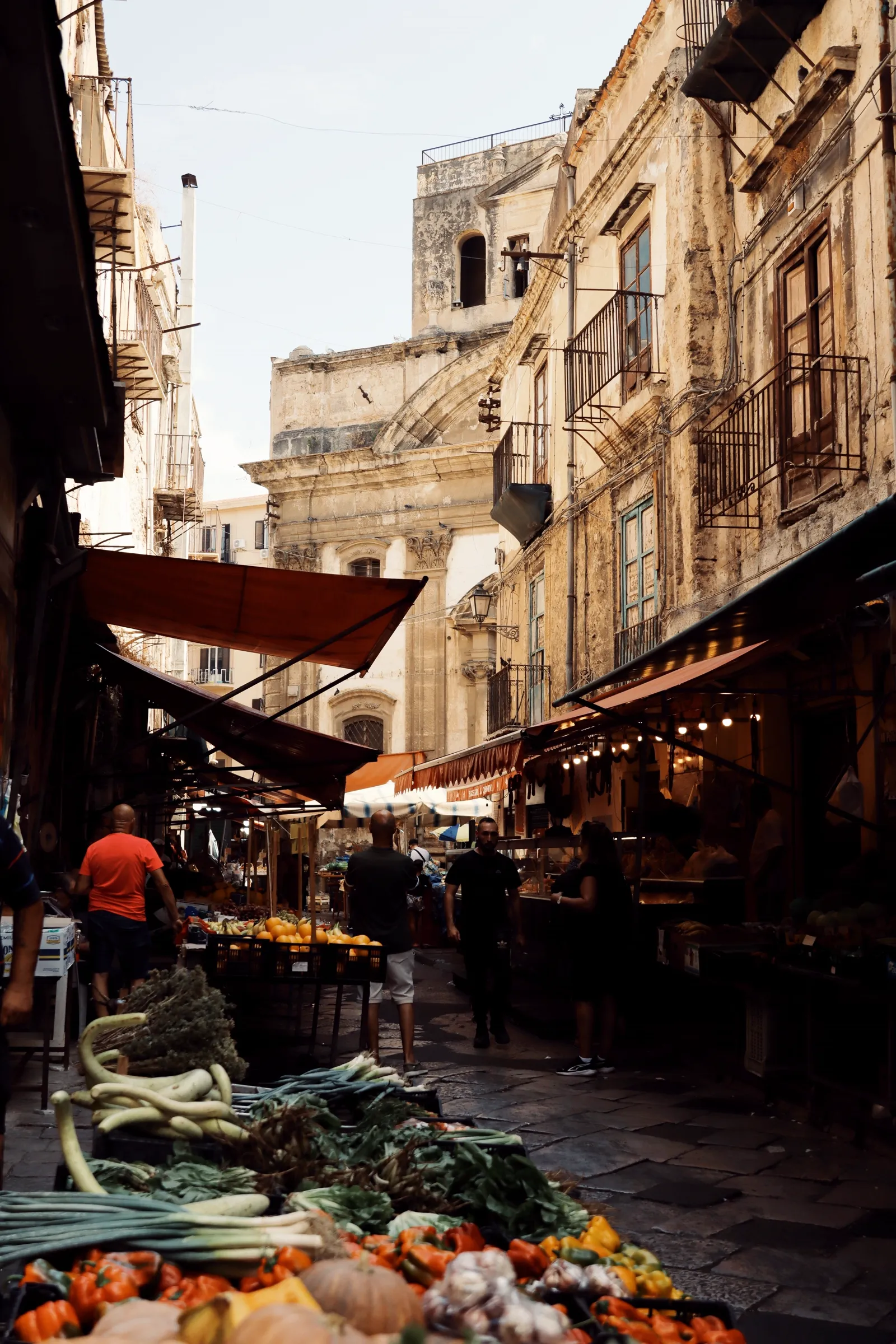
- 📍 Location: Albergheria district, between Corso Tukory and Via Maqueda — main entrance Via Dalmazio Birago
- 🕐 Hours: Monday-Saturday 7:30am-8pm, Sunday mornings only
- 💶 Cost: free to walk through; street food a few euros per item
- ⏱️ Best time: early morning for the freshest produce; Saturday morning is the busiest, every stall open
- 👨👩👧 Good for kids: yes, but crowded and loud — hold hands in the busiest stretches
Ballarò isn’t Palermo’s prettiest market — that’s arguably Vucciria, parts of which have been tidied up for visitors. Ballarò is the one that’s stayed closest to what it’s always been: a genuinely working market where Palermitani do their actual grocery shopping, more than a thousand years after it was founded.
Founded over 1,000 years ago, specifically to dodge taxes
Ballarò dates back to the 10th century, during Arab rule in Sicily. Its name comes from “Suq al-Balhara” — roughly, “Market of Mirrors” — Palermitan dialect eventually smoothing the Arabic into “Ballarò.” The location wasn’t an accident: the market was deliberately set up outside the city’s old Phoenician walls, because trade conducted beyond the walls wasn’t subject to the city’s duties and taxes. It’s one of the oldest continuously operating markets in Europe, and the reason it exists where it does is a tax dodge over a thousand years old.
The abbanniata: Sicily’s street-vendor sales pitch
Walk through Ballarò and you’ll hear it before you see it: the abbanniata, a half-shouted, half-sung sales chant vendors use to pitch their produce to passersby. There’s no standard version — every vendor invents their own, and over years it becomes something like a personal trademark, instantly recognizable to regulars even from around a corner. It’s not performed for tourists; it’s simply how business has been done here for generations, and it’s one of the few living oral traditions you can actually stand in the middle of.
What to actually eat: pane ca meusa
The market’s signature dish is pane ca meusa — bread with spleen — a genuinely old recipe, dating back roughly 1,100 years to Jewish butchers who settled in Palermo. The traditional filling combines lung, spleen, and “scannarozzato” (pieces of ox windpipe cartilage), simmered in lard and piled into a soft sesame roll, served either “schettu” (plain) or “maritatu” (with a squeeze of lemon and grated caciocavallo cheese). It’s not a dish built for a squeamish first bite, but it’s genuinely central to Palermo’s food identity, not a novelty invented for visitors. Alongside it, the usual Palermo street-food staples show up throughout the market too: panelle (chickpea fritters), arancine, and produce stalls that have stayed in the same families for generations.
If you’d rather not guess which stall is worth stopping at, this small-group street food tour walks both Ballarò and Vucciria with a local (affiliate link — booking through it costs you nothing extra and helps support this site) — which also solves the ordering problem, since almost nothing here is written down or translated.
Not just Sicilian anymore
Since the 1980s, immigrant communities have settled in the Albergheria district around Ballarò — sub-Saharan African, Eritrean, Ethiopian, Pakistani, Bangladeshi, and Sri Lankan among others — drawn originally by cheap, sometimes abandoned housing in a neighborhood that had fallen into disrepair. Today the district counts more than 25 different nationalities and cultures. It’s less a blended “melting pot” than a genuine patchwork — each community tends to keep to itself rather than merging into one shared identity — but the practical effect on the market has been real: new stalls and food alongside the traditional Sicilian ones, and a historic center that stayed lived-in and functioning rather than emptying out the way old centers often do elsewhere in Europe. Walking Ballarò today means walking through both layers at once, not a museum version of one.
Getting oriented
Ballarò sits in the Albergheria district, roughly bounded by Corso Tukory on one side and Via Maqueda on the other, with its main entrance on Via Dalmazio Birago. You can also slip in from several side streets off Via Maqueda — Via Cesare Battisti, Via delle Pergole, Via del Bosco, or through the Arco di Cutò. It’s not a single street but a genuine tangle of narrow lanes, which is part of the point: there’s no one “correct” route through it.
Practical tips
- Go in the morning — the market winds down noticeably by early afternoon, and produce is freshest earlier in the day.
- Saturday morning is peak Ballarò — every stall is open and the crowd is thickest, good for atmosphere, less good if you actually want to move quickly.
- Negotiating is normal for non-food items, less so for produce and street food, where prices are usually fixed and honest.
- Bring small bills and coins — most stalls are cash-only, and vendors don’t always have change for anything large.
- Combine it with Quattro Canti or the Cattedrale — both are a reasonable walk away, making Ballarò a natural morning anchor for a wider Palermo old-town loop.
More on the area in the Palermo region guide, and see Ballarò on our interactive Sicily map.