Pesto alla Trapanese – the Original Version with Busiate
 Daniele Bellia · 3 min read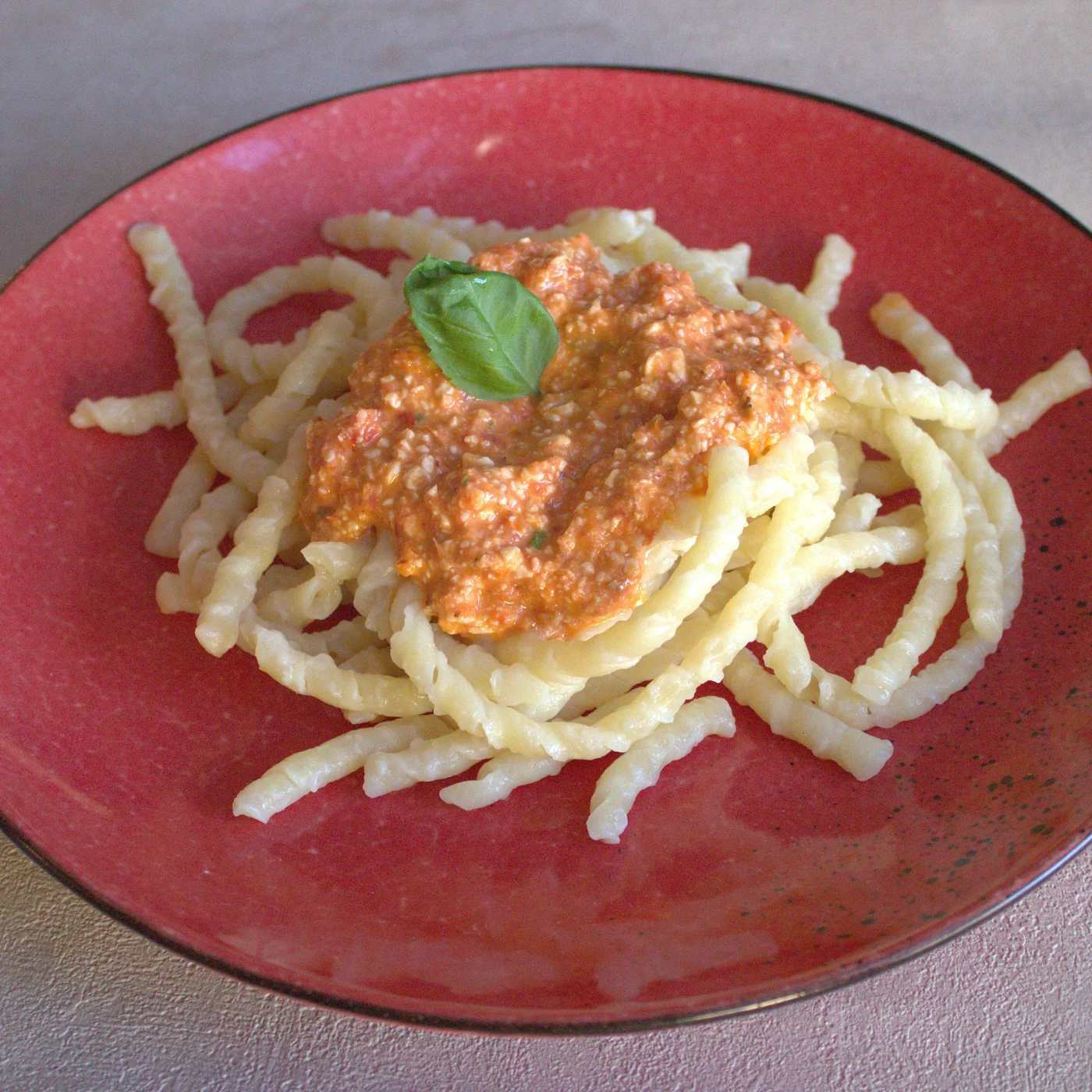
Ingredients
Before anyone asks: no, this only shares an idea with the green pesto from Genoa, not the recipe. Pesto alla Trapanese was born in the port of Trapani in the 16th/17th century, when Genoese sailors brought their pesto along and locals reworked it with what actually grows in Sicily: ripe tomatoes, almonds from Avola, red garlic from Nubia near Paceco, pecorino, and basil. The original name was blunter and more direct: “Pasta cu l’agghia pistata” — pasta with pounded garlic.
Like Pasta alla Norma, this dish is naturally vegetarian too — no adapting required, the original comes without meat or fish.
The mortar isn’t a detail — it’s the whole point
The original is made in a mortar (mortaio), not a blender. That’s not nostalgia for its own sake — there’s a real reason behind it: pounding crushes the almonds and garlic instead of shredding them, so small, noticeable pieces survive and the essential oils release more slowly and evenly. A fast-spinning blender warms the mixture slightly and turns it into a homogeneous cream — the result ends up tasting more like almond paste than the grainy, fresh sauce Pesto alla Trapanese is supposed to be.
Method
Almonds and garlic: Pound in a mortar with a pinch of coarse salt until small, still-visible pieces remain. The salt acts like sandpaper here, helping everything break down evenly.
Basil: Add the leaves whole (no need to chop — the pounding takes care of that) and keep working until you get a coarse, strongly fragrant paste.
Tomatoes: Blanch briefly, peel, seed, and dice small. Fold into the almond-garlic-basil paste — stirring is enough here, no need to pound; the tomatoes shouldn’t break down completely.
Finishing: Stir in plenty of olive oil until you get a thick but pourable sauce, season with salt. Cook the busiate al dente, toss with the sauce cold (no heating the sauce — this is the second big way Trapanese pesto differs from a warm-served Norma sauce), and top generously with grated pecorino.
Why busiate specifically
Busiate are a handmade pasta shape from western Sicily, originally wound around a reed stem (“buso” in Sicilian dialect), which gives them their spiral, hollow shape. That shape isn’t a coincidence: the coils catch the chunky sauce far better than smooth pasta, which would just let the almond pieces and tomato dice slide right off. If you can’t get busiate, fusilli or casarecce are the best substitutes — both have enough texture for the same reason.
The most common mistake
A lot of recipes outside Sicily blend the sauce completely smooth and still call the result “Pesto alla Trapanese.” The flavor isn’t necessarily wrong, but structurally it’s a different dish — the entire point of the sauce is the contrast between creamy tomato and crunchy almond pieces, not a uniform paste.
What to drink with it
A cool, dry white from the west coast works best — a Grillo or Catarratto, both native grape varieties from around Trapani. Their freshness balances the sweetness of the tomatoes and the oiliness of the almonds nicely, without overpowering the garlic.
More on Trapani on our interactive Sicily map.
FAQ
Do I really need to use a mortar?
For the real thing, yes — a mortar crushes the almonds and garlic instead of shredding them, so small pieces survive and the essential oils release differently than with a fast-spinning blender. In a pinch, a blender on short pulses gets you close; a blender left running makes the sauce too fine.
What if I can't find busiate?
Busiate are a specialty of Trapani and hard to find outside Sicily. Fusilli or casarecce are the closest substitutes, since their shape holds onto the chunky sauce in a similar way.
Can I leave the tomatoes unpeeled?
Traditionally they're peeled so the skins don't turn the sauce unpleasantly stringy. A quick blanch in boiling water makes the skin easy to slip off.
How long does the pesto keep?
In the fridge, covered with a layer of olive oil, 2–3 days. Because of the fresh tomatoes, it doesn't keep nearly as long as classic tomato-free pesto genovese.