Monastero dei Benedettini: The Monastery Etna Tried to Bury, Twice
 Daniele Bellia · 5 min read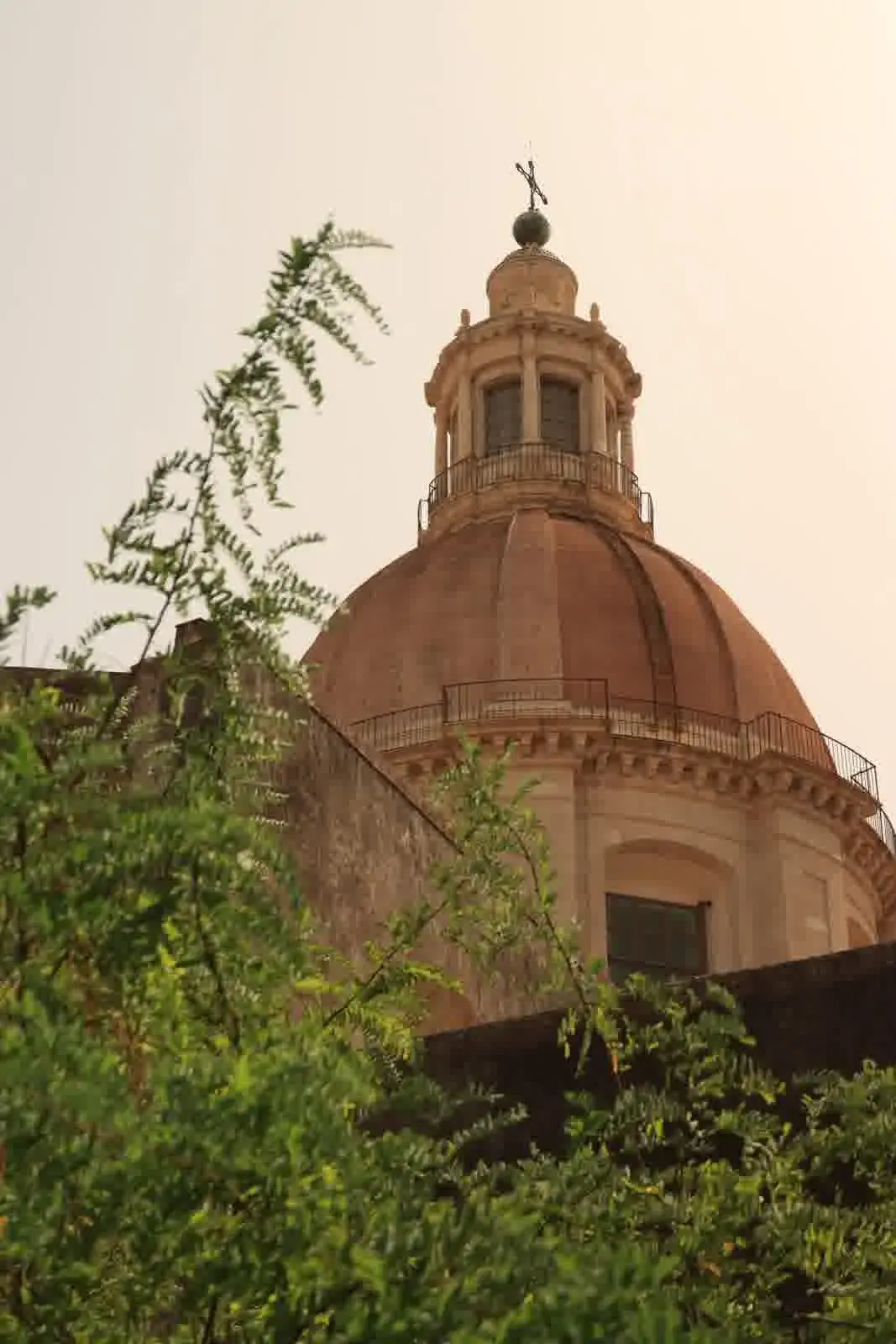
- 📍 Location: Piazza Dante 32, Catania — in the historic center, a 10-15 minute walk from the Duomo
- ⏱ Time needed: guided tours run about 75 minutes
- 🚗 Car recommended: no — deep in Catania's pedestrian old town
- 💶 Ticket price: €10 full price; reduced rates for seniors, groups and non-UNICT students
- 👨👩👧 Good for kids: yes, but it's a real guided walking tour, not a quick self-paced stop
Most visitors to Catania never make it past the cathedral and Via Etnea, which means most visitors never see the second-largest Benedictine monastery in Europe — a genuinely enormous Baroque complex a few minutes’ walk away, buried under Etna’s lava once, nearly leveled by an earthquake once, and now home to university students instead of monks. If you only have time for one thing in Catania beyond the obvious postcard stops, this is a strong candidate.
Founded to be the biggest, and it very nearly was
The Monastero dei Benedettini — formally the Monastery of San Nicolò l’Arena — was founded in 1558 by a Cassinese Benedictine congregation, and the monks built it with real ambition from the start. By the time later expansions were finished, it had grown into the second-largest Benedictine monastery in Europe, smaller only than the Mafra National Palace in Portugal. This wasn’t a quiet rural abbey; it was a statement of wealth and institutional power built right in the middle of a major Sicilian city.
The night lava reached the walls
On March 8, 1669, Etna erupted in one of its most destructive episodes in recorded history. By late April, the lava flow had reached Catania itself, and it kept going until it hit the monastery. The church attached to it, San Nicolò l’Arena, was completely destroyed. The monastery itself survived — but the surrounding land didn’t: lava stone piled up to 12 meters high around the complex, burying the cultivated grounds under what one account describes as a genuinely lunar landscape. Reconstruction of the church began in 1687 under the Roman architect Giovan Battista Contini.
Then the ground itself gave way
Six years into rebuilding, disaster hit again — but this time it wasn’t Etna directly. The catastrophic earthquake of 1693, which flattened much of southeastern Sicily and forced the total reconstruction of towns across the Val di Noto, killed 34 of the 48 monks living in the monastery at the time. It’s a brutal detail that tends to get lost next to the more photogenic lava story, but the earthquake was by far the deadlier event. Catania’s historic center — rebuilt afterward in the same Late Baroque style seen across Noto, Modica, Ragusa and the other towns of the Val di Noto — is itself one of the eight sites that make up the UNESCO World Heritage listing for the region, and the monastery’s later Baroque phases are part of that same rebuilding wave.
A building with four centuries stacked on top of each other
What makes the monastery genuinely fascinating to actually walk through isn’t just its size — it’s that you can trace the site’s entire history in its architecture, layer by layer. Beneath the current structure are the remains of a Roman-era house, excavated and now visible as part of the tour. Above that: Renaissance-era cloisters, then the Baroque reconstruction after 1693, all standing on the same footprint the original 1558 monastery occupied. Few buildings in Sicily let you walk through this many distinct centuries in a single guided route without leaving the block.
Gardens grown on top of a lava flow
One of the more unusual details: parts of the monastery’s hanging gardens and its small botanical garden — locally nicknamed the “villa of marvels” — were built directly on top of the hardened 1669 lava flow that had buried the original grounds. Rather than clearing it away, the monks built over and around it, which is why the roof garden today sits noticeably higher than you’d expect and has a distinctly volcanic base beneath the soil.
From monks to students
The monastery stopped being a working religious community long ago. Today it houses the Department of Humanities (Dipartimento di Scienze Umanistiche) of the University of Catania — meaning the cloisters and corridors that monks once walked are now genuinely busy with students between classes, not preserved as a static museum piece. That mix of a 16th-century religious complex functioning as an active university building is part of what makes a visit feel different from most historic sites, which tend to be frozen in time rather than still in daily use.
Visiting practically
Guided tours run daily, roughly 10:00-13:00 and 15:00-18:00 (last departure), and last about 75 minutes — book ahead through the monastery’s own website rather than just showing up, since access outside of a guided tour is limited. Full price is €10, with reduced rates for groups over 20, visitors over 65, and non-UNICT university students; under-19s pay less still. On weekends and holidays, some tours extend into the abbot’s former private apartments, so it’s worth checking which slot you’re booking if that interests you. The entrance is at Piazza Dante 32, right behind the church of San Nicolò l’Arena’s unfinished Baroque façade — itself worth a look even if you don’t go inside.
My honest verdict
The Monastero dei Benedettini doesn’t get anywhere near the tourist traffic of the Duomo or Via Etnea, and that’s genuinely part of its appeal — you’re touring a building with a real, violent, well-documented history (a volcano tried to bury it, an earthquake nearly finished the job) without fighting a crowd to do it. If you’re already investing time in Castello Ursino or planning a rainy-day alternative to the coast, add this one to the same afternoon.
More on the city in the Catania & Etna region guide, or see it plotted alongside every other stop on our interactive Sicily map.