Tindari: A Black Madonna, a Greek Theatre and the Lagoons That Shouldn't Be There
 Daniele Bellia · 6 min read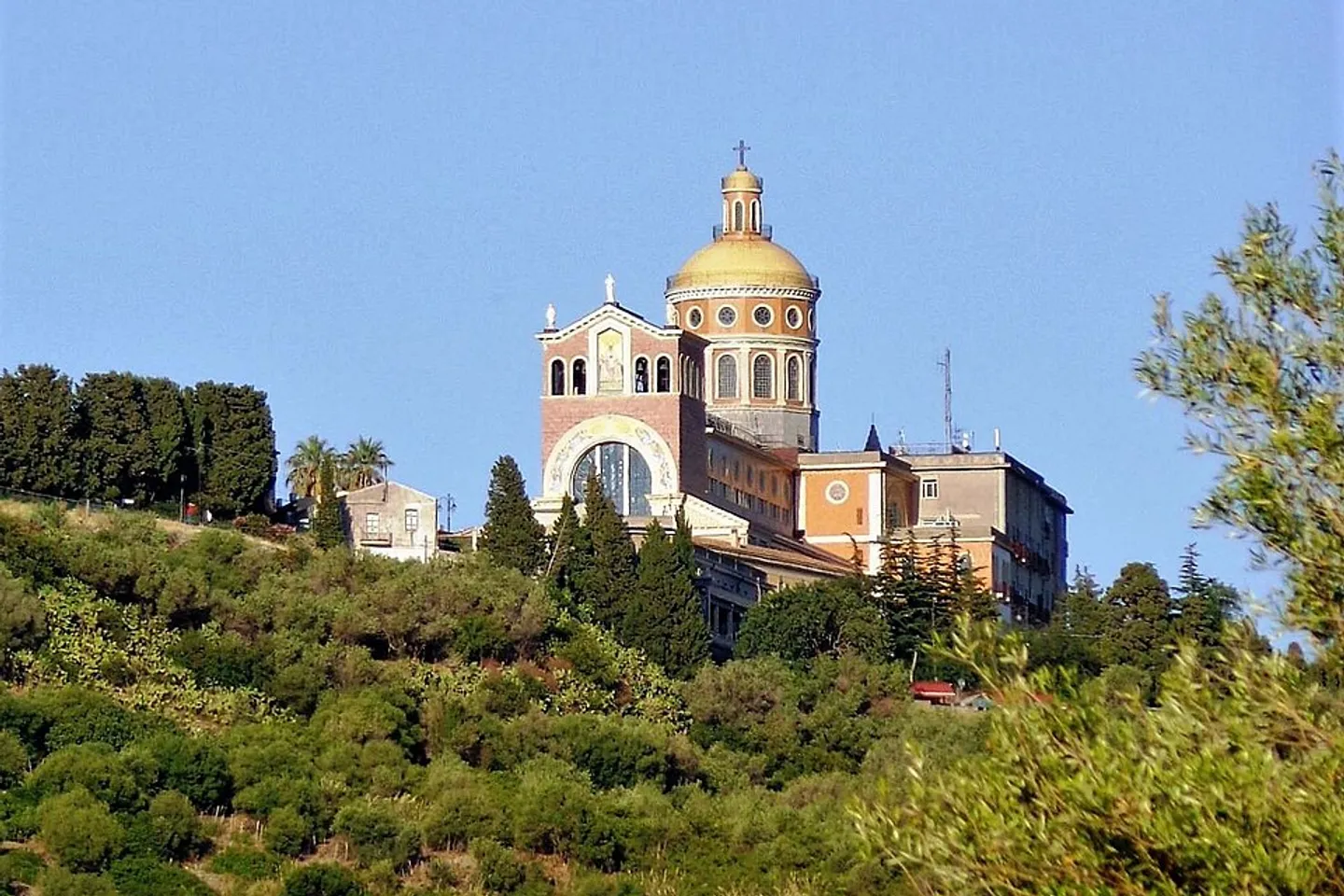
- Where — Tindari, a hamlet of Patti, on the Tyrrhenian coast in Messina province
- What’s there — the Black Madonna sanctuary, a Greek-Roman archaeological site, and the Marinello lagoons below
- Archaeological site — €6 full, €4 reduced; closed Mondays
- The sanctuary — free, and open when the site is not
- Time needed — half a day for both; a full day if you walk down to the lagoons
- Best paired with — the Nebrodi mountains inland, or Milazzo and the Aeolian ferries 40 minutes west
Most people drive past Tindari on the A20 without knowing it is there. It sits on a headland 268 metres above the Tyrrhenian, halfway between Messina and Cefalù, and from the motorway you see only a hillside.
What is up there is three things that have almost nothing to do with each other: a Byzantine statue of a black Madonna that draws pilgrims from across Sicily, a Greek theatre carved to face the sea, and a set of sand lagoons at the foot of the cliff that a legend insists appeared in a single moment.
The Black Madonna, and why she is black
The sanctuary holds a wooden statue of the Virgin, dark-faced, seated, holding the child. Tradition dates it to around 750 AD and says it came from the East — carried away by people fleeing the Byzantine iconoclasm, when religious images were being destroyed.
The story of how it got to Tindari specifically: the ship carrying it sheltered in the bay below during a storm, and afterwards could not leave. The crew unloaded cargo until they took the statue ashore, and only then could the ship sail.
Under the statue is the inscription Nigra sum sed formosa — “I am black but beautiful”, from the Song of Songs. It is the standard line on Black Madonnas across the Mediterranean, and it is worth knowing that art historians generally attribute the colour to cedar wood and centuries of candle smoke rather than to intent.
The building you see now is not the old one. The modern sanctuary was finished in the 1970s, next to the small original church, because the pilgrim numbers had long outgrown it. The feast day is 8 September, and if you come then you will find a crowd that has nothing to do with tourism.
The lagoons the legend explains
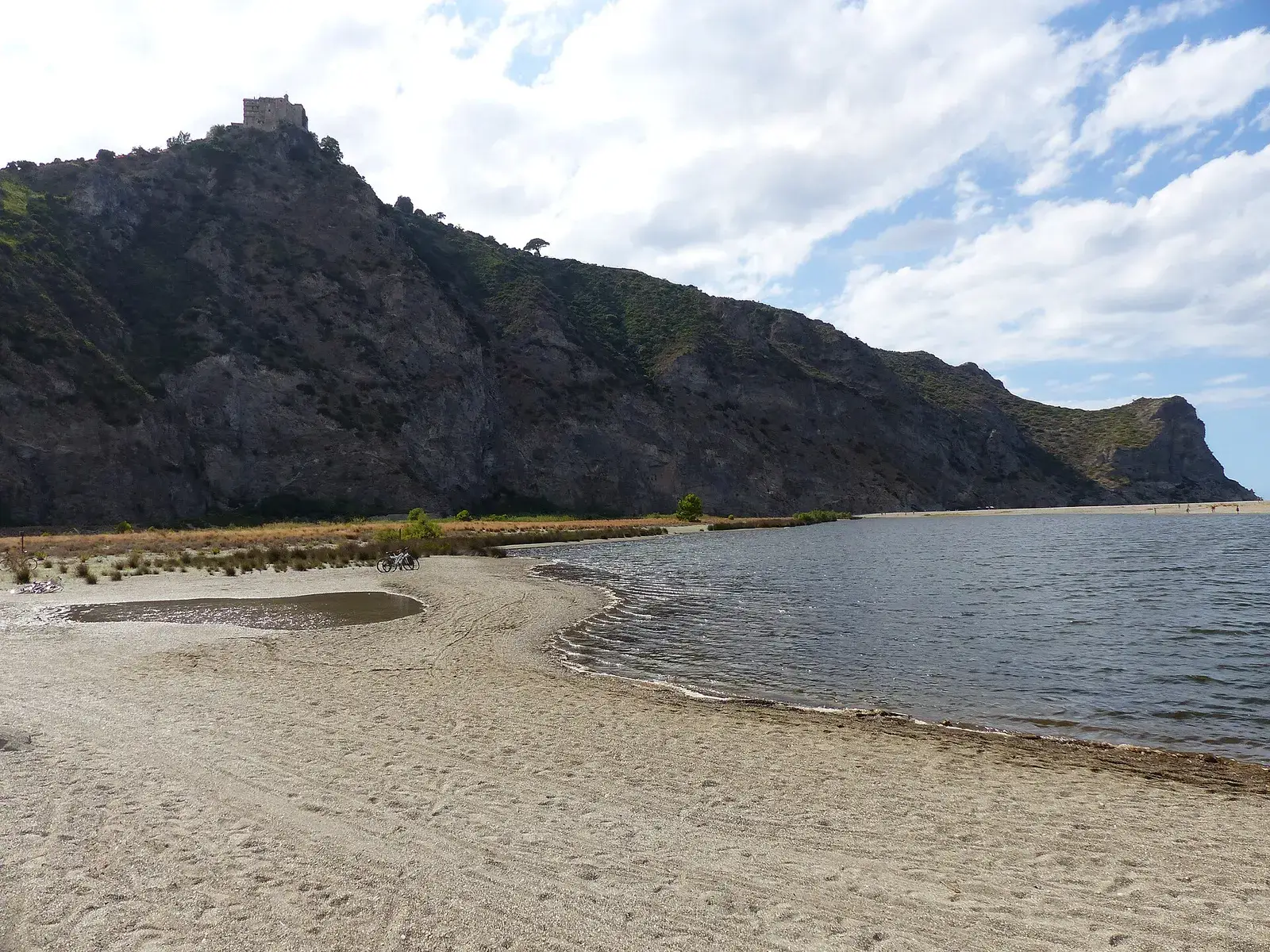 Photo: Benjamín Núñez González, via Wikimedia Commons (CC BY-SA 4.0)
Look down from the terrace and you see a strip of sand curling into the sea, holding shallow pools of water that change shape from year to year. These are the Laghetti di Marinello, a protected nature reserve.
The legend attached to them is the reason half of Sicily knows Tindari. A woman came as a pilgrim, saw the dark face of the Madonna, and said out loud that she was ugly. Moments later her small child fell from the cliff. The sand rose up from the sea to catch him.
You do not have to believe it to appreciate what it is doing: the story exists to explain a real and genuinely odd piece of geography. The sandbanks do shift, sometimes dramatically, and locals have watched the shapes change within a lifetime.
You can walk down to them, but not from the sanctuary — the path starts at Oliveri, on the coast below, and takes about 20 minutes each way along the beach.
The Greek theatre, and the view it was built for
Tyndaris was founded in 396 BC by Dionysius I of Syracuse, settled with Greek mercenaries and built as a military outpost. It later became Roman.
The theatre is the part worth the ticket. It seats around 3,000, was cut into the slope by the Greeks and rebuilt by the Romans for gladiatorial use, and it faces directly out to sea — the Aeolian Islands are visible on the horizon on a clear day. It is still used for summer performances.
Around it: Roman houses with black-and-white mosaic floors, a bath complex with standing columns, and the structure usually called the basilica — a monumental Roman gateway rather than a church.
What it costs and when it is open
- Archaeological area: €6 full, €4 reduced. A combined ticket with the Roman villa at Patti Marina is €11.20 full / €5 reduced and stays valid three days.
- Closed Mondays, year-round. This is the single thing most likely to waste your trip.
- Hours shift with the season and are shortened in winter — the regional archaeological park publishes the current ones, and they change more often than you would expect.
- The sanctuary is free and keeps its own hours, so a Monday visit still gets you the church, the terrace and the view. Just not the theatre.
Practical tips for visiting
- Park below and take the shuttle. There is a car park at the entrance to the village and a shuttle every ten minutes for about €1. The road up is narrow, and on feast days and summer Sundays driving to the top is not realistic.
- Go early or late. The headland is exposed and there is very little shade in the archaeological area. Midday in July and August is punishing.
- Dress for a church. Covered shoulders and knees. This is an active pilgrimage site, not a museum, and on some days you will be walking past people who have come a long way to be there.
- The lagoons are a separate trip. Do not plan to combine them with the site in one hour — the descent starts from Oliveri, several kilometres round by road.
- Combine it with the coast, not with Etna. Tindari is on the Tyrrhenian side. Milazzo and the Aeolian ferries are about 40 minutes east; the Nebrodi start immediately inland.
My honest verdict
Tindari is one of the few places in Sicily where the religious site is the reason to come and the ruins are the bonus — usually it is the other way round.
If you have no interest in churches at all, the theatre and the sea view still justify the stop, and the ticket is €6. If the Black Madonna means something to you, or you simply want to see what a working Sicilian pilgrimage site looks like on an ordinary Tuesday, it is one of the best places on the island to do that.
What I would not do is treat it as a quick photo stop off the motorway. The shuttle, the site and the terrace take three hours if you are honest about it, and the drive down to the lagoons doubles that.
Planning the Tyrrhenian coast? Our interactive map of Sicily has Tindari alongside Milazzo, the Nebrodi and the Aeolian ports — more at sicily-insider.com.