Il Capo: The Palermo Market Locals Still Shop At Every Day
 Daniele Bellia · 8 min read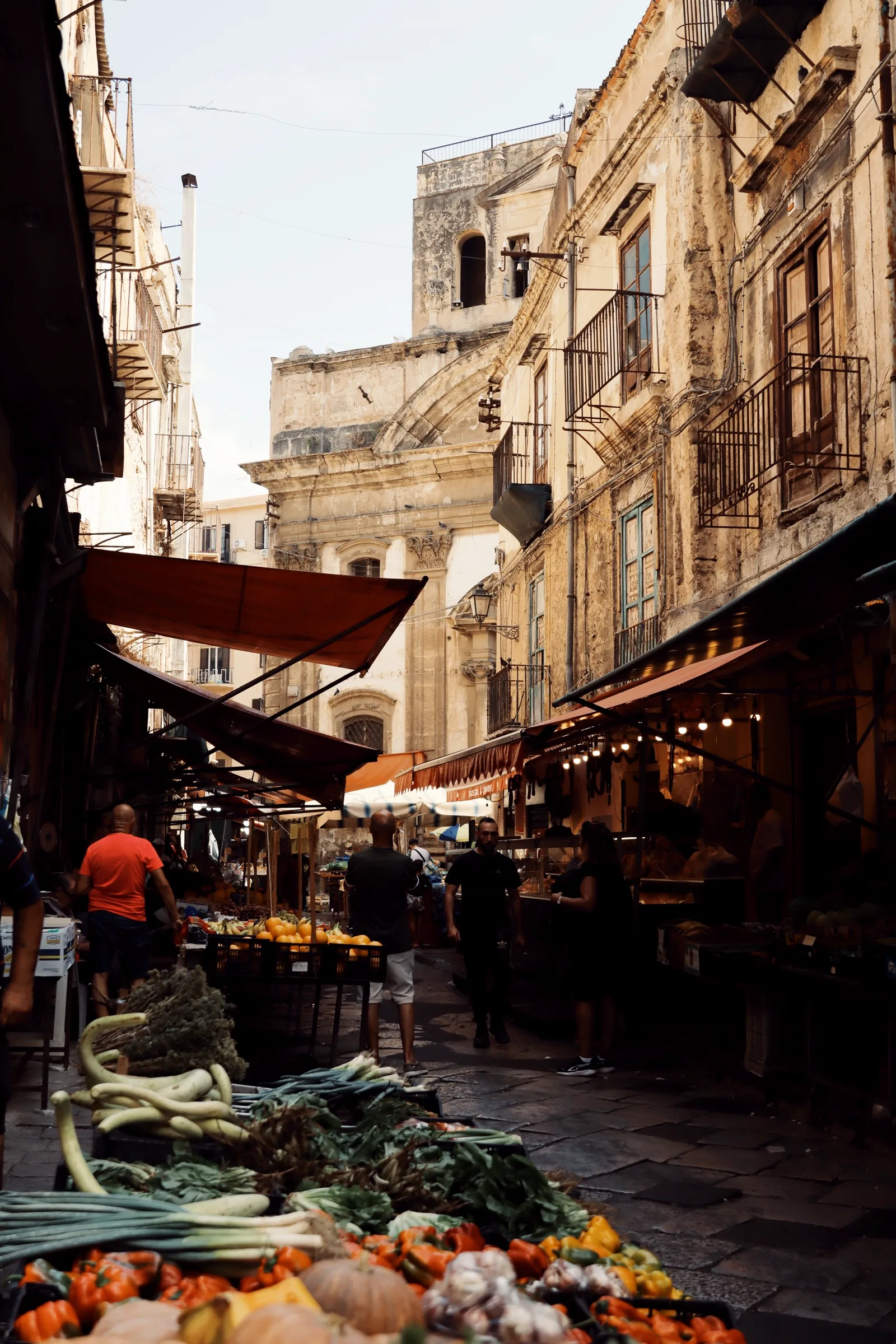
- 📍 Location: Capo district — enter at Porta Carini, then Via Porta Carini into Via Sant'Agostino
- 🕐 Hours: Monday-Saturday, roughly 7am-8pm. Sunday is unreliable — plan around it, not on it
- 💶 Cost: free to walk; street food €1.50-5 an item
- ⏱️ Time needed: 45 minutes to walk it, two hours if you eat properly
- 🍞 Eat this: sfincione, panelle e crocchè, stigghiola — in that order if it's your first time
Palermo has three historic markets, and most visitors only really meet two of them. Ballarò gets the “most authentic” label in every guide. La Vucciria gets the painting, the nightlife and the Instagram traffic. Il Capo gets the locals.
That is not a romantic claim, it’s an observation about what the place is for. Vucciria has spent thirty years converting from a food market into an open-air bar. Ballarò still works as a market but has adjusted itself, sensibly, to the fact that a good share of the people walking through it are holding a phone. Il Capo has done neither. It is still, on an ordinary Tuesday, where a large part of the historic centre buys its fish, its vegetables and its bread — and that is exactly why it is worth an hour of your trip.
Where the name comes from
The Capo is one of the four historic quarters of central Palermo, carved out by the crossing of Via Maqueda and Corso Vittorio Emanuele at the Quattro Canti. Its older name is Seralcadio, from the Arabic — a reminder that the street plan here is not Italian in origin at all. Walk two minutes off the main market lane and the grid dissolves into something closer to a medina: lanes that bend, narrow, and dead-end without warning.
“Capo” itself most likely comes from the quarter having been the head — the capo — of that district. What matters for a visitor is the shape it left behind. Ballarò is a market that spreads across small squares. The Capo is a market that runs along a single spine of street, hemmed in tight on both sides, with the buildings leaning over it and canvas strung between them. It feels less like a square full of stalls and more like a corridor you walk down.
Start at Porta Carini, not in the middle
This is the single most useful piece of navigation for the Capo, and almost nobody says it.
The market has one proper beginning: Porta Carini, a city gate at the northern edge of the old town. Enter there and the market unrolls in front of you in the right order — fruit and vegetables first, then fish, then the street-food stalls and the butchers deeper in, as Via Porta Carini becomes Via Sant’Agostino and ends near Piazza Capo. Walk out the far end and you are a few streets from the Teatro Massimo.
Arrive from any other direction — and most people do, because they come off Via Maqueda — and you drop into the middle of it with no sense of where it starts or ends, which is how the Capo gets remembered as “a confusing market” rather than the very legible thing it actually is.
The other two streets worth knowing are Via Beati Paoli, running roughly parallel, and Via Cappuccinelle. Both are part of the market district and both are considerably quieter than the main spine.
The Beati Paoli, and the street named after them
Via Beati Paoli is named after the most persistent legend in Palermo: a secret sect said to have met in caves and tunnels beneath this quarter, trying and executing the nobility in a court of their own while the official courts protected the powerful. Sicilian Robin Hoods, in the popular telling.
The historical evidence for them is thin to the point of vanishing. What is not in doubt is the story’s grip, and where it came from: Luigi Natoli’s serialised novel I Beati Paoli, published in a Palermo newspaper in 1909-1910 and devoured by the city. The novel did not invent the legend, but it fixed it permanently to these streets.
It is worth knowing before you walk, because it explains something about the Capo that a food description cannot. This quarter has always been the part of central Palermo that the authorities understood least, and the market’s atmosphere — closed-in, self-contained, faintly conspiratorial — is not an accident of architecture alone.
What to actually eat here
The Capo is a street-food market that happens to also sell groceries, and the order below is the one that makes sense for a first visit.
Sfincione is the one to start with, and the Capo is one of the best places in the city to eat it. It is a thick, soft, spongy focaccia-style base — the name shares a root with spugna, sponge — topped with onions, tomato, anchovy and breadcrumbs, and no mozzarella. It is sold by the slice, often from a three-wheeled Ape parked in the street, and it is meant to be eaten at room temperature rather than hot.
Panelle e crocchè come next: chickpea-flour fritters and potato croquettes, usually served together in a soft sesame roll. It is the cheapest proper meal in Palermo and one of the few street foods here that a vegetarian can eat without negotiation.
Stigghiola — lamb or kid intestines wrapped around spring onion and grilled over coals — is the smell you will notice before you see it, and it is a genuine Palermo institution rather than a dare invented for visitors.
Pane ca meusa, the spleen sandwich, is more associated with Ballarò and the Vucciria, but you will find it here too. And frittola, a dish of simmered veal offcuts kept warm under a cloth in a basket, is about as far into local territory as street food goes — it is sold almost nowhere that is not a Palermo market.
If pointing at unlabelled food and hoping for the best is not how you want to spend lunch, this street food and history walking tour goes through the Capo market itself with a local guide (affiliate link — booking through it costs you nothing extra and helps support this site), which mostly solves the problem that almost nothing in these stalls is written down, let alone translated.
Two churches worth breaking the walk for
The Capo hides two serious churches directly on the market route, and both reward the ten minutes.
Chiesa dell’Immacolata Concezione al Capo, just off Via Porta Carini, is the better story of the two. It was built from 1612 as the church of a Benedictine convent founded in 1576, and its facade is deliberately austere — plain stone, almost nothing to look at. The interior is the opposite: wall-to-wall polychrome marble inlay, stucco and fresco, one of the most densely decorated baroque interiors in Sicily. The contrast is the whole point, and you can walk past the door without suspecting a thing.
Chiesa di Sant’Agostino, at the far end where the market street takes its name, is older — 13th century, with a Chiaramonte-Gothic rose window and a carved marble portal. Step into the cloister if it is open.
How the Capo differs from the other two
Short version, so you can decide which market to give your time to:
- Il Capo — the working food market. Busiest in the morning, but it stays alive through the afternoon better than Ballarò does. Best for street food eaten standing up, and for seeing a market that is not performing.
- Ballarò — the oldest and the liveliest, spread over squares, strongest on produce and on the theatre of the abbanniata, the sung sales shout. Thins out significantly after lunch.
- La Vucciria — barely a market by day now, and the city’s most crowded outdoor drinking spot by night. Go in the evening or don’t go.
If you only have time for one and you want food, take the Capo. If you want noise and colour, take Ballarò. If you want a drink at 11pm in a piazza full of people, that is the Vucciria and nowhere else.
Practical tips
Go between 9am and noon. The stalls are all open, the fish is still on ice and the light down the narrow street is at its best. If mornings are impossible, the Capo is the market most likely to still be trading at 5pm.
Sunday is a gamble. Sources genuinely disagree on whether it opens at all, and plenty of stallholders simply don’t. Don’t build a Sunday plan around the Capo — use it as a weekday or Saturday stop.
Bring cash in small notes. Card acceptance at market stalls is improving but far from universal, and a €50 note for €3 of panelle will not be popular.
Watch your pockets, not your safety. The Capo is not a dangerous place to walk in daylight — it is a crowded one, and crowded is what pickpockets need. Bag in front, phone away while you are walking.
Don’t drive. There is no parking and the lanes are barely wide enough for an Ape. The market is a ten-minute walk from the Teatro Massimo and about fifteen from the Quattro Canti.
Eat standing, and order by pointing. No table, no menu, no English in most stalls. Point, hold up fingers for how many, pay, eat. That is the correct way to use this market, not a failure to do it properly.
Combine it with the morning, not the afternoon. The natural Palermo route is Capo market first, then Teatro Massimo, then down Via Maqueda towards the Quattro Canti and the cathedral — all on foot, all within twenty minutes of each other.