Palermo Cathedral: The Building That Changed Religion Four Times
 Daniele Bellia · 4 min read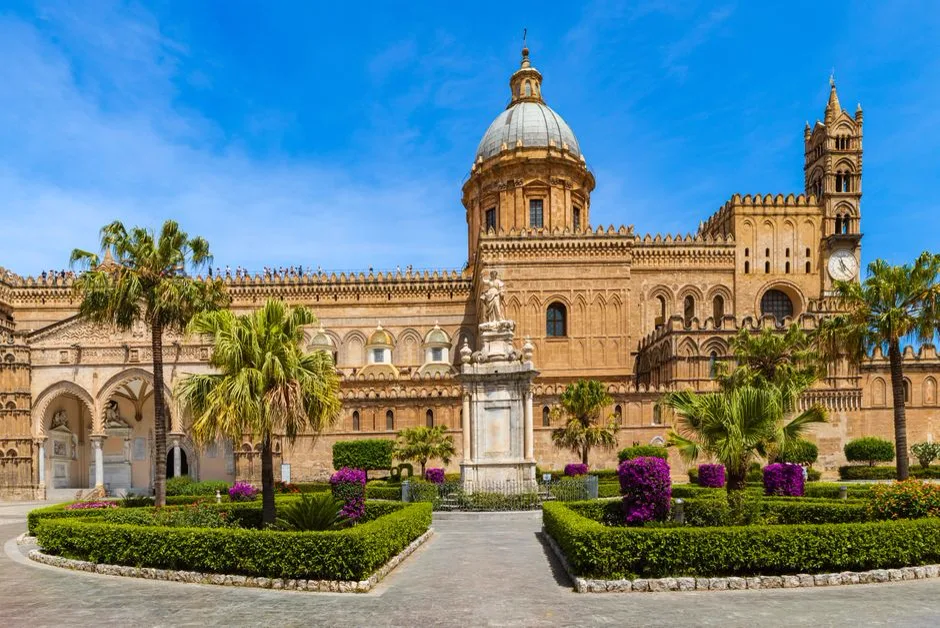
Most cathedrals have one architectural style, maybe two if they took centuries to finish. Palermo’s has at least four, stacked on top of each other in a way that shouldn’t work but somehow does — and the reason is written into the building’s own history: this site has been fought over by nearly every power that ever controlled Sicily.
From church, to mosque, to church again
The current cathedral was built in 1185 under Archbishop Walter Ophamil, on the site of an earlier Byzantine church that Sicily’s Arab rulers had converted into the city’s main mosque during the ninth and tenth centuries. When the Normans took Palermo in 1072, they eventually reclaimed the site for Christian worship and built the structure whose bones are still standing today — but the Arab influence on the skill and style of the local builders never really left. That’s why the exterior still reads as unmistakably Arab-Norman: pointed arches, interlacing geometric patterns, and the crenellated battlements along the roofline that look more like a fortress than a church.
The dome that doesn’t match the rest
If the building looks slightly mismatched at first glance, that’s not an illusion — the large neoclassical dome was added in the 1780s, nearly six hundred years after the original structure, during a renovation led by architect Ferdinando Fuga. It’s a genuinely different architectural language grafted onto a medieval Arab-Norman shell, and depending who you ask, it’s either an unfortunate 18th-century intervention or the thing that gives the building its distinctive silhouette on the skyline. Either way, it’s part of why the cathedral looks like several different buildings depending on which angle you’re looking from.
Royal tombs inside
Inside, the side chapels hold something most visitors don’t expect: the actual tombs of medieval Sicilian royalty, including King Roger II (the Norman king who unified Sicily), Emperor Frederick II, and Constance of Aragon. These aren’t replicas or empty monuments — they’re the real porphyry and marble sarcophagi, moved here from the older cathedral in Cefalù centuries ago. The treasury, accessible with a separate small ticket, holds Constance of Aragon’s actual imperial crown, recovered from her tomb.
What this means for a visit
The cathedral is free to walk through and see the main nave and the royal tombs; the roof terraces, crypt, and treasury each need a small separate ticket, sold at a counter inside. If you only have time for one thing beyond the main nave, the roof terraces are worth it — you walk along the same crenellated battlements visible from the garden outside, with a close-up view of Fuga’s dome and a wide view over Palermo’s rooftops toward the mountains.
Part of the wider UNESCO World Heritage listing “Arab-Norman Palermo and the Cathedral Churches of Cefalù and Monreale,” the cathedral pairs naturally with a visit to Palermo’s old town neighborhoods — see the Palermo neighborhoods guide for where to base yourself nearby, or go the full UNESCO route and add Monreale’s mosaics, 30 minutes away by bus.
Practical tips before you go
Dress code: this is still an active church, not just a monument — shoulders and knees covered, no exceptions, and they do check at the door during busier hours. Keep a light scarf or shawl in your bag for exactly this situation if you’re visiting multiple churches that day.
When to go: early morning, right after opening, is the only real way to see the main nave without a wall of tour groups in front of the royal tombs. Cruise-ship days (check the port schedule if you’re around Via Vittorio Emanuele) noticeably thicken the crowd by mid-morning. It’s free either way, which helps if you’re tracking spending — see our Palermo budget breakdown for what else costs what.
Buying tickets: the roof terrace ticket has a capacity limit and sometimes a scheduled entry time, especially in summer — buy it as soon as you arrive rather than saving it for last, or the day’s slots can sell out from under you.
What most guides skip: people photograph the exterior and walk straight past the royal tombs without realizing what they’re looking at — there’s minimal signage pointing out that Roger II and Frederick II are actually in there. Look for the dark porphyry and red sarcophagi in the chapels just past the entrance, on the right.
More on the city in the Palermo region guide.