Solunto: the Greek-Roman Town Above Palermo That Almost Nobody Visits
 Daniele Bellia · 6 min read
- Where — Monte Catalfano, in the comune of Santa Flavia, about 20 km east of Palermo
- What it is — an entire Greek-Roman hill town: street grid, houses, cisterns, agora
- Ticket — €5 full, €2.50 reduced; free on the first Sunday of the month
- Hours — Mon–Sat 9:00–18:30 in summer (last entry 17:30), 9:00–17:30 in winter; Sundays and holidays 9:00–14:00
- Time needed — an hour and a half to two hours, plus the climb
- Getting there — train from Palermo Centrale to Santa Flavia–Solunto–Porticello, roughly hourly, about 21 minutes — then 2 km uphill
- Best paired with — Bagheria’s villas, or Palermo itself, twenty minutes back down the coast
Twenty minutes east of Palermo there is an entire ancient city sitting on top of a mountain, and on most days you can walk its main street without meeting anyone.
Solunto is not a temple, a single monument or a museum piece. It is a town — a grid of streets, house fronts you can step into, cisterns, shops, a public square — laid out on the slope of Monte Catalfano with the sea and the headland of Capo Zafferano below. The Valle dei Templi gets over a million visitors a year. This gets a fraction of that, and it costs €5.
The city that was moved
The Phoenicians founded Solus here in about the 7th century BC, down nearer the water. What you walk through today is not that settlement.
Towards the end of the 4th century BC, after Dionysius I of Syracuse had beaten the Punic cities of western Sicily, the town was rebuilt from scratch — higher up, on the mountain, where it could be defended and could see anything coming. That rebuild is the reason the site is so legible: it was planned in one go rather than accumulating over centuries.
So you are looking at a Hellenistic new town, laid out on a grid, built by people who had just learned what happens when you are on the coast and someone stronger arrives by sea.
A street plan you can actually read
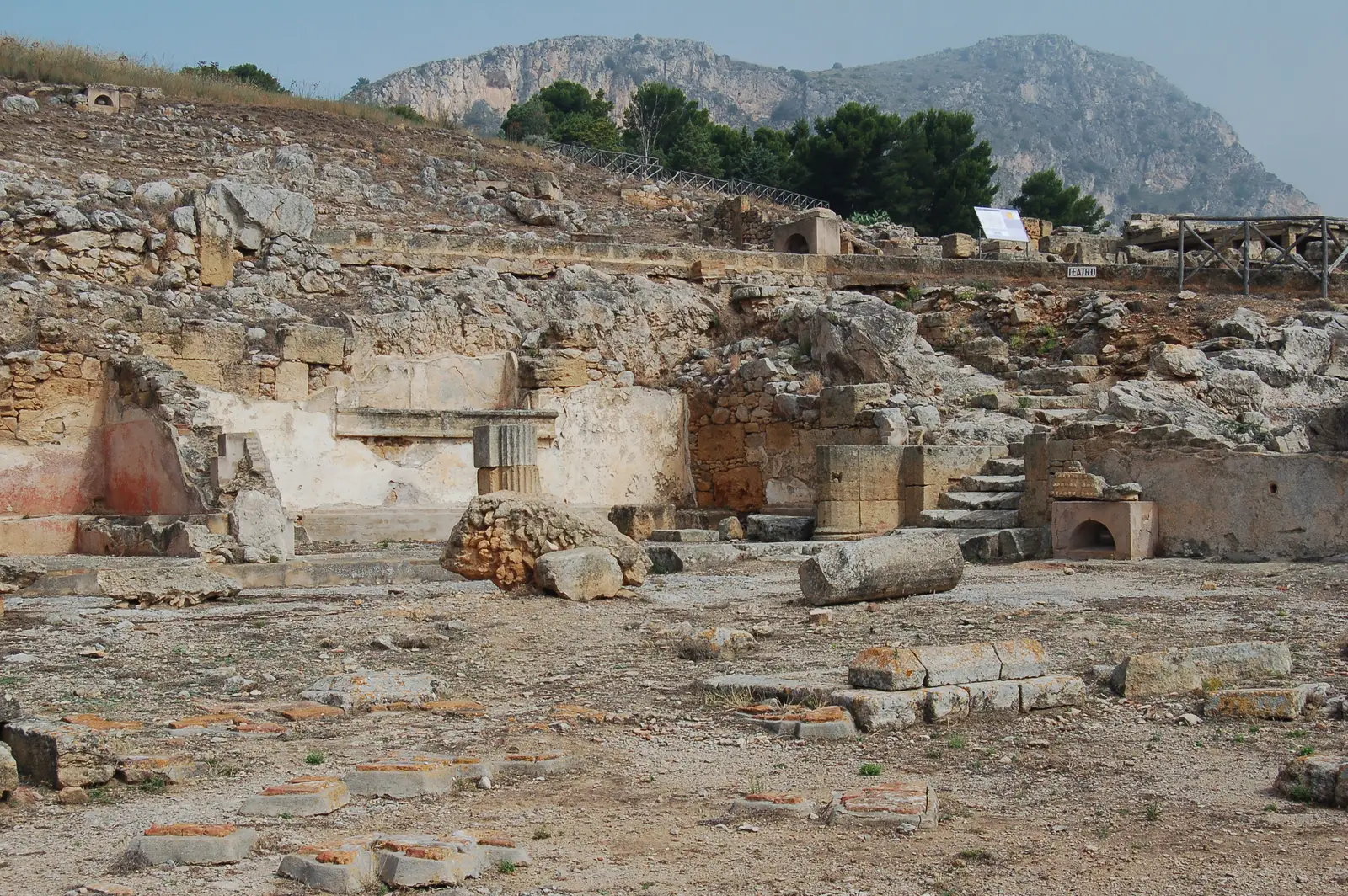 Photo: keithlawson, via Wikimedia Commons (CC BY 3.0)
This is the part that surprises people who have done the big archaeological parks. At Selinunte or Agrigento you look at temples across a distance. Here you walk up the actual main street, paved, with the fronts of houses and shops on either side, and you can tell which doorway was a shop and which was a home.
The town follows a regular Hippodamian grid — long parallel streets crossed at right angles — adapted to a slope steep enough that some of the cross streets are stepped. The rainwater system is still visible: channels cut into the paving, and the deep cisterns each house needed, because a town on a mountain has no spring.
The richer houses are built around a peristyle — a colonnaded courtyard — with mosaic floors and painted walls, mostly reworked in the Roman period.
The House of Leda, and the oldest armillary sphere in the world
The grandest of them is the Casa di Leda, excavated in 1963 and built on three levels down the slope. It takes its name from a painted wall showing Leda with the swan; there are also traces of Hymenaeus and the Dioscuri, from more than one decorative phase.
But the object that came out of this house is stranger than the paintings. It is a depiction of an armillary sphere — the ringed model of the heavens used by ancient astronomers — dated to the 2nd century AD, and it is the oldest known representation of the instrument anywhere.
It is not on the hill. It is in the site’s small Antiquarium, by the entrance, which most visitors walk straight past on their way up. Do not.
Rome, and then silence
In 254 BC, during the First Punic War, Solunto passed to Rome. The town carried on — the mosaics and wall paintings you see are largely from this period — and it was certainly still inhabited into the 3rd century AD.
Then it stops. Nobody knows why. There is no destruction layer telling a story of sack or earthquake, no account of a siege, no plague recorded. A functioning Roman town on a good site simply ceased to be one, and the reason has not survived.
That absence is worth carrying with you as you walk around. Most ruins come with a reason for being ruins. This one does not.
What it costs and when it is open
- Ticket: €5 full, €2.50 reduced. Free on the first Sunday of the month, which is worth planning around if your dates allow.
- Summer hours: Monday to Saturday 9:00–18:30, last entry 17:30.
- Winter hours: Monday to Saturday 9:00–17:30, last entry 16:30.
- Sundays and public holidays, all year: 9:00–14:00. Note the earlier closing — this is the detail most likely to catch you out, because it is exactly when people plan day trips.
Practical tips for visiting
- There is no shade, and the whole site is on a slope. It is a hill town, exposed on all sides, and you spend the visit walking uphill on stone. In July and August go at opening or in the last two hours; midday is genuinely punishing.
- Proper shoes. The paving is original, worn smooth in places and uneven everywhere. Not a sandals site.
- Going by train is realistic, but know what you are signing up for. Trains from Palermo Centrale to Santa Flavia–Solunto–Porticello run roughly hourly and take about 21 minutes. From the station it is about 2 km to the site, uphill — walkable in half an hour if you are willing, unpleasant in August heat. A taxi from the station solves it.
- By car it is easy: the A19 towards Catania, exit at Bagheria, then signs for Santa Flavia. There is parking at the entrance.
- Do the Antiquarium first, not last. It is small, it is at the bottom, and after ninety minutes of climbing in the sun nobody wants to look at display cases.
- Combine it with Bagheria, five minutes away, whose 18th-century aristocratic villas — the Villa Palagonia and its grotesque statues above all — make an odd and very good pairing with a Roman town.
My honest verdict
Solunto is not on the list of things people fly to Sicily for, and it should not be the reason you build a day around Palermo’s eastern edge. But if you are in Palermo for more than two days, it is the best-value half day within reach of the city.
What you get for €5 is the experience of having an ancient town more or less to yourself: standing in someone’s courtyard, following a street that goes somewhere, working out from the stonework which room was for storage. The big sites give you scale and crowds. This gives you the thing scale usually costs you, which is the sense that people actually lived here.
Go on a weekday morning, take water, and give yourself time for the Antiquarium at the bottom.
Planning Palermo and the coast east of it? Our interactive map of Sicily has Solunto alongside Bagheria, Cefalù and the city itself — more at sicily-insider.com.