Monreale Cathedral: 6,000 Square Meters of Gold, 15 Minutes from Palermo
 Daniele Bellia · 5 min read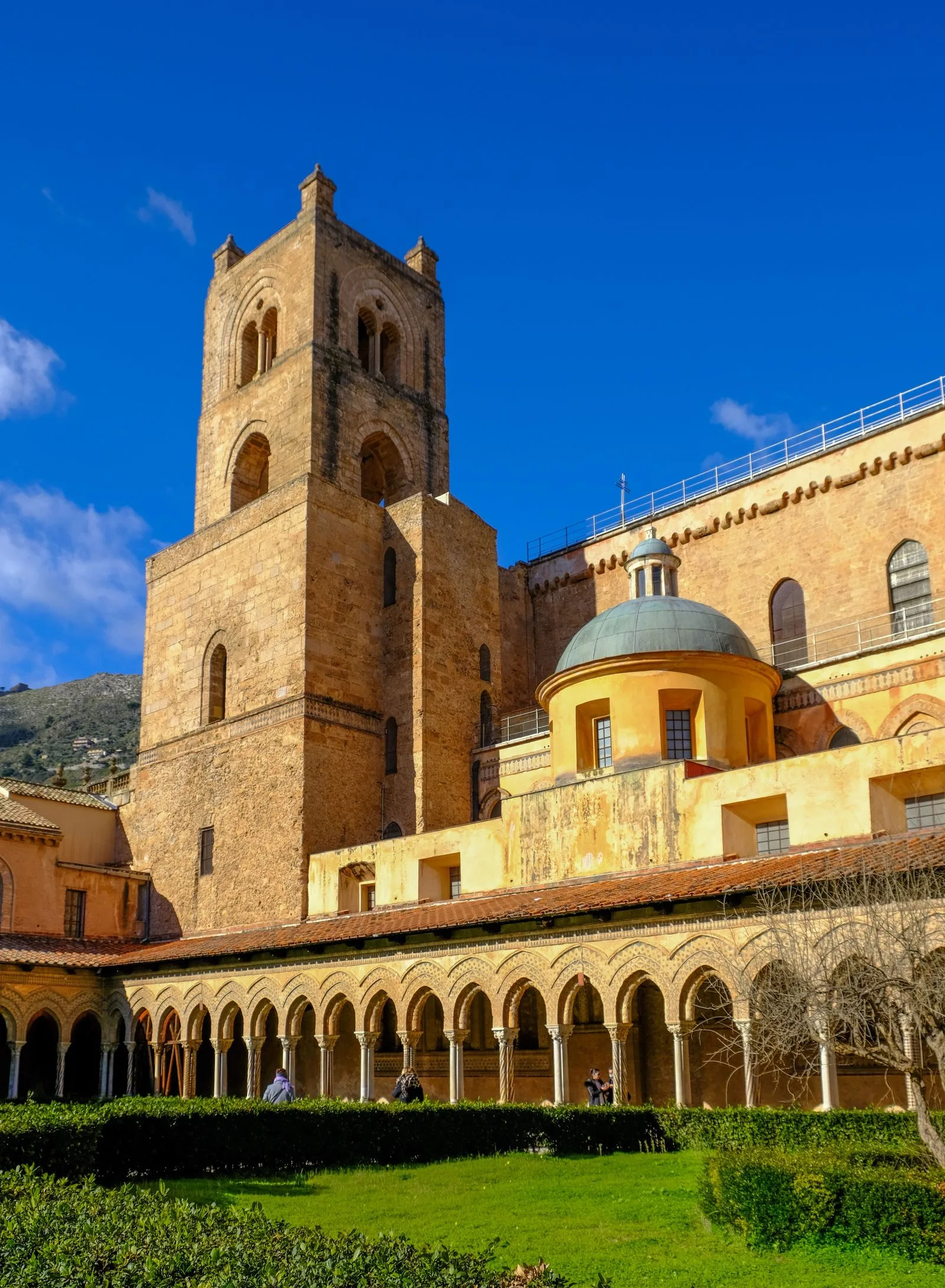
Most visitors to Palermo never make it up the hill to Monreale, and that’s a genuine loss — this is arguably the single most impressive interior in Sicily, and it’s a thirty-minute bus ride away. From the outside, it looks like what it originally was: a fortress. Inside, the walls disappear entirely under gold.
From the outside: a fortress, not a church
King William II of Sicily built the cathedral in the 1170s, and the exterior still shows it — thick honey-colored stone walls, a squared-off Norman bell tower, narrow windows built for defense as much as light. There’s very little here to hint at what’s waiting inside, which is exactly what makes walking through the doors so disorienting the first time.
The legend behind why it exists at all
The story told locally is that William II fell asleep under a carob tree while out hunting in the royal park his grandfather Roger II had created, and dreamed of the Virgin Mary. She told him a great treasure was buried beneath where he slept, and instructed him to dig it up and build a church in her honor. He woke, dug, found gold — and used it to fund Monreale.
The more likely real story sits right next to the legend rather than replacing it: William’s former tutor, Walter Offamilio, had by then become Archbishop of Palermo and a genuine rival for influence at court. Building an entirely new cathedral outside Palermo, staffed with loyal Benedictine monks, gave William a religious power base independent of Walter’s — a plan that worked, culminating in 1183 when Pope Lucius III elevated Monreale to its own archbishopric. Walter responded in kind, launching work on what’s now Palermo’s own cathedral partly to keep pace. Two of Sicily’s most important churches exist largely because two powerful men stopped getting along.
Inside: 6,000 square meters of Byzantine mosaic
Nearly every surface of the nave — walls, arches, the entire apse — is covered in gold-ground mosaic, made by Byzantine craftsmen brought in specifically for the job. The mosaics tell the full biblical narrative from Genesis to the New Testament, running in registers around the entire church, but the image that stops people mid-step is the one at the far end: a colossal Christ Pantocrator filling the apse, one of the largest depictions of Christ anywhere in the world. Stand in the center of the nave and look straight down the aisle — that’s the shot, and no photo actually captures how large it is in person.
The royal tombs
William II made Monreale his family’s royal pantheon, and the tombs are still here to see. In the right transept lie William I (“the Bad”) and William II (“the Good”) himself; the left wing holds Margaret of Navarre, William I’s wife, along with their sons Roger and Henry. It’s an easy detail to miss while the mosaics are pulling every eye upward — worth deliberately looking down at floor level for once.
The cloister: 228 columns, one still standing quietly
Attached to the cathedral, the Benedictine cloister is a masterpiece in its own right and easy to rush past if you’re short on time — don’t. It has 228 twin columns arranged in a square, and no two capitals are carved the same way; some inlaid with colorful mosaic patterns, others carved with hunting scenes or foliage. In the middle of the garden, a single ancient olive tree provides the only shade for what is otherwise one of the quietest spots in the whole complex, even when the cathedral itself is crowded.
The ticket trap nobody warns you about
Here’s the detail that catches almost everyone off guard: the cathedral and the cloister are run by two completely separate organizations, with two completely separate tickets. A cloister ticket does not get you into the cathedral, and a cathedral ticket does not get you into the cloister — buying one assuming it covers both is the single most common mistake here. Budget for both if you want to see everything, and buy them at their respective entrances (they’re a short walk apart, both facing the same piazza).
Practical tips before you go
Dress code: this is an active cathedral — shoulders and knees covered, checked at the entrance. Same rule as every other church in Sicily, but Monreale’s staff are stricter about enforcing it than most.
Getting there: AMAT bus line 389 runs from Piazza Indipendenza (right by the Norman Palace in Palermo) to Monreale, roughly every 40 minutes, about a 30-40 minute ride depending on traffic. Buy your ticket before boarding — 1.40 euros, the same as any other AMAT ticket, valid for the whole trip. If you’re combining this with Palermo’s own cathedral, the two make a natural half-day pairing — both Arab-Norman, both UNESCO-listed, and worlds apart in style.
Best time to visit: go early, ideally right at opening. Monreale is a standard stop for Palermo day-tour buses, and the nave gets genuinely crowded with tour groups by mid-morning — the light on the mosaics is also better earlier, less washed out by the midday sun through the windows.
What most people miss: the cathedral’s roof terraces are accessible with a separate ticket (sold at the cathedral entrance) and give a close-up view of the exterior mosaics and domes that you simply can’t get from ground level, plus a wide view over the Conca d’Oro valley toward Palermo — worth the extra few euros if your legs can handle the stairs.