Sperlinga: the Sicilian Village That Said No, Carved Into a Single Rock
 Daniele Bellia · 7 min read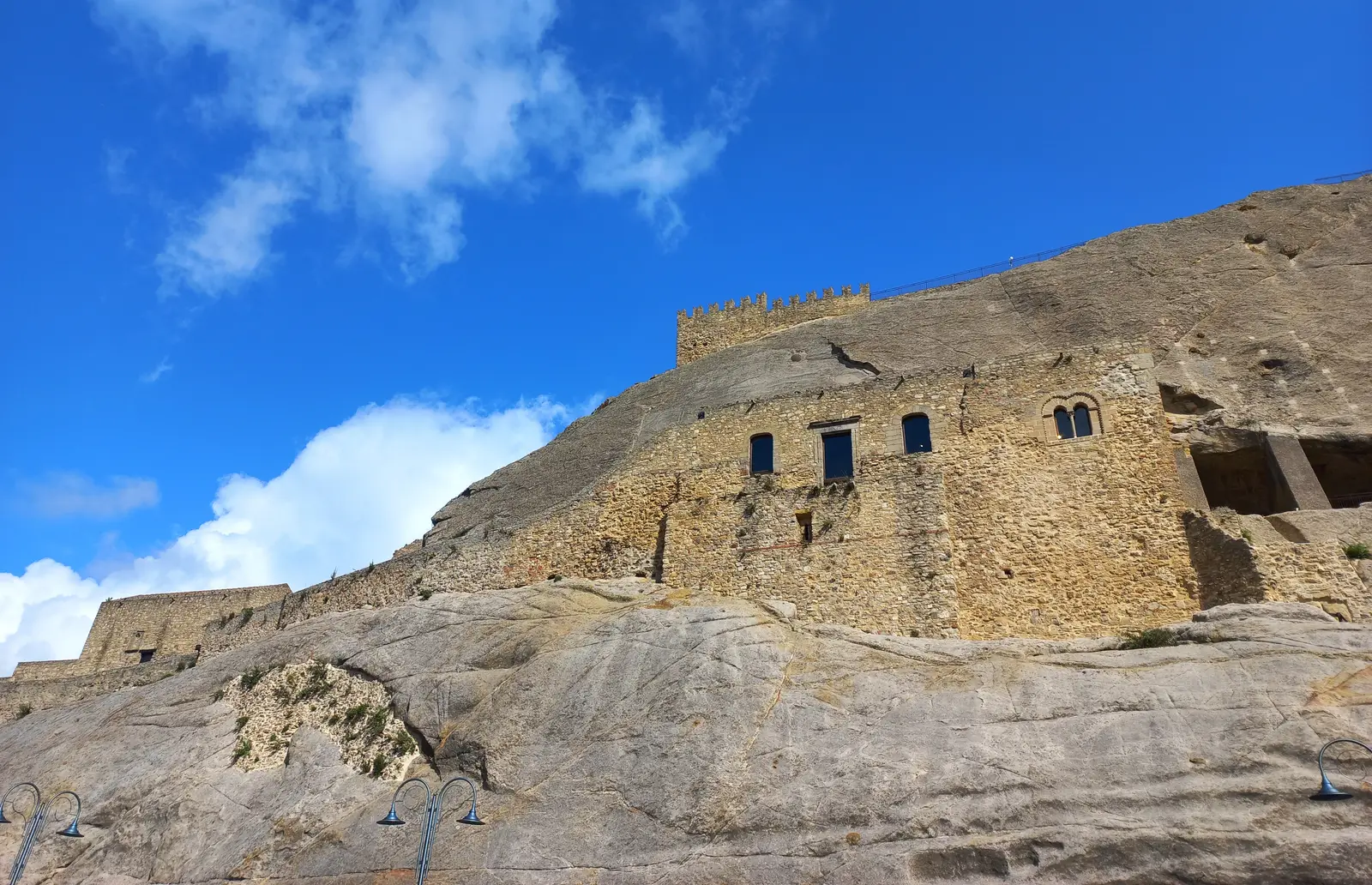
- Where — Sperlinga, province of Enna, on the SS117 between Nicosia and Gangi, about 750 m up
- What’s there — a castle carved into a sandstone outcrop, around fifty rock-cut cave houses, and a museum inside the caves
- Ticket — about €5 for the castle; hours are seasonal, so check before driving
- Time needed — two to three hours for the castle and the village
- Getting there — car only; there is no useful public transport
- Best paired with — Nicosia 13 km away, or Gangi and the Madonie to the west
There is a sentence carved into the pointed arch of the castle entrance that has kept this village in Sicilian memory for seven centuries:
Quod Siculis placuit, sola Sperlinga negavit. What pleased the Sicilians, Sperlinga alone refused.
In 1282, the whole island rose against Angevin rule in the revolt known as the Sicilian Vespers. French garrisons were hunted down across Sicily. One fortress held out and gave them shelter, and it was this one. The village has been carrying the line ever since — with something closer to pride than embarrassment.
That would be enough to make Sperlinga worth an hour. What actually makes it remarkable is that the castle is barely a building at all.
A castle that was mostly not built
Sperlinga sits on a long outcrop of soft sandstone, and the castle was not put on top of it. It was cut out of it.
Walk up and you see the seam clearly: at the bottom, bare rock with rooms, corridors and staircases carved straight into the stone. Higher up, where the rock ran out, masonry takes over — walls, battlements, windows. The two are welded into one object, and it is often hard to say where the mountain stops and the architecture starts.
The caves underneath are far older than the castle. They were dug by the indigenous Sikel population and used as tombs, some of them going back thousands of years. The fortress as you see it is generally dated to the late 11th or early 12th century, under the Normans, who built on top of what was already there rather than clearing it away.
The name follows the same logic. Sperlinga comes from the Greek spélaion by way of the local word for cave. The place is named after its holes.
What the inscription actually means
The line about the Vespers is usually read as a boast about loyalty or stubbornness. The likelier explanation is more interesting, and it explains the rest of the village too.
When the Normans took Sicily, they brought settlers with them from northern Italy — Lombardy, Piedmont, Liguria — and planted them in a string of towns across the interior. Sperlinga was one. Nicosia, San Fratello, Aidone and Piazza Armerina were others.
So in 1282, the people inside these walls were not Sicilians in the sense the rebels meant. They were the descendants of northern colonists, a couple of centuries in, still speaking their own language and still oriented towards a different set of loyalties. The town did not so much refuse the Vespers as fail to recognise itself in them.
It is worth adding that the inscription itself is later — it was carved well after the events, by people deciding how they wanted the episode remembered. That is normal for this kind of thing, and it does not make the underlying story false.
The village still speaks a northern dialect
This is the part that surprises visitors who happen to overhear it.
The dialect of Sperlinga belongs to the Gallo-Italic group — the same family as the speech of Lombardy and Piedmont, transplanted here nine hundred years ago and left to develop on its own. It is not a Sicilian accent. To a Sicilian ear it is barely comprehensible, and it preserves sounds and words that vanished from the mainland long ago.
Sicily has a handful of these linguistic islands, and we have written about the strangest of them at San Fratello in the Nebrodi, an hour and a half north of here. Sperlinga is the smaller and quieter case, but the same history produced both.
Fifty cave houses, lived in until 1960
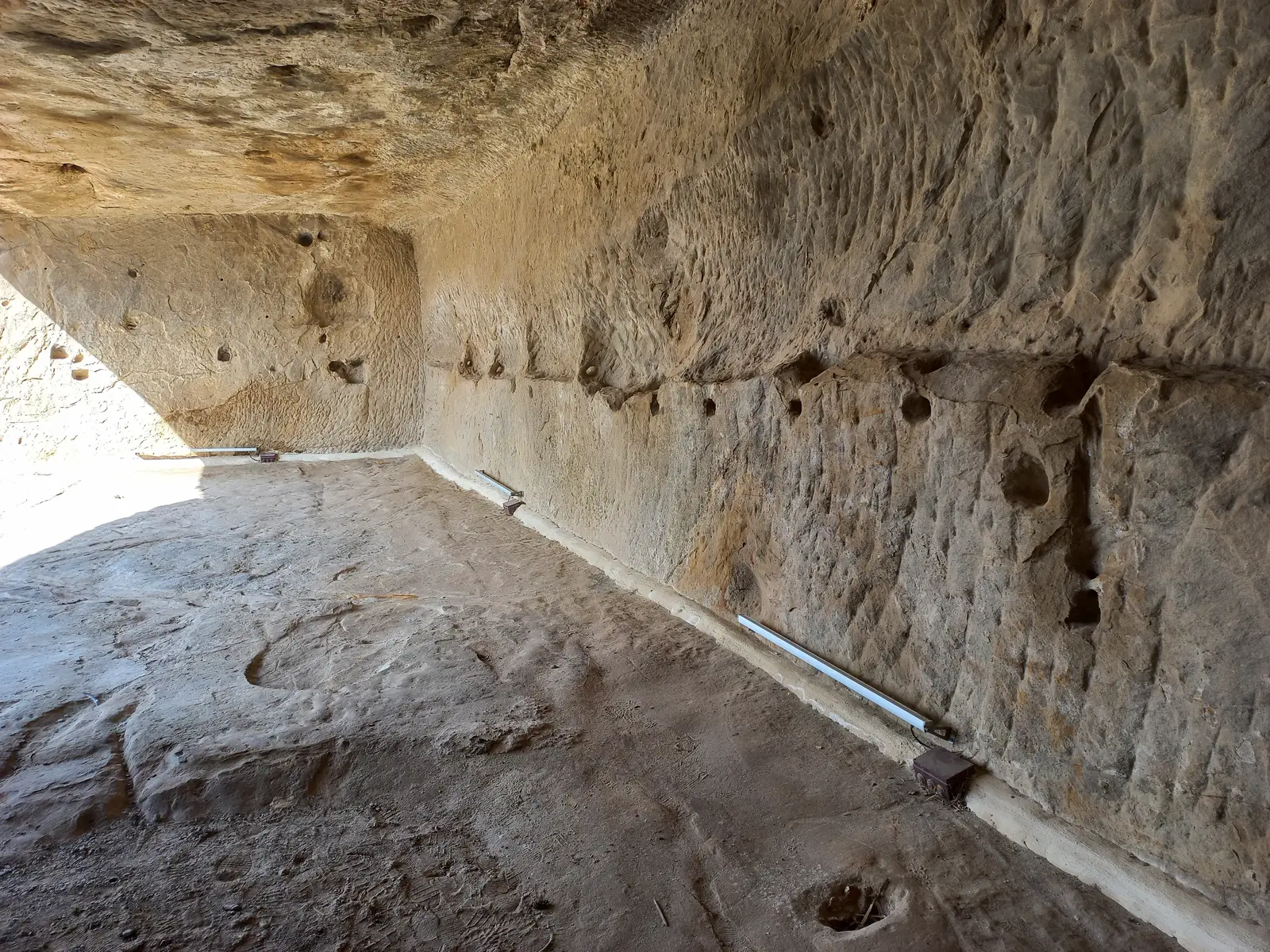 Photo: Carmelovunque, via Wikimedia Commons (CC0)
Below the castle, along the base of the outcrop, there are around fifty cave houses cut into the rock face. They are not a prehistoric curiosity. People lived in them until 1960 — within living memory for plenty of residents.
A few are still private property. Others have been turned into an ethno-anthropological museum: five rock-cut rooms furnished as the dwellings actually were, with the tools, pottery and household objects of Sicilian peasant life. It is a small museum and it will not take you long, but it does something that a conventional display cannot. You are standing in the room, not looking at a reconstruction of it.
The detail worth noticing is that the rooms were shaped around the rock rather than against it. Niches, shelves, mangers and channels are all cut from the same stone as the walls. Nothing was brought in that could be carved instead.
What it costs and when it is open
- Castle ticket: around €5, with the caves and museum usually included.
- Hours are commonly listed as roughly 9:00 to 19:00 daily, but they shift with the season and with local events. This is a small municipal site, not a regional park with a press office.
- Check before you drive. Sperlinga is an hour and a half from Catania and about two from Palermo. Arriving to find a closed gate is a wasted afternoon, and the comune or the local tourist office is the only reliable source.
- The village itself — streets, viewpoints, the outside of the rock — costs nothing and is always open.
Practical tips for visiting
- Wear proper shoes. The route through the castle is carved stone, worn smooth by centuries of feet, with steps of uneven height. After rain it is genuinely slippery, and there are stretches with a drop on one side. This is the single thing most likely to spoil the visit.
- There is no shade up there. The outcrop is fully exposed. In July and August, go early or go late, and take water — the village is small and not everything is open at midday.
- Go with a car, and expect mountain roads. No train is any use here. The SS117 is a decent road but it is not fast, and the interior of Sicily takes longer to cross than the map suggests.
- Combine it with Nicosia, 13 km away, which is the larger Lombard town of the pair and has a cathedral worth the stop. To the west, Gangi and Petralia Soprana put you in the Madonie.
- 16 August is the Sagra del Tortone, established in 1982 to mark the Vespers episode. The tortone is fried bread dough with sugar and cinnamon — a poor man’s sweet, and the village is full that day. Come for it deliberately or avoid it deliberately, but do not arrive unaware.
My honest verdict
Sperlinga is not a half-day of things to do. It is one very unusual object and a village of eight hundred people around it, and if you are the kind of traveller who needs a full itinerary in each stop, you will find it thin.
What it offers instead is rare in Sicily: a place where the thing you came to see was made by removing material rather than adding it, and where the strangeness is structural rather than decorative. Standing in a corridor cut through a hill, with a Norman wall growing out of the ceiling above you, is not an experience the island repeats anywhere else.
Go if you are already crossing the interior — between Etna and the Madonie, or on the way to Piazza Armerina. Do not build a day around it from Taormina. And do check the opening hours first, because that road is long in both directions.
Planning central Sicily? Our interactive map of Sicily has Sperlinga alongside Enna, the Nebrodi and the Madonie villages — more at sicily-insider.com.