Gangi: Italy's Actual 'Borgo Dei Borghi' and Its €1 Houses
 Daniele Bellia · 6 min read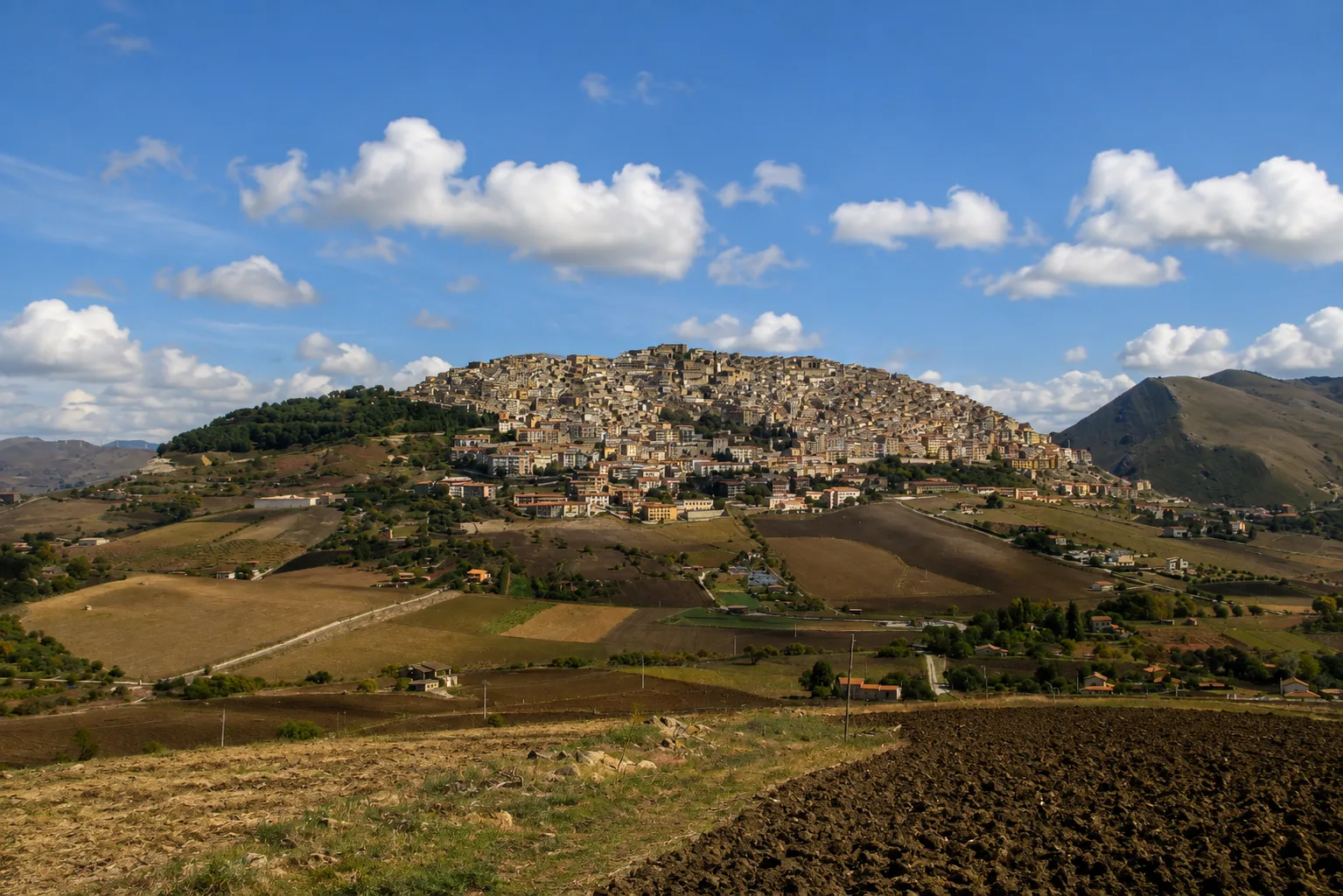
Every region of Italy has a village that locals swear is the country’s prettiest. Gangi actually won the argument: in 2014, the RAI program “Alle Falde del Kilimangiaro” crowned it Italy’s official “Borgo dei Borghi” — beating out hundreds of competitors from every region. But the tower and the view aren’t even the most interesting thing here. This is also the town that spent the last decade giving away its empty houses for a single euro, and the one where an Escher lithograph of mummified priests came from.
- 📍 Location: Madonie mountains, about 80km southeast of Palermo, 1,011m elevation
- 🏰 Torre dei Ventimiglia / Chiesa Madre: Tue–Sat 10:00–13:00 & 15:00–17:30, Sun 10:30–13:30 & 15:00–18:00
- ⏱️ Time needed: half a day for the tower, crypt and old town
- 🚗 Car recommended: the drive up is steep and switchbacked; public transport is limited and slow
- 🌡️ Best season: spring through autumn — winters at 1,000m are cold and often foggy
The €1 houses that made the New York Times
Gangi didn’t become internationally famous for its architecture — it became famous for giving that architecture away. Like a handful of other depopulating Sicilian hill towns, the comune launched a scheme offering abandoned houses in the historic center for a symbolic €1, on the condition that the new owner commits to restoring the property (typically a minimum spend of around €35,000) within five years. The idea wasn’t a gimmick to sell headlines, even though it worked as one: Gangi’s version of the program has been covered by the New York Times and the Telegraph, and the town says it received around 2,000 requests from all over the world. Roughly 108 houses have been reassigned so far, with dozens more still on offer.
What that means for a visitor is a town that’s genuinely being restored rather than emptied out — you’ll see recently renovated facades next to still-abandoned shells, new foreign residents next to families who’ve been here for generations. It’s one of the more honest pictures of what depopulation and its slow reversal actually look like in inland Sicily, not just a pretty backdrop.
Torre dei Ventimiglia: the view that explains everything
The Torre dei Ventimiglia (also called the Torre Civica) is a 14th-century watchtower, attributed to the Ventimiglia counts of Geraci, now built directly into the Chiesa Madre di San Nicolò di Bari at the top of the town. Climbing it is the one thing worth doing even if you skip everything else — from the top you can see across the Madonie toward Etna on a clear day, and understand immediately why this specific hilltop, at over 1,000m, was worth fortifying in the first place.
The church around it holds its own art, including a Last Judgment fresco by Giuseppe Salerno, a painter nicknamed “the little hunchback of the Madonie” whose work quietly rivals what you’d travel to a major city to see. Opening hours are Tuesday to Saturday, 10:00am–1:00pm and 3:00–5:30pm, Sundays 10:30am–1:30pm and 3:00–6:00pm — check ahead, since a hill this steep is not somewhere you want to arrive to a locked door.
The crypt Escher climbed down into
Beneath the same Chiesa Madre is “a fossa dî parrini” — the priests’ pit — a crypt lined with niches holding mummified clergy, dressed in their vestments, the same natural-mummification tradition better known from the Capuchin Catacombs in Palermo but on a smaller, stranger, more intimate scale. In June 1932, the Dutch artist M.C. Escher descended into this exact crypt, took photographs, and made a lithograph titled “Mummified Priests in Gangi, Sicily” as soon as he got home — four robed figures under four arches, with “ITE MISSA EST” inscribed at the bottom. The original print now hangs in museum collections including the National Gallery of Canada. Seeing the actual crypt that inspired one of the 20th century’s most idiosyncratic printmakers is the kind of detail no generic “top 10 Sicily villages” list will ever mention, because it requires knowing Gangi exists in the first place.
The siege of 1926
Gangi’s history isn’t all churches and towers. For over three decades, the town was effectively controlled by the Andaloro-Ferrarello gang, one of the most entrenched criminal networks in the Madonie. On January 1, 1926, Cesare Mori — the Fascist-era “Iron Prefect” sent by Mussolini to crush the Sicilian Mafia — chose Gangi as the site of one of his most famous operations. He surrounded the town with a 20km police cordon and gave fugitives twelve hours to surrender, threatening their families and property if they didn’t. After ten tense days, the gang that had run Gangi as its own fiefdom for a generation was finished. It’s a grim, complicated piece of history — Mori’s methods were also used to round up ordinary political opponents under the same “anti-mafia” banner — but it’s real, well-documented, and part of why this particular inland town carries more weight than its size suggests.
Walking the old town
Beyond the headline sights, Gangi rewards slow wandering: narrow stepped streets built for mules rather than cars, stone houses stacked up the hillside in a spiral around the summit, and none of the tour-bus energy of the coast. Palazzo Bongiorno and Palazzo Sgadari (home to the Civic Museum) are worth a look for their 18th-century interiors, and the Sanctuary of the Holy Spirit is a quieter stop outside the main circuit if you have the time.
Getting there
A car is the realistic option — the SS120 winds up from the coast through genuinely dramatic Madonie scenery, and Gangi sits close to both Petralia Soprana and Castelbuono if you want to make a full day of the inland Madonie towns. Public transport exists (SAIS runs limited routes from Palermo) but schedules are thin and not built around a day-trip visit; without your own car, this is a harder stop to fit in than Cefalù or Castelbuono. Staying the night sidesteps the problem and is how Gangi is best seen anyway — the village lights up along the ridge after dark, which is the view that made it famous and which day-trippers never see.
My honest verdict
Gangi isn’t a place you stumble into — it takes a deliberate detour into the Madonie to get here, and the winding drive up is part of the commitment. But it’s the rare hill town that backs up its “most beautiful village” title with layers most visitors never dig into: a genuine repopulation experiment making international news, a crypt one of the 20th century’s stranger artistic geniuses found worth sketching, and a history that goes well beyond pretty stonework. If you’re already doing Castelbuono or Petralia Soprana, Gangi is the one that turns an inland Madonie detour into the most memorable day of an otherwise coast-heavy Sicily trip.
More on the area in the Cefalù region guide, and see Gangi plotted on our interactive Sicily map.