Marsala: The Wine, the Salt Pans, and the Landing That Made Italy
 Daniele Bellia · 8 min read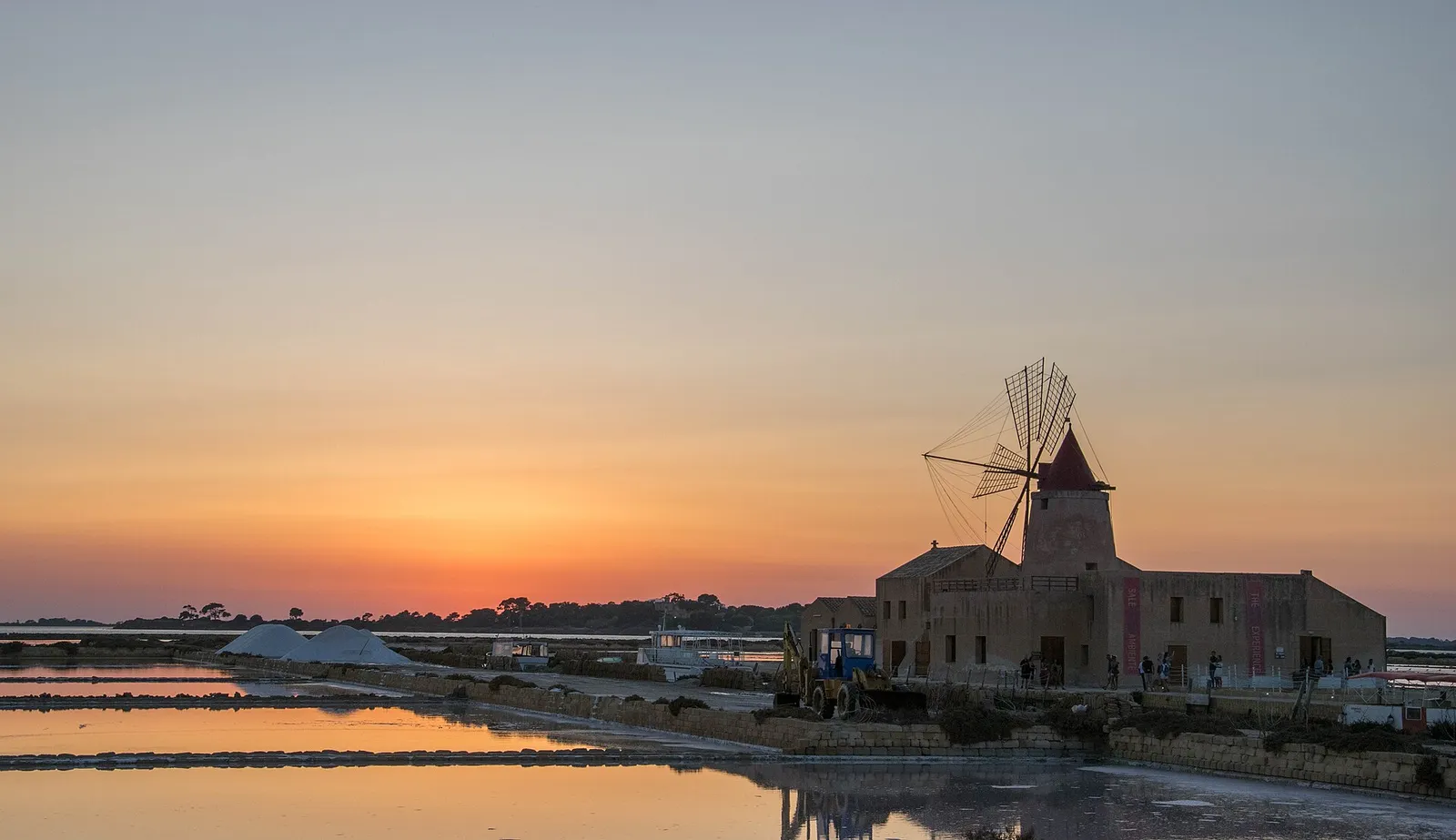
- Location: west coast of Sicily, Trapani province, about 30 km south of Trapani
- Getting there: train or bus from Trapani (roughly 30 minutes); Trapani-Birgi airport is 15 minutes away
- Cost: old town free; Museo Archeologico Baglio Anselmi €10; Florio winery tour with tasting from €51
- Good for: half a day for the town, a full day if you add the salt pans and Mozia
- Don’t miss: sunset over the Stagnone lagoon — Marsala faces west, and it is the best-timed sunset on the island
Most people meet Marsala as a bottle in the cooking aisle — the thing you deglaze a pan with. That version, sweet and slightly harsh, is a long way from what this town actually produces, and it is an even longer way from what the town actually is.
Marsala is the westernmost city in Sicily, built on top of the Carthaginian settlement of Lilybaeum, and it has three separate claims on your attention: a fortified wine invented by an Englishman, a 2,200-year-old warship that no other museum in the world has, and the beach where Giuseppe Garibaldi came ashore and started the chain of events that produced modern Italy.
The wine: invented by accident, by a Liverpool merchant
The story starts in 1773, when John Woodhouse, a merchant from Liverpool, put in at Marsala and tasted the local wine that farmers here had been aging in wooden casks. He thought it resembled the Madeira and sherry that England was drinking in quantity, and he added brandy to the barrels he shipped home — partly to fortify the flavour, partly so it would survive the voyage. It sold. Woodhouse came back and built a proper operation.
The Italian half of the story starts in 1833, when Vincenzo Florio bought a strip of land sitting deliberately between the Woodhouse and Ingham-Whitaker establishments and set out to build a Sicilian competitor. The Florio cellars, built in tufa stone, are still there and still working.
What matters for a visit is that “Marsala” is not one wine. The classification runs by ageing:
- Fine — minimum 1 year
- Superiore — minimum 2 years
- Superiore Riserva — minimum 4 years
- Vergine — minimum 5 years
- Vergine Stravecchio — minimum 10 years
And separately by sugar: secco (up to 40 g/l), semisecco (40-100), dolce (100+). The grapes are Sicilian whites — Grillo above all, plus Catarratto, Inzolia and Damaschino.
The bottle you cook with is almost always a young, sweet, cheap one. A Vergine secco, aged a decade with no added cooked must, is a completely different drink: dry, nutty, closer to an amontillado sherry than to anything you would put in a pan. Tasting the two side by side is the single best reason to stop here, and it reliably surprises people.
If you want to do that properly, the Florio winery runs tours of the tufa cellars with food-paired tastings (affiliate link — booking through it costs you nothing extra and helps support this site). It takes about 90 minutes and it is the one thing here I would book rather than improvise.
The Punic ship: the only one of its kind anywhere
The Museo Archeologico Baglio Anselmi, on the seafront at Lungomare Boeo, holds something no other museum has: the partially reconstructed hull of a Carthaginian warship, most likely a liburna, sunk off the Egadi Islands at the close of the First Punic War in 241 BC. It is the only example of a Punic warship ever recovered.
The hull itself is impressive, but the small finds are what stay with you, because they are startlingly ordinary: rope, cooking pots, amphora corks, a brush, olive stones, a sailor’s wooden button. These are the possessions of men who lost a battle 2,200 years ago, and they look like the contents of anyone’s kitchen drawer.
Admission is €10. The museum sits in a converted baglio, the fortified courtyard building typical of western Sicily, which is worth a look in its own right.
Garibaldi landed here, and Italy followed
On 11 May 1860, Garibaldi came ashore at Marsala with roughly a thousand volunteers — the Mille. Within months the Bourbon kingdom had collapsed and the unification of Italy was effectively decided. Every Italian schoolchild learns this date; most foreign visitors have no idea it happened on this particular stretch of coast.
The town marks it plainly rather than theatrically. You enter the old centre through Porta Garibaldi, a monumental gate with a carved lion’s head, and walk the Cassaro — the old Roman decumanus, now Via XI Maggio, named for the date — straight to Piazza della Repubblica and the Chiesa Madre. It is a ten-minute walk that happens to run along the axis of a Roman street plan.
The Stagnone: Sicily’s largest lagoon, and its best sunset
Just north of town lies the Riserva Naturale dello Stagnone, over two thousand hectares of shallow, hyper-saline water, protected since 1984. Four islands sit inside it, along with the working salt pans of San Teodoro, Genna and Ettore Infersa — the restored windmill in the photo at the top of this article.
Two things to be clear about, because they get conflated online:
- These are the Marsala/Stagnone salt pans. The Saline di Trapani e Paceco are a different reserve, 30 km north — see our Trapani guide for those.
- The water here is very shallow and very salty, which is why it turns pink in late summer and why kitesurfers use it.
Marsala faces west, so the sun sets over the lagoon and the salt mounds. It is genuinely the best-timed sunset in Sicily, and unlike Taormina you will not be sharing it with a coach party.
You can drive the lagoon road and stop where you like for free. If you want the salt explained rather than just photographed, there are guided walks of the pans with a windmill visit (affiliate link — booking through it costs you nothing extra and helps support this site) lasting about an hour.
Mozia: a Phoenician city on an island in the lagoon
Inside the Stagnone sits Isola di San Pantaleo, better known as Mozia (Mothia) — a Phoenician-Punic city founded in the 8th century BC and destroyed in 397 BC. A short boat crossing gets you there, and the island holds an archaeological museum, the excavated city, and a submerged Punic road that once linked it to the mainland.
It is a genuinely unusual half-day: a whole ancient city on an island you can walk around in an afternoon, with almost none of the crowding of Sicily’s headline sites.
What Marsala is not
Worth saying plainly, because expectations matter: Marsala is a working provincial city of about 80,000 people, not a preserved postcard town like Erice or Cefalù. The old centre is handsome and walkable, and the rest of it is ordinary Sicilian urban sprawl.
Come for the wine, the ship, the lagoon and the history. Do not come expecting a picturesque hill village, because that is not what this is — and the guides that photograph only the Cassaro are quietly selling you one.
Practical tips before you go
- Do the wine tasting sober about timing. Cellar tours run to a schedule and the last one is usually mid-afternoon. If Marsala is a day trip, do the winery first and the old town after, not the other way round.
- Ask specifically for a Vergine. If a tasting only pours you sweet young Marsala, you have not really tasted Marsala. The dry aged style is the point.
- The museum closes at lunchtime. Like most Sicilian civic museums, Baglio Anselmi runs a split day — check the current hours the morning you go rather than assuming afternoon opening.
- Time the lagoon for the last hour of daylight. The salt pans are flat, white and glaring at midday and spectacular at sunset. There is very little shade out there.
- Bring cash for the Mozia boat. The crossing is run by small operators and card payment is not reliable.
- Don’t try to add Erice on the same day. It is only 45 minutes away, but both places deserve unhurried time — see our Erice guide for why.
My honest verdict
Marsala rewards people who arrive curious about one specific thing. If you like wine, the Florio cellars and a proper Vergine tasting justify the drive on their own. If you like archaeology, the Punic ship is a genuine one-of-a-kind object, not a regional museum’s local finds.
And if you like neither, come anyway for the Stagnone at sunset — it costs nothing, it is the best sunset on the island, and it is the one thing here that nobody leaves disappointed by. That is also the argument for sleeping here rather than day-tripping in from Trapani: the sunset happens after the day-trippers have left, and a night in Marsala costs less than the equivalent in Trapani or Erice.
See Marsala plotted against Trapani, Erice and the rest of western Sicily on our interactive Sicily map, or browse the whole Trapani region guide.