Trapani: Salt Pans, Old Town, and the Ferry to Favignana
 Daniele Bellia · 6 min read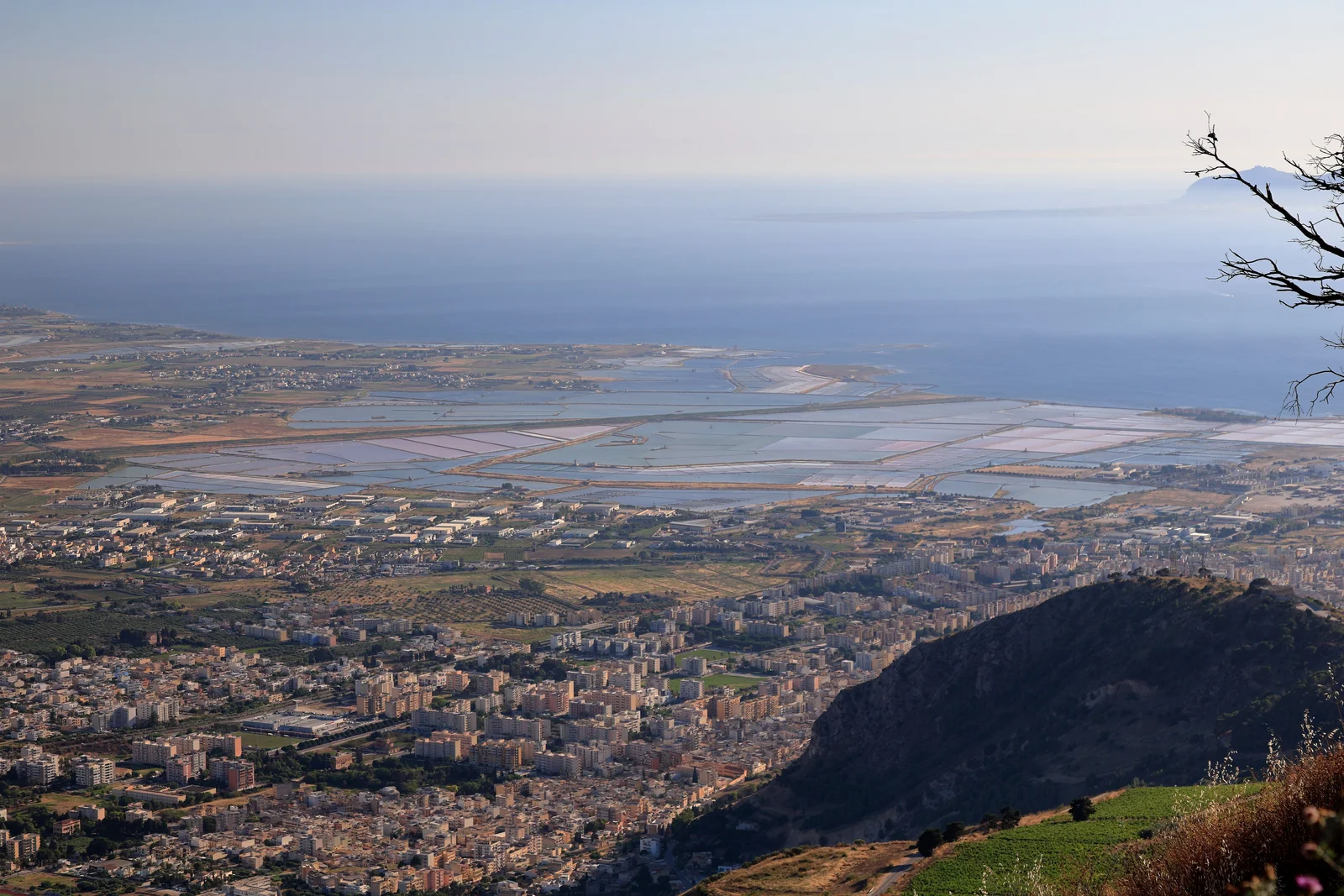
When I tell friends in Catania I spent a few days in Trapani, I get almost the same reaction every time: “Isn’t that all the way on the other side of the island?” True, and that’s exactly why most Sicily travelers skip it, even though it’s one of the few places where you can fit salt pans, a medieval hilltop town, and a departure point for the Egadi Islands into a single afternoon. If you’re already in western Sicily, don’t just treat Trapani as a ferry terminal you rush through.
The Saline di Trapani: no ticket needed, but timing matters
The Riserva Naturale Saline di Trapani e Paceco stretches south of the city along the road to Marsala, right on the sea. Here’s the useful part: you don’t need a booked tour to walk through it. The road running past the salt basins (the old Via Salinara, now part of the SP21) is public, and you can walk or cycle alongside the pools and past the historic windmills without paying anything. Only the WWF’s guided tours, which manage the reserve’s core zone, require online booking — and those are really for birdwatchers who want to know exactly where the flamingos are standing that day.
The Museo del Sale sits inside a restored 19th-century mill, the Mulino Maria Stella, and displays old salt-harvesting tools — 20 to 30 minutes is enough. The real reason to come out here, though, is the light: in the hour before sunset, the salt basins turn into mirrors that throw the sky’s reds and oranges back at you , with the windmills standing out as silhouettes against it. July through September is also when you can watch actual salt harvesting happening as you pass, with the characteristic white salt mounds piled beside the pools. If you don’t have a rental car: city buses toward Nubia/Paceco stop near the reserve, but a taxi for the roughly 15 minutes from the old town is simple and usually not expensive split two or three ways.
The old town: a peninsula shaped like a fishhook
Trapani’s Centro Storico sits on a narrow spit of land that curves into the sea like a fishhook — which is why the Greeks called the city Drepanon, “sickle.” The pedestrian zone runs roughly 800 meters through three main streets: Via Garibaldi, Via Torrearsa, and Corso Vittorio Emanuele. Via Garibaldi, laid out by the Aragonese in the 18th century and also known as Rua Nova, is the prettiest of the three — lined with churches and palazzi, and in the evening full of restaurants spilling their tables out onto the street.
At the western tip of the peninsula, at the Torre di Ligny, you reach the point where the Tyrrhenian and the Mediterranean visually meet, with the Egadi Islands on the horizon. If you have an extra day, our Sicily trip cost guide has benchmark numbers for what accommodation and food cost in a less touristy city like Trapani compared to Taormina or Catania.
One thing that rarely makes it into travel blogs, probably because it isn’t especially photogenic but matters culturally: Trapani holds the Processione dei Misteri on Good Friday, a 24-hour, uninterrupted procession of twenty life-size Passion sculptures from the 17th and 18th centuries, carried by the city’s traditional guilds since 1612. If you happen to be here at Easter, it’s worth catching — one of the oldest continuously held religious events in Europe.
Erice: the hilltop town above Trapani, ten minutes by cable car
You see it constantly from the old town: Monte Erice, 751 meters high, with the medieval town of the same name perched on top. The Funivia Trapani-Erice gets you up there in about ten minutes, with panoramic views over the salt pans and the Egadi Islands along the way. A round-trip ticket costs 11 euros, one-way is 6.50 euros , and the cabins are air-conditioned, which isn’t a small detail in summer.
For opening hours, check the current website since they shift by weekday and season — roughly: Tuesday through Thursday from 8:30 am, Friday through Sunday and holidays from 10 am, Mondays not until 2 pm. Once you’re up there, half a day is enough for the narrow lanes, the cathedral, and the view from Castello di Venere — skip the midday heat and go up late morning or for sunset instead, since it’s noticeably cooler up top than down in Trapani.
The ferry to the Egadi Islands: Favignana in 30 minutes
The real reason most travelers end up in Trapani at all is the port. Liberty Lines runs the hydrofoils to the three Egadi Islands — Favignana, Levanzo, and Marettimo — right from the city harbor, a short walk from the old town. The crossing to Favignana, the largest and most visited island, takes only about 30 minutes , with up to a dozen connections a day in peak season, the first around 6:30 am and the last around 9 pm. A one-way ticket runs roughly 12 to 15 euros depending on season and how far ahead you book — I’d still book online in summer, because the boats genuinely fill up on good days.
Levanzo, the smallest of the three, is barely longer by ferry and worth it if you want quiet over beach crowds; Marettimo sits furthest out and really needs a full day. For a day trip out of Trapani, Favignana is the realistic choice — rent a bike there (the island is completely flat) and cover several of the turquoise coves like Cala Rossa in just a few hours. If you’d rather have the coves, swimming stops and Levanzo covered for you instead of the DIY ferry-plus-bike version, this boat tour from Trapani hits both islands in one day (affiliate link — booking through it costs you nothing extra and helps support this site).
Getting to Trapani: doable from Palermo, its own project from Catania
From Palermo, Trapani is a straightforward day trip or stopover: Segesta Autolinee buses take roughly 1.5 to 2 hours depending on the line, with tickets starting around 6 to 9 euros , and a fairly frequent schedule during the day. If you’re already based in Palermo, our Palermo region overview has more options for the western coast.
From Catania, the math looks different: it’s about 234 kilometers, the fastest bus takes around 4.5 hours, and the train takes noticeably longer since there’s no direct connection and you have to change . This isn’t a day trip you do from Catania — realistically, Trapani only makes sense if you’re already in western Sicily or willing to give up a full travel day to get there. Build it into your route as its own stop rather than a day trip, and check the Sicily packing list for sturdy shoes — Erice’s cobblestones are unforgiving.
What’s actually worth it and what you can skip
Honestly: you don’t need a booked tour for the salt pans, a full day for Erice, or an overnight stay for Favignana if time is tight. What is worth building in is enough time for sunset at the salt pans instead of just driving past them — that’s the moment behind most of the photos you’ve already seen online. Two full days are enough to fit in the old town, the salt pans, Erice, and an island trip without rushing. If you only have one day, pick either Erice or Favignana — don’t try to force both.