Mozia: The Phoenician City on an Island Almost Nobody Visits
 Daniele Bellia · 7 min read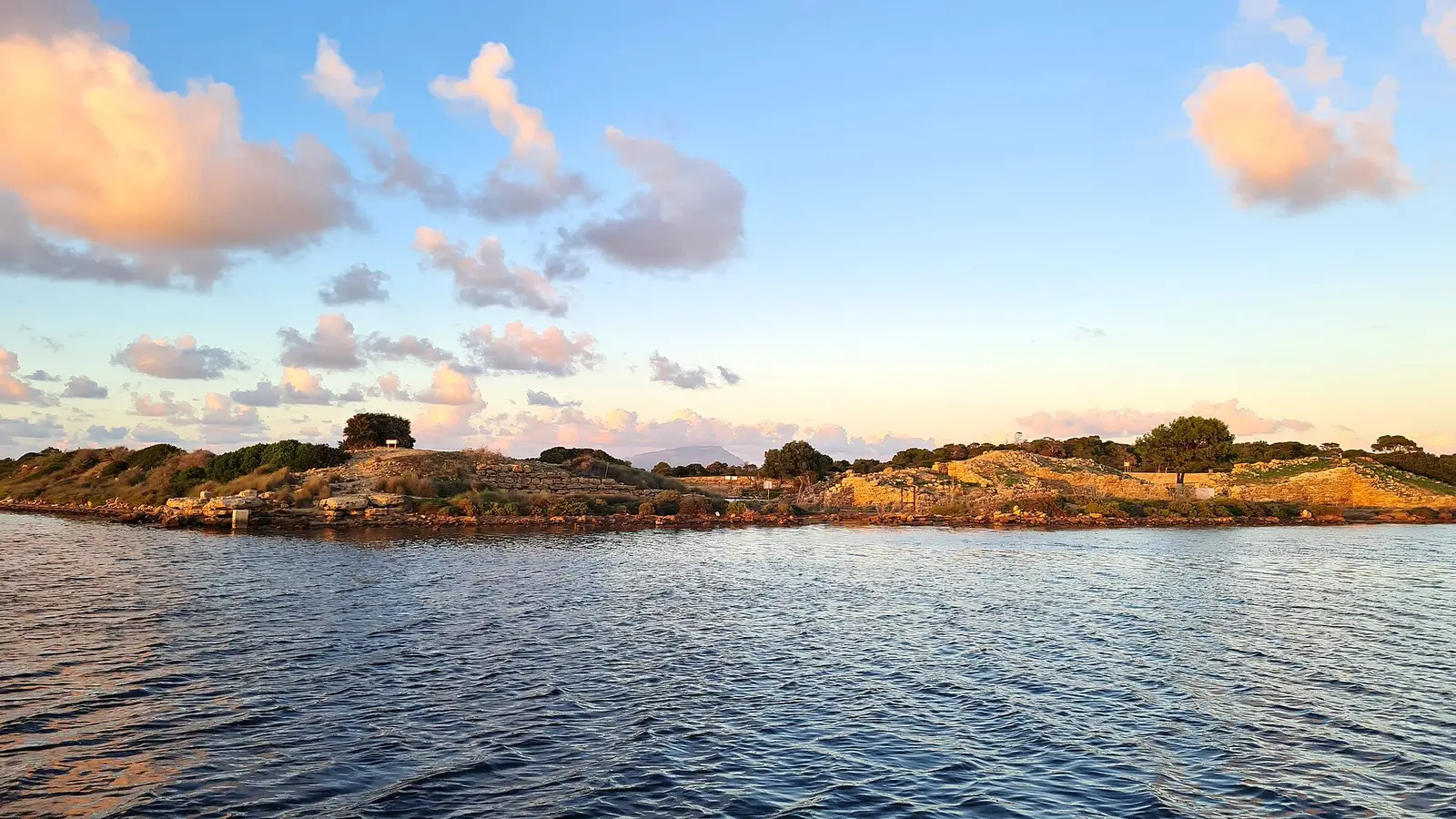
- Location: Isola di San Pantaleo, in the Stagnone lagoon north of Marsala, Trapani province
- Getting there: short drive from Marsala to the Stagnone jetty, then a 10-minute boat crossing roughly every 30 minutes
- Cost: boat €5 return (€2.50 reduced) plus island and museum entry €10 (€6 reduced)
- Hours: April-October, 9:30am-6:30pm
- Good for: half a day, easily paired with Marsala and the salt pans
Most ancient cities in Sicily are buried under modern ones. Syracuse has a cathedral built inside a Greek temple; Palermo’s Phoenician layer sits somewhere beneath the traffic. Mozia is the exception: a whole Phoenician city, destroyed in a single campaign in 397 BC, abandoned, and never built over again.
It sits on a flat island barely 45 hectares across, in the middle of a shallow lagoon. You reach it on a small boat that takes ten minutes. And almost nobody goes — which is the strange part, given what’s on it.
Founded by Phoenicians, held by Carthage
Phoenician traders settled the island around 700 BC, and the choice was pure logistics: a defensible island in a sheltered lagoon, positioned on the sea route between Carthage and the western Mediterranean. Over the following centuries Mozia became one of Carthage’s most important strongholds outside North Africa.
The island’s flatness, which looks unremarkable today, was the whole point — it could be walled completely, and the shallow lagoon around it kept larger warships at a distance.
397 BC: the siege that ended it
In 397 BC, Dionysius I of Syracuse brought his army west. The account we have comes from Diodorus Siculus, and it is not a gentle one: Dionysius deployed advanced siege engines against the walls, took the city, and the aftermath involved massacres and crucifixions.
Two details make the story stick. The first is that the Motyans, seeing the army coming, destroyed their own causeway — the artificial road, roughly a mile long, that linked the island to the mainland — to slow the siege down. It didn’t save them.
The second is what happened to the survivors: they fled five miles across the water and founded Lilybaeum, which is the city we now call Marsala. Mozia was never meaningfully rebuilt. That is precisely why there is anything left to see.
The submerged road you can still trace
The causeway the Motyans destroyed is still there, sitting about a metre below the surface of the lagoon. In the right light and at low water you can follow its line across the shallows — a Phoenician road, underwater, running from the island toward the mainland.
It is the single most atmospheric thing here, and it costs nothing to look at.
The Kothon: not the harbour everyone calls it
Near the South Gate lies a rectangular basin known as the Kothon, and for a century almost every guidebook described it as an artificial inner harbour for loading and repairing ships.
More recent archaeological work has argued something different, and more interesting: the basin was never connected to the lagoon at any point during the Phoenician city’s life, from the eighth to the fifth centuries BC. A harbour that doesn’t reach the sea isn’t a harbour. The reinterpretation is that it was a sacred pool, associated with the god Ba’al, fed by freshwater springs rather than seawater.
You will still hear guides call it a harbour. Both readings are worth knowing about — but if you stand there and notice that it has no outlet to the water thirty metres away, you are noticing exactly what prompted archaeologists to rethink it.
The Tophet, and what it means
On the western side of the island, near the necropolis, is the Tophet — a sacred enclosure holding cinerary urns.
This is where a visit gets uncomfortable, and it should. Tophets are associated with the sacrifice of infants and young children, and the urns here contained cremated remains. How routine this practice actually was remains genuinely debated among archaeologists — some read the urns as evidence of systematic ritual sacrifice, others as a burial ground for children who died young in a society with high infant mortality. The site does not resolve the argument for you. It is a quiet field of stone markers, and it is worth standing in for a few minutes rather than walking past.
The Giovinetto: a Greek statue in a Phoenician city
The Giovinetto di Mozia — the Motya Youth — is the reason most people who do come, come. It is a marble figure of a young man in a long, close-fitting pleated robe, carved in the fifth century BC, and it is startlingly good: the fabric reads as fabric, clinging and creased, in a way almost nothing else from that period manages.
It is also a puzzle. The sculpture is Greek in technique and style, found in a Carthaginian city that Greeks besieged and destroyed. Who he is has never been settled — a charioteer, a priest, a god, a local aristocrat. He gets called “the statue of mysteries” for good reason, and the museum does not pretend to have an answer.
He alone justifies the €10.
Whitaker: the Marsala wine heir who dug it up
The island belongs to the story of Marsala wine, which is a connection almost no one expects.
Joseph Whitaker bought San Pantaleo outright in 1902. He was an Englishman, an amateur archaeologist and a serious ornithologist — he published two illustrated volumes on the birds of Tunisia in 1905 — and he was heir to the Ingham Marsala fortune, the same English wine dynasty that competed with Woodhouse and Florio in the town across the lagoon.
He began excavating in 1905 and published Motya, a Phoenician Colony in Sicily in London in 1921. The museum on the island carries his name, and the foundation he left behind still runs the site.
So the sequence runs: Englishmen come to Sicily for the wine, one of them gets rich, and uses the money to dig up the Phoenician city that the founders of his own adopted town fled from in 397 BC.
Practical tips before you go
- Check the season first. The island and museum run April to October, 9:30am to 6:30pm. Outside that window you can find yourself at the jetty with nothing running.
- Book the ticket online if you’re going in August. Boats are small and leave roughly every half hour; a coach group arriving at the jetty ahead of you costs you a full turnaround.
- Bring water and a hat. The island is flat, open, and has almost no shade. It is a genuinely exposed walk in midsummer.
- Budget three hours, not one. The museum takes half an hour, but the walk around the perimeter — Tophet, necropolis, Kothon, city walls — is what the visit actually is.
- Go late in the day and stay for the crossing back. The Stagnone salt pans and their windmills are directly on the return route, and the light at that hour is the reason photographers come to this lagoon at all.
- Wear something on your feet you don’t mind getting wet. Landing and paths are rough in places, and the shallows are tempting.
My honest verdict
Mozia is not a spectacle. There are no standing temples and no theatre; what you get is a low island, a wall circuit, a strange dry basin, a field of urns, and one extraordinary statue in a small museum.
What makes it worth the detour is the thing you can’t get at Agrigento or Selinunte: a city that stopped in 397 BC and was left alone. Nobody quarried it for building stone, nobody put a town on top of it. You are walking around a plan that has not changed in 2,400 years.
Come for that, and for the Giovinetto. Come late enough that the crossing back happens at golden hour.
See Mozia plotted against Marsala, Trapani and the rest of western Sicily on our interactive Sicily map, or browse the whole Trapani region guide.