Mazara del Vallo: Sicily's Most Arab Town, and the Bronze a Trawler Pulled Up
 Daniele Bellia · 7 min read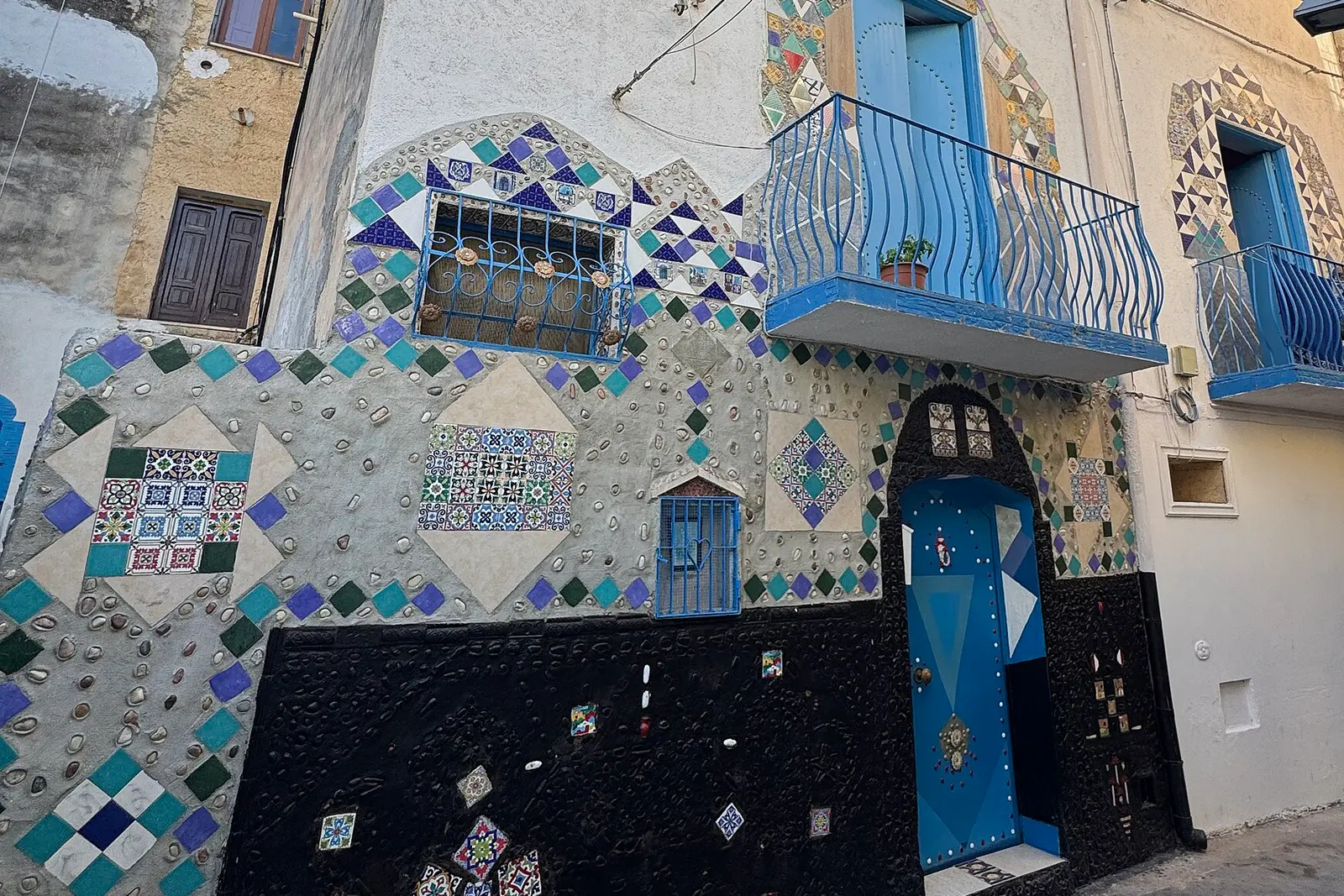
- Location: Mazara del Vallo, on the south-west coast, Trapani province
- Getting there: about 25 minutes by car from Marsala, 50 minutes from Trapani airport, 1h45 from Palermo
- The two things to see: the Kasbah quarter (free, open street) and the Museo del Satiro (€6)
- Museum hours: daily 9:00–19:45, last entry 19:15
- How long you need: two to three hours for both, comfortably
- Best paired with: Marsala and Mozia to the north, Selinunte 30 minutes east
Most Sicilian towns will tell you about their Arab period in the past tense. Mazara del Vallo is the one place where it is still the present tense, and where nobody is performing it for visitors.
This is where the conquest actually landed. In the summer of 827 an Aghlabid army came ashore here and began the campaign that would take the whole island. Mazara went on to give its name to the Val di Mazara, one of the three administrative districts into which Sicily’s Arab rulers carved the island — a division so durable that it outlived them by seven centuries and was only abolished in 1812. The “Vallo” in the town’s name is not a valley. It is an administrative unit that started out in Arabic.
And then, unlike everywhere else on the island, the thread never quite broke.
The Kasbah is a neighbourhood, not an attraction
The old Arab quarter west of the cathedral is still called the Kasbah, and it is still laid out the way it was built around 827: a deliberately confusing grid of alleys barely wide enough for two people, dead ends, blind corners, courtyards you glimpse through an open door. Norman rule came and went. The street plan stayed.
What makes it unusual in Sicily is that it never became a heritage zone. From the 1960s and 70s, Tunisian families began settling in Mazara to work on the fishing boats, and they moved into exactly these streets. Today the Kasbah has Arabic on the shop signs, a mosque, a Tunisian school and bilingual street plaques — with washing hanging out of the windows above all of it, because people live there.
Walk it in the late afternoon and you will hear Arabic and Sicilian in the same alley, often from the same person. This is worth saying plainly: it is a residential neighbourhood, not an open-air museum. Wander freely, but read it the way you would read any street where families are having dinner three metres away.
The tiled steps
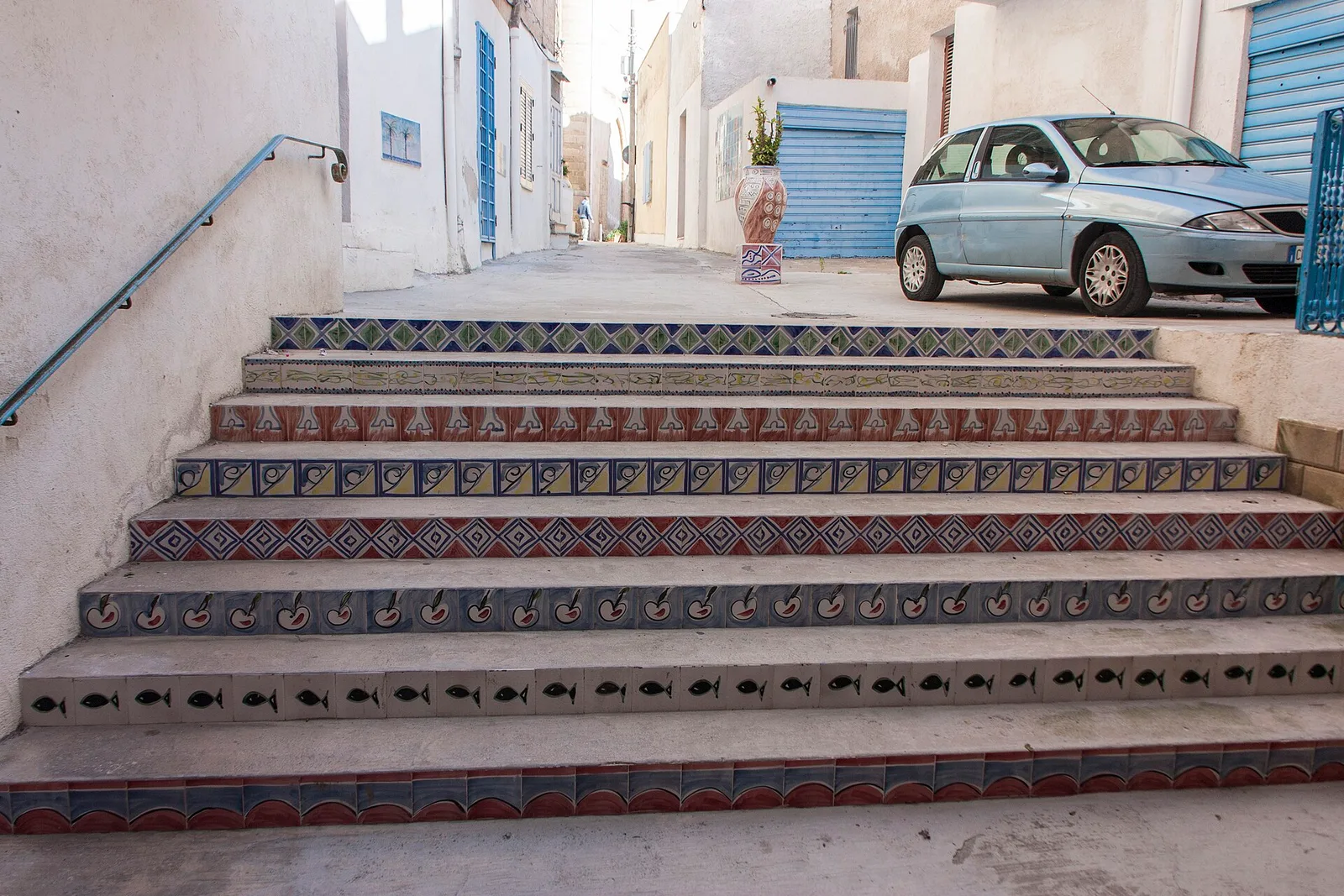 Photo: Davide Mauro, via Wikimedia Commons (CC BY-SA 4.0)
The one piece of deliberate decoration is wonderful. Several of the Kasbah’s stairways and alley walls have been faced in hand-painted ceramics, riser by riser, each step a completely different pattern — a row of black fish, a row of cherries, Tunisian-blue geometry, Sicilian maiolica borders. It was a community art project, and it does in tile exactly what the neighbourhood does in life: sets two traditions side by side without blending them into mush.
They photograph beautifully, they are free, and nobody charges you to stand there.
The fleet is the whole explanation
Mazara has one of Italy’s largest fishing fleets, and it is the reason the town looks the way it does. More than 350 boats work out of the canal harbour, and roughly half the crews are of Tunisian origin. Tunisia is around 200km away. Sicily is closer to Africa here than to the Italian mainland, and the harbour has never pretended otherwise.
It is also the source of the town’s other export: the gambero rosso di Mazara, the deep-water red prawn that turns up on menus across Italy at prices that would fund a small holiday. Here it is simply the local catch. Eat it raw if you are offered it that way.
The Satyr came up in a net
On a July night in 1997, the trawler Capitan Ciccio — skipper Francesco Adragna — hauled its net up from the waters between Sicily and Africa and found a bronze human leg in it.
They went back. On 4 March 1998, the same boat brought up the rest: a life-size bronze male figure, caught mid-movement, head thrown back, hair flying. It had been on the seabed for something like 2,400 years, presumably lost from a ship that was carrying it somewhere else.
Consider the odds for a moment. A working fishing crew, dragging a net across open sea, hooks one of the finest ancient bronzes to survive from the Greek world — and hooks it twice, in the right order.
What you are actually looking at
The Satiro Danzante is usually dated to the end of the 4th century BC and attributed to the school of Praxiteles. It shows a satyr in the middle of an ecstatic dance, and the pose is genuinely violent: the whole body is rotating, off balance, caught at the instant before it falls.
It is also incomplete, and the museum does not hide it. Both arms are gone, one leg is gone, and the tail — which was cast separately — is gone. What survives is the head and torso, and they survive extraordinarily well. The eyes are inset alabaster, still in place, still looking somewhere over your shoulder.
Very few large Greek bronzes exist at all; most were melted down for the metal centuries ago. The ones we still have are mostly the ones that sank. This is one of a small handful in the world that genuinely matter, and it is in a small town in western Sicily because a fishing boat found it.
The museum is a deconsecrated church
The Museo del Satiro occupies the former church of Sant’Egidio, and the setting does a lot of work: a single figure, dramatically lit, in a bare stone church interior with nothing competing for attention. It turns slowly on its mount, so you can see it from every angle without moving.
The rest of the collection is small — other finds from the same waters, including a bronze elephant’s foot — and the whole visit takes about forty minutes unless you sit down and stare, which you probably will.
If you would rather have someone open the doors and explain the ceramics and the harbour as you go, there is a private walking tour of Mazara’s hidden corners — though the town is small enough, and safe enough, that most people do it perfectly well on their own.
Practical tips before you go
- Museum hours and price: open daily 9:00–19:45, last entry 19:15. €6 full, €3 reduced. It is rarely busy — this is not a coach-tour stop.
- Go to the Kasbah late. Between roughly 17:00 and sunset the alleys come to life and the light gets down into them. At 13:00 in August it is shuttered, empty and hot, and you will wonder what the fuss was about.
- Park outside and walk in. Do not try to drive into the Kasbah. Leave the car near the seafront or the Piazza Mokarta area and go on foot; the alleys are too narrow and half of them are not through-roads.
- Photograph the streets, not the people. Point a lens into someone’s doorway and you will get the reaction you would get anywhere. The tiles and the doors are the shot anyway.
- Combine it properly. Mazara works best as a half-day inside a Trapani-province run: Marsala and Mozia to the north, Selinunte 30 minutes east. On its own it is a long drive for two hours.
- Eat the prawns. Any harbour-side restaurant will do. This is the one place where gambero rosso di Mazara is a local ingredient rather than a menu boast.
- Sunday is quieter than you might want. Some shops in the quarter close; the museum stays open.
My honest verdict
Mazara is not a pretty town the way Erice or Cefalù are pretty, and if you arrive expecting a picturesque set piece you will be underwhelmed for the first twenty minutes. It is a working port with a scruffy edge.
What it has instead is something no other Sicilian town can offer: an Arab quarter that is genuinely Arab, right now, for ordinary economic reasons — and, ten minutes’ walk away, a masterpiece of Greek sculpture that a local trawler pulled out of the sea within living memory. Two things that have no business being in the same small town, both entirely real, neither of them staged.
Give it an afternoon. Go late. Stay for dinner.
Planning the west coast? Our interactive map of Sicily has Mazara pinned alongside Marsala, Mozia, Selinunte and the rest of Trapani province — and there is more at sicily-insider.com.