Parmigiana di Melanzane: The Sicilian Original, and Why the Name Isn't About Parmesan
 Daniele Bellia · 3 min read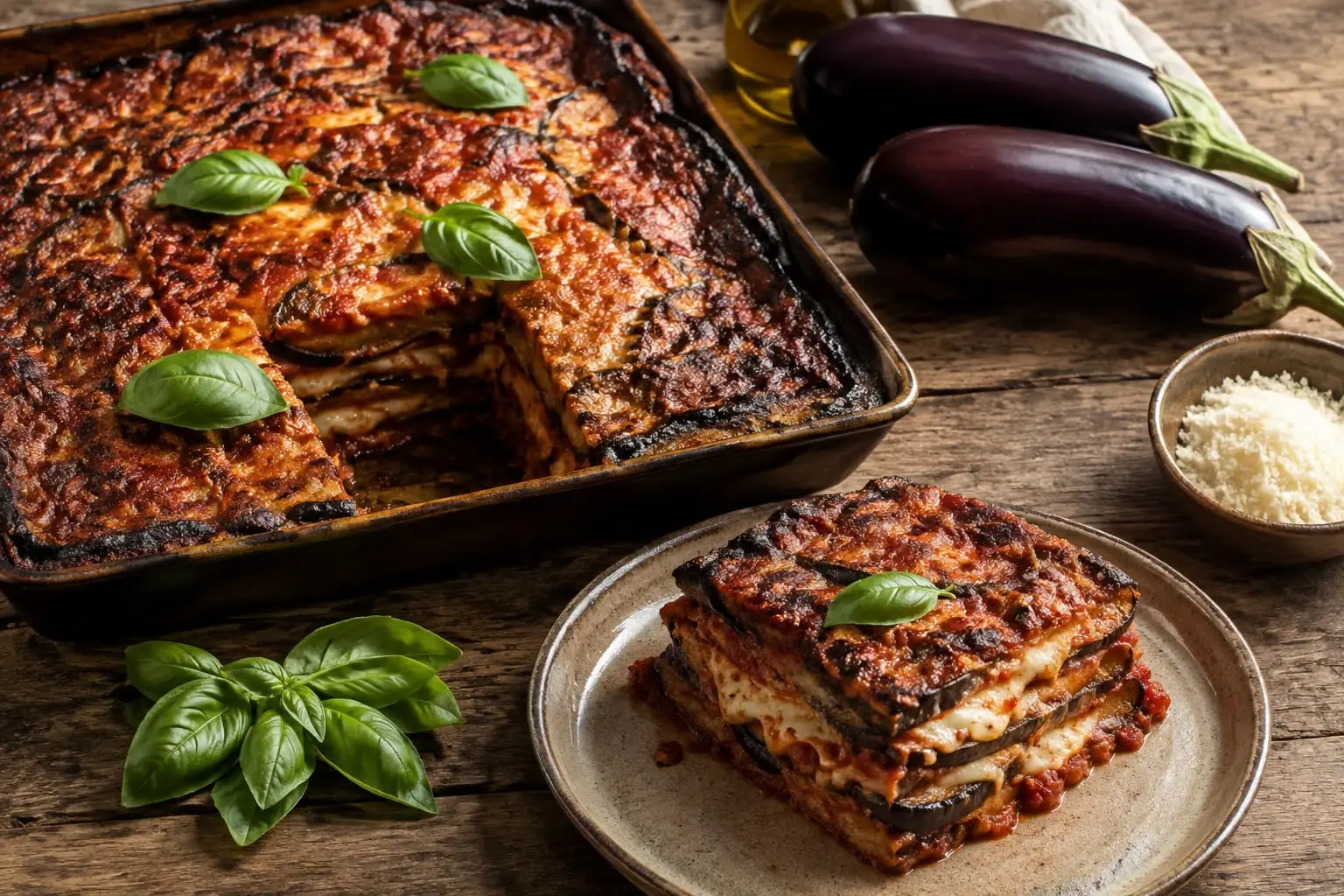
Ingredients
Ask where parmigiana comes from and you will start an argument. Ask what the name means and you will get a wrong answer almost every time.
It is not about Parmesan. The most convincing explanation traces “parmigiana” to the Sicilian parmiciana — the set of overlapping wooden slats that make up a window shutter. Lay fried aubergine slices in a dish, each one riding slightly over the last, and you have built exactly that. The dish is named after what it looks like.
That is the detail worth carrying into the kitchen, because it also tells you how to assemble it.
What makes it Sicilian rather than Neapolitan
The two versions have drifted apart, and the differences are not decoration:
- No mozzarella. Mozzarella is the Neapolitan contribution. The Sicilian version uses caciocavallo — ideally the square-shaped ragusano — or provola, with grated pecorino between the layers. It melts drier and tastes sharper.
- No breadcrumbs, no egg, no flour. The slices are fried in purezza, plain. Coating them is a different dish.
- Very few ingredients. Aubergine, tomato, basil, cheese, oil. Anything else is somebody’s family variation, not the base.
On the origin question itself: the oldest written record is Neapolitan, Vincenzo Corrado’s Il Cuoco Galante of 1733. The case for Sicily rests on the aubergine arriving in Italy through Arab Sicily in the 15th century, and on the Sicilian etymology. I am from Catania, so treat my vote as interested — but the honest answer is that nobody can prove it either way.
The three things that actually decide whether it works
Dry the aubergine properly. Salting is often explained as removing bitterness, and modern aubergines are barely bitter, so plenty of cooks now skip it. Keep doing it anyway, for a different reason: the slices that come out of the colander drained and squeezed dry soak up far less oil in the pan. That single step is the difference between a parmigiana and something heavy you regret.
Reduce the sauce further than feels necessary. It should coat a spoon, not run off it. A loose sauce turns the whole tray into soup, and no amount of oven time fixes it.
Let it rest. Half an hour minimum, and it is genuinely better an hour later at room temperature. Cut it straight from the oven and it slides apart on the plate. In Sicily nobody eats it hot — this is a dish that gets made in the morning and eaten at lunch, or made for lunch and finished, better, at dinner.
When to make it
August, if you can choose. Aubergines are cheap and heavy with flavour, the tomatoes are worth using, and the dish is at its best warm rather than hot — which in a Sicilian summer is the only temperature anyone wants.
If you are cooking your way through the island’s classics, this sits naturally alongside pasta alla Norma, the other great Catania aubergine dish, and caponata, which uses the same vegetable in the opposite direction — sweet-and-sour instead of baked and mellow.
FAQ
Does the name come from Parmesan cheese?
Almost certainly not. The leading explanation traces it to the Sicilian word "parmiciana" — the overlapping wooden slats of a window shutter, which is exactly how the fried aubergine slices are laid down. There is a competing theory that it refers to cooking "in the Parma style", in layers, so it is not fully settled — but the shutter explanation is the one that matches how the dish is actually built.
Is it Sicilian or Neapolitan?
Contested, honestly. The oldest written recipe is Neapolitan — Vincenzo Corrado's "Il Cuoco Galante", 1733. The case for Sicily is that aubergines reached Italy through Arab Sicily in the 15th century, and that the name itself is Sicilian. What is clearer is the split today - mozzarella in the dish is the Neapolitan contribution; the Sicilian version uses caciocavallo or pecorino.
Why no breadcrumbs or egg on the aubergine?
Because that is a different dish. The Sicilian original fries the slices "in purezza" — plain. Flouring or breading them makes the layers heavy and stops the aubergine tasting of aubergine, which is the whole point.
Do I really have to salt the aubergines?
Modern cultivated aubergines are far less bitter than they used to be, so plenty of Sicilian cooks now skip it. The reason to keep doing it is not bitterness but water - drained slices absorb noticeably less frying oil, which is the difference between a parmigiana and a greasy one.
Can I bake the aubergine instead of frying it?
You can, and it will be lighter, but be honest with yourself that it is a variation, not the traditional dish. Frying is what gives the slices the soft, almost creamy texture the layers depend on.
Is it vegetarian?
Yes — aubergine, tomato, basil, cheese and oil. Check the cheese if you need it to be strictly vegetarian, since traditional caciocavallo and pecorino are made with animal rennet.