Catania-Style Caponata – Not the Palermo Version
 Daniele Bellia · 3 min read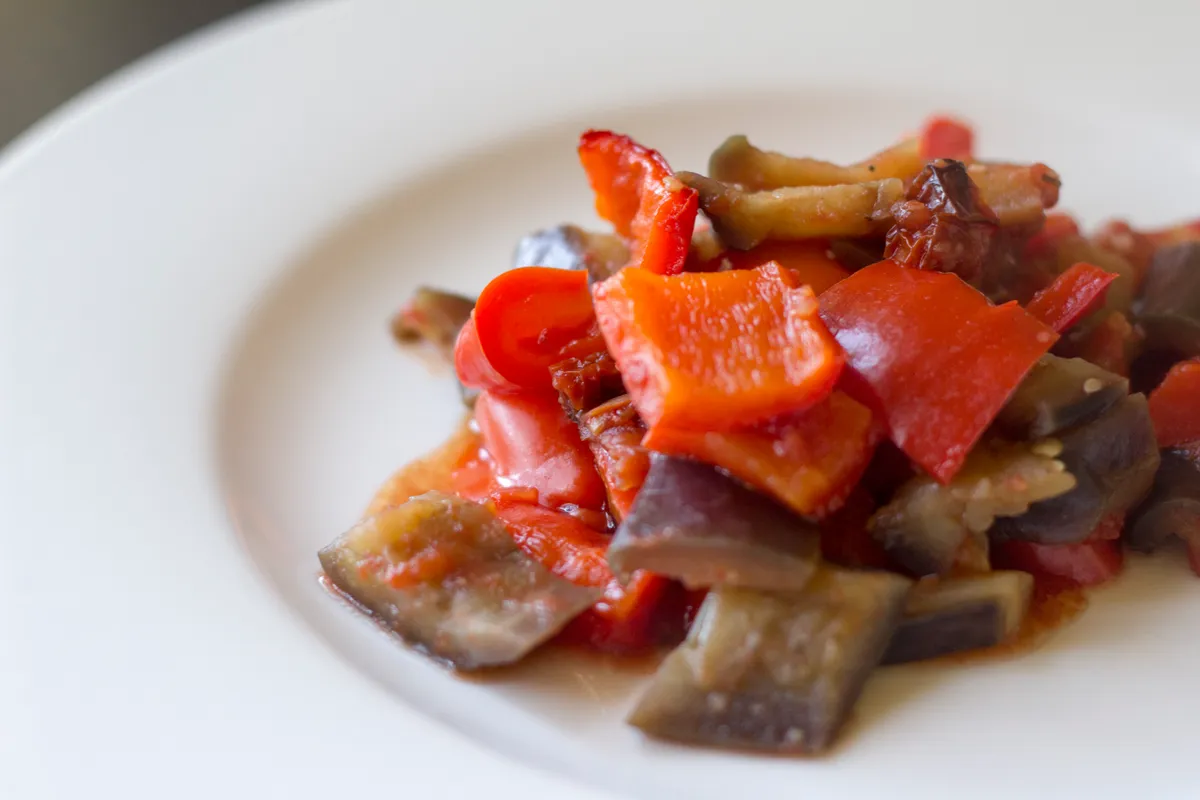
Ingredients
If you order caponata at a German restaurant, you’ll almost always get the Palermo version: eggplant, celery, onion, olives, capers, all in a sweet-and-sour tomato sauce. That’s not wrong — but it’s not the caponata I grew up with. In Catania, there’s something else in the mix that Palermo leaves out: bell peppers. That’s not a minor detail — it’s the giveaway that tells you instantly where a caponata actually comes from.
Where the name comes from
Food historians still argue about where the word “caponata” comes from — there are several competing theories, none of them fully settled. One traces it to the Latin “caupona” (tavern, inn): the story goes that cheap Sicilian harbor taverns served a simple vegetable-vinegar-oil dish to sailors and the poor. Another points to “cappone di galera,” hard ship’s biscuit that sailors made more palatable with a sweet-and-sour sauce. What’s better documented is the origin of the technique itself: eggplant arrived in Sicily with Arab traders in the 9th–11th century, and the sweet-and-sour (agrodolce) principle itself also comes from Arab culinary tradition — one of many traces Islamic rule over Sicily left on the island’s cooking.
Method
The eggplant and peppers: Cut into cubes and fry separately in plenty of olive oil until golden brown. Drain on paper towels. Frying them separately matters, since peppers cook faster than eggplant — throw them in the pan together and one of them ends up mushy while the other’s still raw.
The celery: Blanch briefly in salted water — it should stay slightly firm, not go completely soft. This is a detail a lot of recipes outside Sicily skip, but it’s exactly what separates a caponata with real texture from a uniform mush.
The base: Sauté the onion in olive oil until soft, add the tomatoes, and let it reduce a little. Stir in the capers and olives.
The sweet and sour: Mix the vinegar and sugar separately, then add to the tomato sauce and let it cook briefly until the sharp vinegar smell fades and only the rounded sweet-sour flavor remains. This is the point where most home cooks either play it too safe (too little vinegar, tastes like nothing) or go overboard (tastes only of vinegar, not of caponata).
Bringing it together: Add the fried eggplant, peppers, and blanched celery to the tomato sauce, folding gently so nothing falls apart. Let it cool.
The most important tip: don’t eat it warm
Caponata tastes best at room temperature, not served hot — and on the second day it’s actually better than fresh, since the flavors settle. Serve it warm right away and you lose exactly the effect that makes caponata what it is: the contrast between the cool, silky texture and the intense sweet-and-sour hit.
What a lot of German recipes get wrong
Most German-language recipes I’ve seen either skip the celery entirely or cook it down with the rest of the sauce until it’s completely soft. Both change the result noticeably — the slight bite from the celery matters just as much as the sweet-and-sour balance itself. And obviously: without bell peppers, what you’ve got is a Palermo-style caponata, not a Catania one. Both are legitimate, but they’re not the same dish.
Serving and storing
Caponata is a classic antipasto — with crusty white bread for mopping up the sauce, or as a side to grilled fish. It keeps fine in the fridge for 4–5 days in a sealed container, and as mentioned, it’s often best on the second or third day. Some Catania families finish it with a few toasted almond slivers or pine nuts on top — not part of the original recipe, but a legitimate variation if you want extra crunch.
More on Catania on our interactive Sicily map.
FAQ
Is caponata vegan?
Yes, entirely — no animal products anywhere in the recipe.
Can I freeze it?
Technically yes, but the texture suffers — the celery and eggplant go softer after thawing. Better to keep it in the fridge and eat it within a week.
What olives should I use?
Green, pitted olives, not too mild — Sicilian varieties like Nocellara are ideal, but regular green olives from the supermarket work fine too.
Can I skip the sugar?
Not entirely — you'd lose half of the sweet-sour contrast that gives the agrodolce sauce its name. Reducing it is fine; cutting it out changes the dish noticeably.