Catania-Style Arancino al Ragù – the Real Version
 Daniele Bellia · 4 min read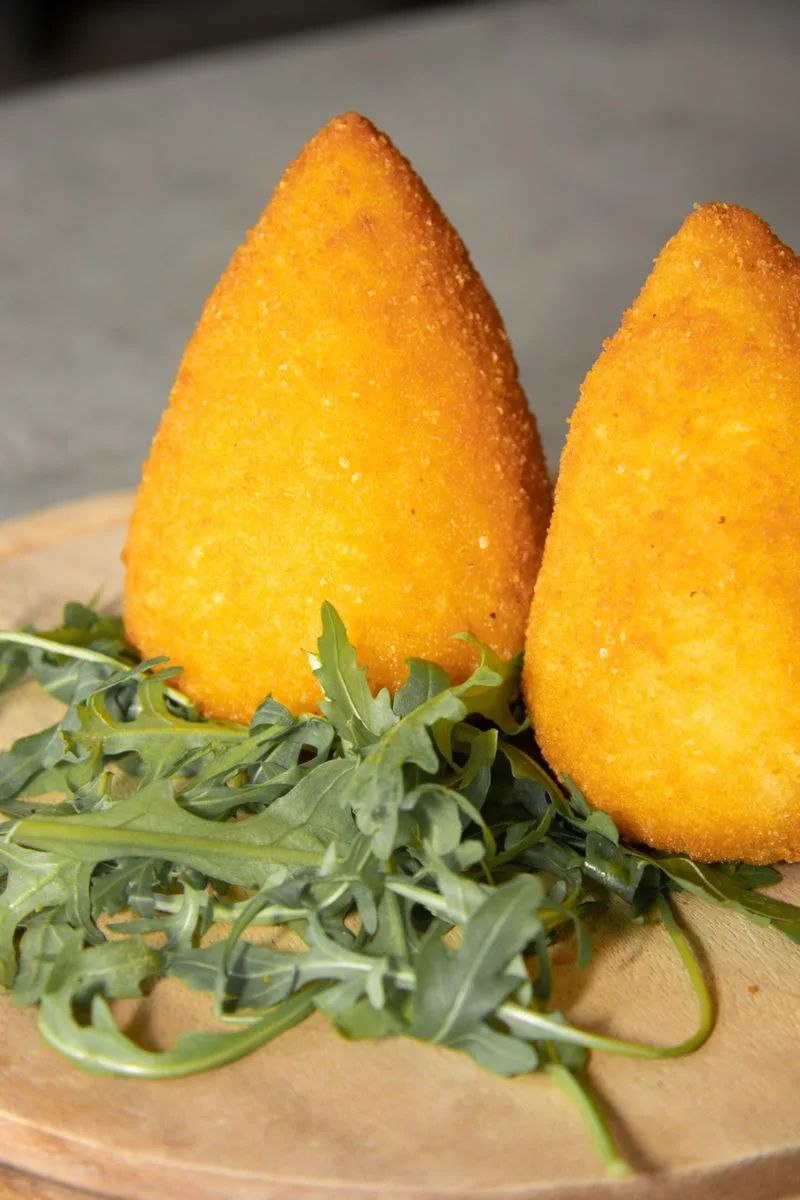
Ingredients
The arancino is probably the most famous Sicilian street food there is — but here’s what a lot of people don’t know: the shape isn’t random. In Catania, the arancino is cone-shaped, meant to represent Mount Etna, the volcano looming over the city. In Palermo, it’s round instead, and it’s called “arancina” — yes, even the gender of the word changes depending on which side of the island you’re on. That’s not a small detail; it’s a decades-old, lovingly held rivalry.
Ingredients (makes 8 arancini)
- 500g risotto rice (Arborio or Carnaroli)
- 1L vegetable stock
- A pinch of saffron threads
- 30g butter
- 100g grated pecorino
- 300g beef or veal, cut into small pieces (not ground)
- 1 onion, 1 carrot, 1 celery stalk (for the soffritto)
- 100g peas
- 200g tomato passata
- 1/2 glass red wine
- 150g caciocavallo, cubed
- 3 eggs
- Flour and breadcrumbs, for coating
- Sunflower oil, for frying
Method
The rice: Cook it in the vegetable stock with saffron until al dente, then stir in the butter and pecorino. The most important step, which a lot of people skip: the rice needs to cool completely, ideally for several hours in the fridge. Warm rice can’t be shaped, and the arancino will fall apart when fried.
The ragù: Finely chop the onion, carrot, and celery, and sauté in olive oil. Add the meat — and here’s where most recipes outside Sicily go wrong: the meat is not ground, it’s cut into small pieces. Deglaze with red wine, add the tomato passata, and let it simmer slowly. Add the peas halfway through cooking.
Shaping: Shape the cooled rice into a ball, press a hollow into the center, add some ragù and a piece of caciocavallo. Seal with more rice and shape into the characteristic cone — it takes a bit of practice, but that shape is exactly what separates a generic rice ball from a real Catania-style arancino.
Coating: Coat each arancino in flour, then beaten egg, then breadcrumbs.
Frying: Deep-fry in plenty of oil at around 180°C (355°F) for at least 4 minutes, until evenly golden brown.
Vegetarian variant: Arancino alla Norma
If you don’t eat meat, you don’t have to skip the arancino — Catania has an equally traditional variant called “alla Norma,” named after the pasta dish. Instead of ragù and caciocavallo, the filling is diced eggplant fried in olive oil, a spoonful of simple tomato sauce, and a piece of ricotta salata. The rice, shape, and coating stay exactly the same — only the filling changes. Just as authentic, just as Catania.
Arancino or arancina?
In Catania and eastern Sicily, it’s “l’arancino” (masculine); in Palermo and the west, it’s “l’arancina” (feminine). Both sides are firmly convinced their version is the only correct one — a rivalry that’s never really been settled, and as a tourist your best move is to enjoy it with amusement rather than pick a side. In 2016, the Accademia della Crusca — Italy’s oldest and most authoritative language institution — was formally asked to weigh in, and gave a diplomatic answer: both forms are correct. “Arancina” comes from the Italian word for orange (feminine), “arancino” from the Sicilian “arancinu.” The linguistic truce hasn’t slowed the argument down even slightly.
Where the name actually comes from
The arancino’s roots go back to Arab rule over Sicily in the 9th–11th century: the story goes that Arab cooks rolled saffron rice into small balls in the palm of their hand — golden and round, just like an orange (Italian “arancia”). Hence the name, regardless of which grammatical gender you use. Today’s breaded, deep-fried, filled version likely developed much later, probably in the 19th century, as practical, portable food for travel — an early ancestor of street food, long before the term existed.
The most common mistake outside Sicily
Ground meat instead of chopped meat is the mistake that immediately gives it away to anyone actually from Catania — the texture ends up completely different, softer and less textured. The second common mistake: rice that’s still warm or not fully cooled, which makes the arancino burst open while frying instead of holding its shape.
Serving and storing
In Sicily, arancini are usually eaten as a snack or light lunch, often bought straight from a rosticceria, not as a sit-down dinner dish. They taste best fresh out of the fryer, but keep fine in the fridge for 2–3 days and reheat well in the oven at around 180°C (355°F) for 10–15 minutes to crisp back up — never in the microwave, or the coating turns soft and the rice goes rubbery.
More on Catania on our interactive Sicily map.
FAQ
Can I shape and coat them ahead of frying?
Yes — once shaped and breaded, they keep for several hours in the fridge, or can be frozen. Fry straight from frozen (don't thaw first), just for a bit longer.
What oil works best?
Sunflower oil or another neutral, high-smoke-point oil — olive oil is too expensive and too strongly flavored for this much frying oil.
Why does my arancino fall apart while frying?
Almost always because the rice wasn't fully cooled or wasn't packed firmly enough. Both steps just need a bit of patience.