La Vucciria: Palermo's Market by Day, Palermo's Party by Night
 Daniele Bellia · 5 min read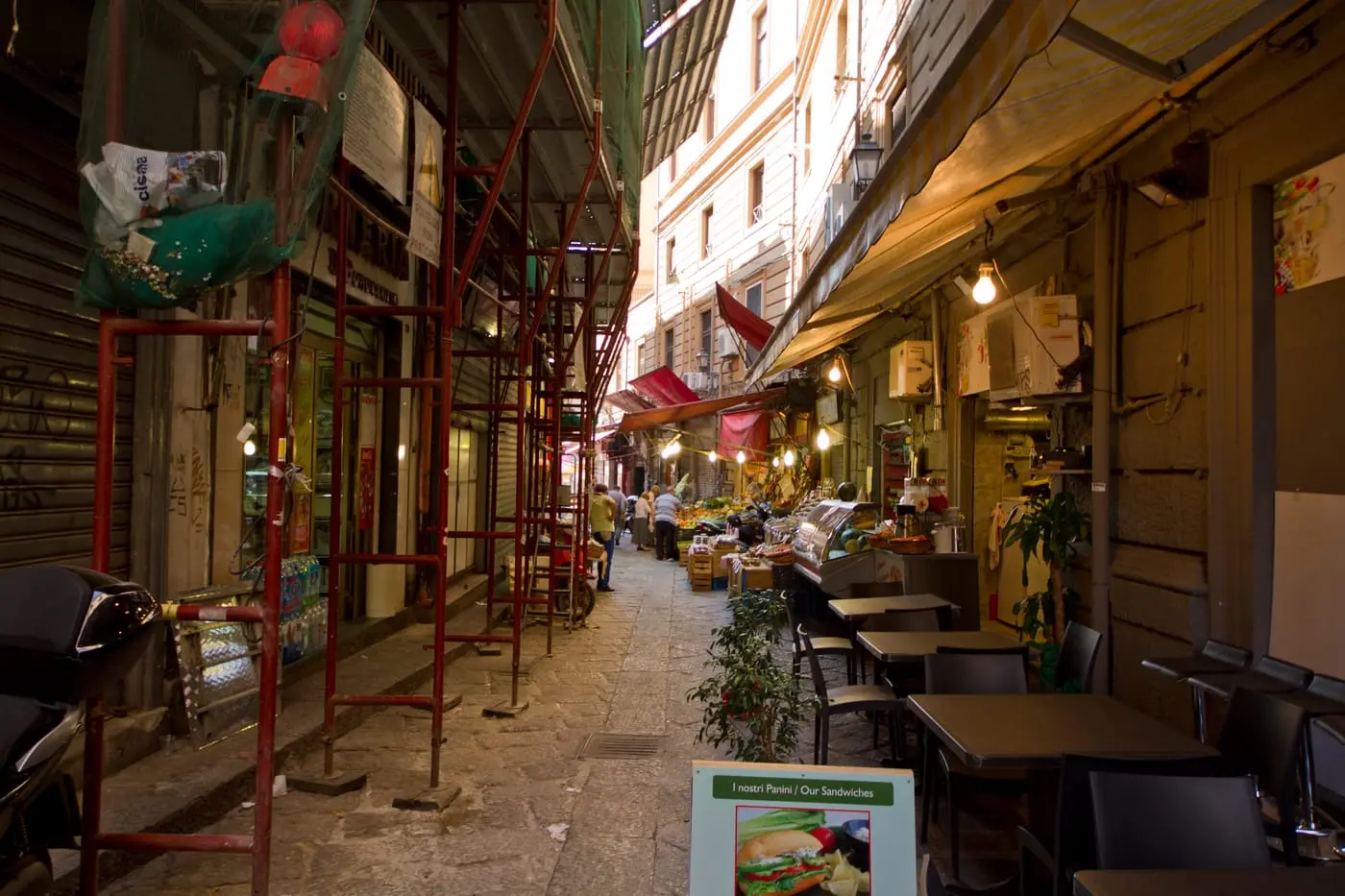
- 📍 Location: Piazza Caracciolo to Piazza Garraffello, historic center of Palermo
- ⏱ Time needed: 30-45 minutes by day, an evening if you're eating and drinking
- 🚗 Car recommended: no — deep in Palermo's pedestrian old town
- 💶 Cost: free to walk through; street food runs a few euros a plate
- 🌗 When to go: morning for what's left of the actual market, evening for the atmosphere it's now known for
Vucciria is Palermo’s oldest market, and depending on when you show up, you’ll see two almost unrelated versions of the same square. By late morning, it’s a handful of fading fish and produce stalls, quieter every year. By nine at night, it’s one of the loudest, most crowded nightlife spots in the city. Both are real, and neither one is the whole story on its own.
Where the name actually comes from
The most widely accepted explanation traces “Vucciria” back to “bucceria,” a dialect version of the French “boucherie” — butchery — since the market originally centered on meat sales going back over a thousand years to the Arab-Norman period. A competing folk explanation ties it instead to “voce,” voice, pointing to the constant shouting of vendors hawking their goods across the square. Nobody can fully settle which came first, and honestly, both explanations describe the same market accurately enough that it barely matters which one is technically correct.
A market that’s been fading since the 1990s
For centuries, Vucciria was Palermo’s main food market, stalls spreading fish, offal, vegetables and spices across the whole quarter. That’s largely over. Only a handful of vendors still set up in the mornings, a fraction of what used to fill the square, and the daytime market that once defined the neighborhood is now closer to a memory than a destination. If you come specifically to see a bustling produce market the way Ballarò still delivers one a few streets away, Vucciria by day will likely disappoint you — that comparison is worth knowing before you plan your morning around it.
How it became Palermo’s nightlife instead
What replaced the market is a genuine second life, not a consolation prize. Since the 2000s, Vucciria has turned into one of Palermo’s key nightlife squares, drawing students, tourists and locals alike once the sun goes down. Plastic cups of wine and beer change hands from makeshift stalls, music spills out of bars until late, and the same lanes that were nearly empty at 2pm are elbow-to-elbow by 11. It’s not staged for visitors — this is where a real cross-section of Palermo actually goes out, which is exactly why it feels different from a curated tourist nightlife strip.
The painting that made this market famous worldwide
In 1974, Sicilian painter Renato Guttuso spent five weeks — October 1 to November 6 — completing a massive 3-by-3-meter canvas titled simply “La Vucciria,” a raw, densely packed scene of the market in its working prime, complete with a quartered half-ox hanging from a hook among the produce. It’s one of the best-known 20th-century depictions of Sicily, and it’s not in some far-off museum: the painting now hangs permanently in a dedicated exhibition space at Palazzo Steri (Palazzo Chiaromonte), a short walk from the market itself. Seeing the actual square and then standing in front of the painting of it, fifty years apart, is a genuinely worthwhile hour for anyone who cares about the place beyond the street food.
What to actually eat here
The stalls that remain, plus the vendors who set up specifically for the evening crowd, are where to try Palermo street food at its most unfiltered. Look for stigghiola — offal grilled over open coals, smoke and all — alongside panelle (chickpea fritters), boiled octopus by the cup, and pane ca meusa, the classic spleen sandwich, sold here by vendors with genuinely loyal followings. It’s not a sit-down dinner scene; it’s stand at a counter, order in Italian or point, and eat with your hands.
If pointing at things you can’t identify isn’t your idea of dinner, this small-group street food tour covers Vucciria and Ballarò with a local guide (affiliate link — booking through it costs you nothing extra and helps support this site), which at least means someone tells you what the stigghiola actually is before you commit.
Safety after dark, honestly
Vucciria at night is genuinely fun, but it’s worth being clear-eyed about it too: this is where large crowds, cheap alcohol, and dim side lanes overlap, and pickpocketing is more common here than in most of the old town. Keep valuables zipped away, stick to the busier lanes once things get crowded, and treat it the way you’d treat any dense nightlife district anywhere — with normal city awareness, not paranoia.
My honest verdict
Vucciria isn’t a market you visit for the shopping anymore, and pretending otherwise sets up the wrong expectations. What it actually offers is a real, unpolished slice of how Palermo eats and goes out at night, plus a genuine piece of art history a few minutes’ walk away for anyone who wants the fuller picture. Go in the morning if you want to see what’s left of the old market quietly fading; go at night if you want to see what Palermo actually does with the same square today.
More on the city in the Palermo region guide, compare it with Ballarò, Palermo’s still-thriving market, or see Vucciria on our interactive Sicily map.