Quattro Canti: The Intersection Most Tourists Photograph and Walk Past
 Daniele Bellia · 6 min read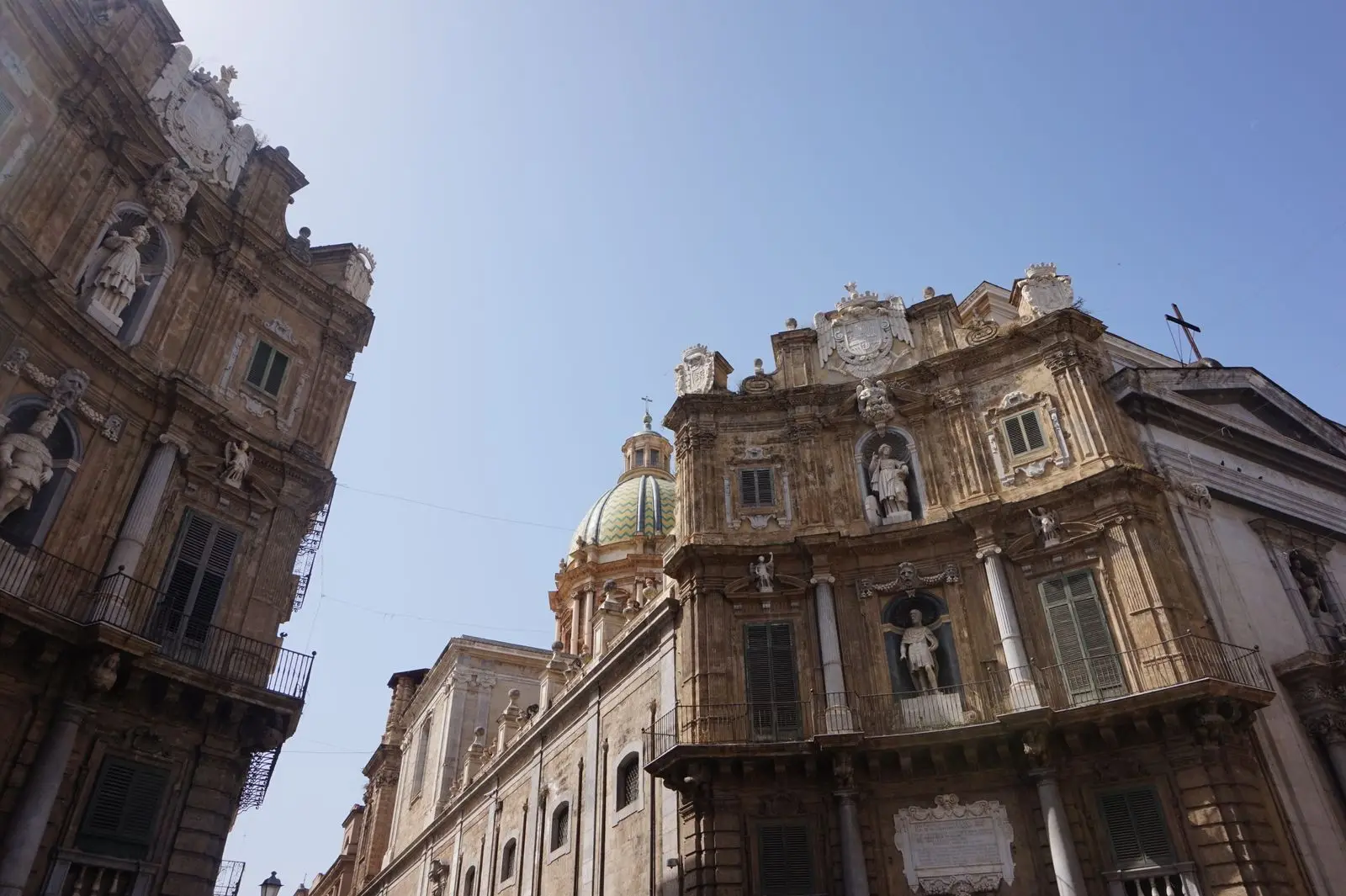
- 📍 Location: intersection of Via Maqueda and Corso Vittorio Emanuele, historic center of Palermo
- ⏱ Time needed: 10 minutes for the intersection, 30-45 with La Martorana and Piazza Pretoria
- 🚗 Car recommended: no — this is deep in Palermo's pedestrian old town
- 💶 Ticket price: free to see the square; La Martorana is €2 (€1 reduced)
- 👨👩👧 Good for kids: yes, it's just a street corner — no climbing or long lines
Quattro Canti — “Four Corners” — is the octagonal Baroque intersection where Palermo’s two main streets cross, and for most visitors it’s a five-minute stop: look up, take a photo of the curved facades, keep walking toward the cathedral or the markets. That’s a reasonable way to see it, but it skips the actual design behind it and two things one block away that are worth doubling back for.
Why it’s nicknamed the “Theater of the Sun”
Built between 1608 and 1620 by Giulio Lasso, with the facades completed by Mariano Smiriglio, Quattro Canti was designed as genuine urban planning, not just decoration — it deliberately splits Palermo’s old town into its four historic quarters (Albergheria, Seralcadio, La Loggia, and Kalsa), one per corner. Because the square is oriented to the compass points, direct sunlight moves across only one facade at a time through the day, which is where the “Theater of the Sun” nickname actually comes from — it’s not just a pretty name, it’s a description of how the light behaves here.
Four levels, deliberately built to rise from earth to sky
Each curved facade actually stacks four tiers, not three, and the sequence is deliberate: a rising path from the natural world at street level up to the sacred at the top. At the bottom, fountains represent four rivers that once ran through ancient Palermo — the Oreto, Kemonia, Papireto, and Pannaria, two of which are now entirely built over and invisible anywhere else in the modern city. Above that, a Doric-columned tier carries allegorical figures of the four Seasons, styled as classical gods — Aeolus, Venus, Ceres, and Bacchus. Higher still, an Ionic tier holds statues of four Spanish kings of Sicily: Charles V, Philip II, Philip III, and Philip IV. At the very top sit statues of four Palermitane saints — Agata, Ninfa, Oliva, and Cristina — who were the city’s official patronesses before Santa Rosalia took over that role in 1624. Interestingly, the top tier was originally meant for more royal statues; architect Mariano Smiriglio changed the plan partway through construction to put the saints there instead, which is why the sacred tier ended up literally above the political one.
The marble statues themselves are the work of Carlo D’Aprile, one of the era’s major Baroque sculptors, with the Spring and Summer allegories carved by Gregorio Tedeschi and Autumn and Winter by Nunzio La Mattina — a level of individual artist attribution that most visitors walk straight past without ever looking up to notice.
The “Fountain of Shame,” one block away
A short walk down Via Maqueda is Piazza Pretoria and its fountain, originally sculpted in 1554 by the Florentine Francesco Camilliani for a private Tuscan villa before Palermo’s Senate bought it in 1573 and had it shipped over piece by piece. When it went up in 1574, its nude statues faced directly onto the windows of the Santa Caterina convent — the nuns were reportedly scandalized enough to fling clothing over the statues, and the square earned the nickname Piazza della Vergogna, the “Square of Shame,” which has stuck for over 400 years. Whether the scandal was really about the nudity or about how much public money went into it depends who you ask; either way, it’s a genuinely striking fountain, not just a punchline.
La Martorana: the gold interior most people walk past
Right next to Piazza Pretoria sits Santa Maria dell’Ammiraglio, better known as La Martorana — founded in 1143 by George of Antioch, admiral to the Norman king Roger II, and easy to underestimate from outside since the entrance is unassuming next to the more photogenic fountain. Inside, the mid-12th-century Byzantine mosaics are some of the best-preserved in Sicily, including a scene of Roger II being crowned directly by Christ rather than by the Pope — a fairly bold political statement in gold glass for its time. Entry costs €2 (€1 reduced), but the hours are easy to miss: weekdays 8am-1pm and 3:30-7pm, while Sundays and holidays it’s open only 8:30-9:45am and 11:45am-1pm — plan around that rather than assuming it’s open whenever you happen to walk past.
A public execution, and a drainage fix
The intersection wasn’t only ever decorative. On June 30, 1789, Giovanna Bonanno — known as “la Vecchia dell’Aceto,” the Old Woman of Vinegar, a poisoner convicted of selling a lethal arsenic mixture disguised as a health tonic to women looking to get rid of their husbands — was hanged here in a public execution. It’s a genuinely dark footnote against the square’s Baroque polish, and one most guided tours skip entirely. On a more mundane note, in 1856 the city lowered the street level along Via Maqueda to fix chronic drainage problems, and added a basin beneath the fountain at each corner as part of the same fix — practical Palermo civic engineering hiding under 250-year-old sculpture.
Getting there
Quattro Canti sits dead center in Palermo’s historic core, at the crossing of Via Maqueda and Corso Vittorio Emanuele — walkable from the Cattedrale, the Palazzo dei Normanni, and the main markets, all within about 10-15 minutes on foot. There’s no realistic case for driving here: the surrounding streets are pedestrian or heavily restricted, and every nearby attraction is closer on foot than by car.
That central position is also why Quattro Canti is a starting or passing point on most guided walks of the old town — this markets-and-monuments walking tour (affiliate link — booking through it costs you nothing extra and helps support this site) strings it together with the markets and the surrounding churches, which is roughly the loop described below anyway.
My honest verdict
The intersection itself genuinely is a five-minute stop, and there’s no need to feel like you’re rushing it. But treat Quattro Canti as the starting point of a short loop rather than the destination: the fountain and the church are both within a two-minute walk, and between the scandal, the mosaics, and the sun-tracking architecture, that short loop tells you more about Palermo than the crossroads alone ever will.
More on the city in the Palermo region guide.