Sciacca: The Spa Town Where You Cannot Take the Waters
 Daniele Bellia · 7 min read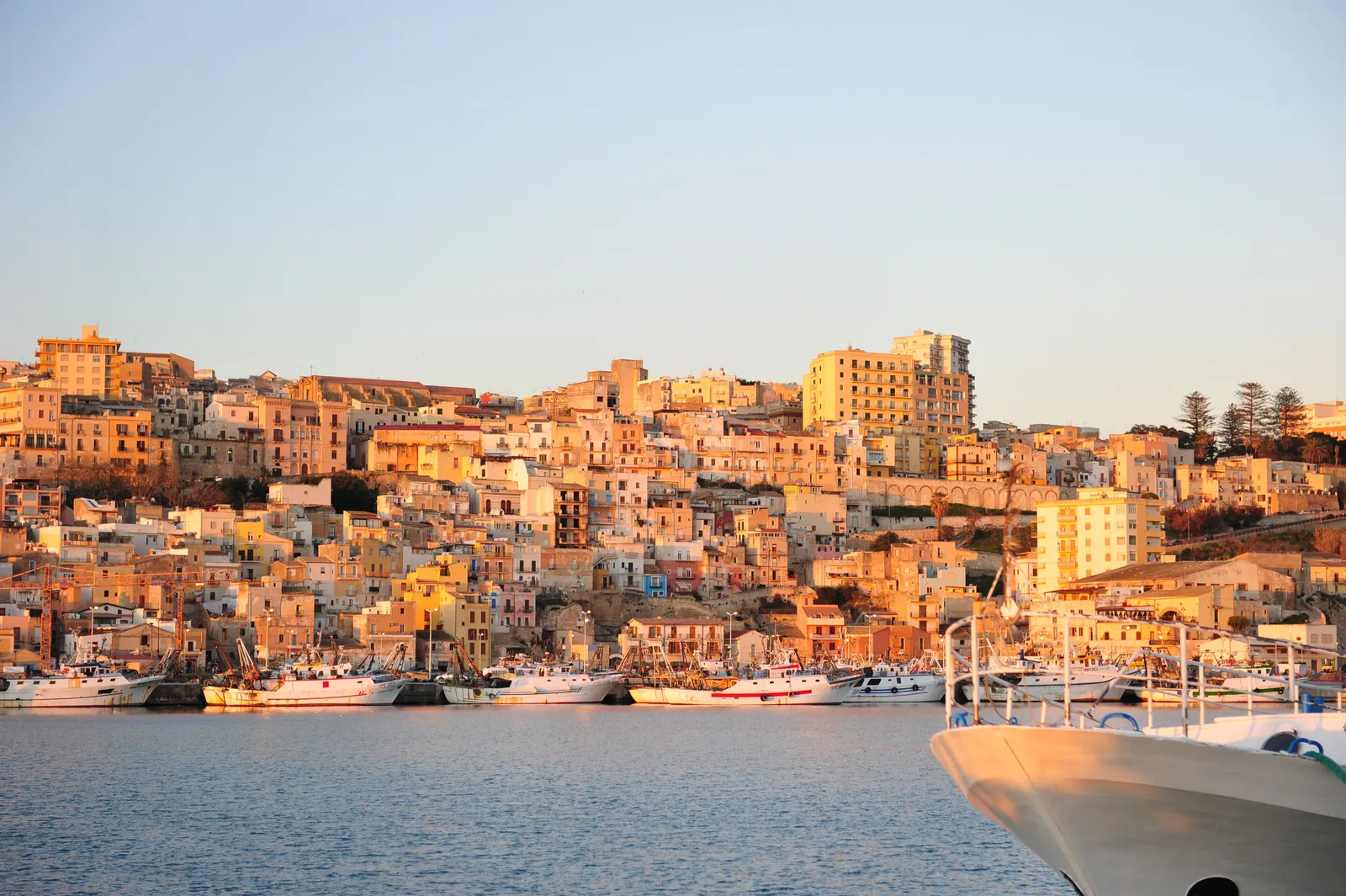
- Location: Sciacca, on the south-west coast between Agrigento and Selinunte
- The thing to know first: the thermal baths have been closed since 2015 and there is still no reopening date
- What is genuinely worth the stop: the Castello Incantato, the ceramics, the working harbour
- How long you need: half a day, or a full day with the Castello Incantato
- Getting there: about 1 hour from Agrigento, 1h45 from Trapani, 1h30 from Palermo
- Best paired with: Scala dei Turchi and Agrigento to the east, Selinunte to the west
Search for Sciacca and you will be told, over and over, that it is Sicily’s great thermal town — sulphur springs, steam caves, a grand spa hotel, waters used since antiquity. Book a trip on that basis and you will arrive to find all of it locked.
The baths have been closed since 6 March 2015. Eleven years. That single fact reshapes the whole visit, and it is astonishing how few guides mention it.
The good news is that Sciacca is still very much worth stopping for. Just not for the reason everyone tells you.
What exactly is closed
Sciacca’s thermal complex was not one building but four, and the 2015 closure took the lot: the Nuove Terme on the Cammordino cliff, the Molinelli pools east of town, the Antiche Terme in the Valle dei Bagni, and the Stufe di San Calogero — the natural steam caves inside Monte Kronio. The Grand Hotel and the thermal park went with them.
The Stufe are the real loss. Inside Monte Kronio is the deepest cavity in Sicily with a natural vapour flow, holding steadily between 37°C and 39°C, used as a sweat-bath since prehistory. It is one of the most unusual natural phenomena on the island, and you cannot go in.
So if a hotel or a tour markets “Sciacca thermal baths” to you, ask exactly which facility they mean before you pay for anything.
Will they reopen?
There is real movement, but no date, and I would not plan a trip around it.
The Sicilian Region issued a tender in November 2025, extended to April 2026, offering a ninety-nine-year concession on the buildings and thirty years, renewable, on the mineral rights. By decree of 27 May 2026 the region identified a bid led by Terme di Saturnia S.p.A. and moved it into evaluation. The financing package is roughly €50 million in public development funds with a further €40 million expected from the operator.
It is also contested: a rival bidder has asked the regional government to suspend the procedure and re-examine its own excluded proposal. Between the appeal and the scale of the restoration, “reopening” is still a process rather than an event.
The man who carved a thousand heads
This is the reason to come, and hardly anyone outside Sicily knows about it.
Filippo Bentivegna was born in Sciacca in 1888, the son of a fisherman. In 1913 he emigrated to the United States, where his brothers already were. There he took a severe blow to the head — the story attaches it to a romantic quarrel — and was left with amnesia serious enough that he was formally classified unfit for work.
He came home in 1919 to be charged as a deserter and sentenced to three years. A psychiatric assessment found him mentally ill but not dangerous, and he was released.
In the early 1920s he bought a rocky patch of ground on the slopes of Monte Kronio, and there he began to carve. Heads. Thousands of them, into the boulders and into the trunks and branches of the olive trees — Garibaldi, Mazzini, Mussolini, Pirandello, and countless faces belonging to nobody at all. He had no artistic training whatsoever. He kept at it for the rest of his life and died in 1967.
The place is now known as the Castello Incantato, the Enchanted Castle, and walking into it is genuinely disorienting: an olive grove where every surface is watching you.
In 1968, a year after Bentivegna’s death, Gabriele Stocchi — a collaborator of Jean Dubuffet, who coined the term art brut — came to Sciacca to see whether the “madman of Sciacca” was the real thing. He left with several heads as a gift for Dubuffet, who added them to his collection. They are in the Collection de l’Art Brut in Lausanne to this day.
The site spent years shut and neglected. It has since been taken over by new management, which has recovered a number of pieces and set up a small museum alongside the open-air grove.
The ceramics are not a souvenir cliché
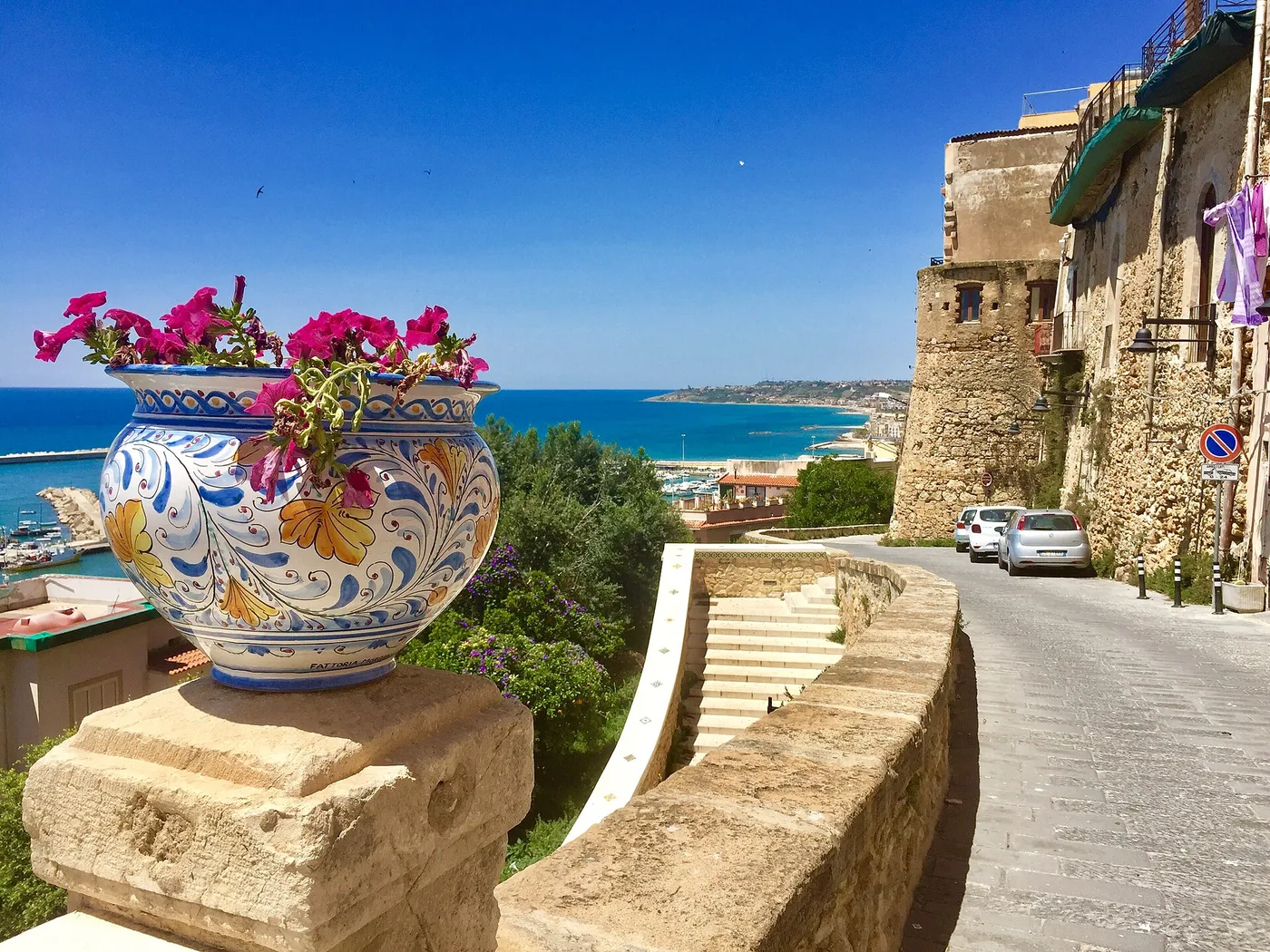 Photo: Stephanie Kroos, via Wikimedia Commons (CC BY-SA 2.0)
Sciacca is one of Sicily’s three serious ceramic towns, alongside Caltagirone and Santo Stefano di Camastra, and its palette is distinctive: yellow, blue and green, with motifs drawn from the sea and from popular tradition rather than the aristocratic patterns you see elsewhere.
You will find the workshops scattered through the old town, and prices well below what the same pieces fetch in Taormina. If you are going to buy one piece of Sicilian ceramic on your trip, this is a sensible place to do it.
And the coral almost nobody mentions
Sciacca coral is a genuine rarity. It comes from fossil banks on the sea floor off this coast, discovered in the nineteenth century, and its colour — a warm orange-salmon rather than the deep red of living coral — exists nowhere else. The banks are essentially exhausted, so what is worked today comes from old stock.
If you want to see it being worked, there is a coral craft workshop in Sciacca that runs hands-on sessions, currently around €92 — not cheap, and worth it only if the craft genuinely interests you.
The old town and the harbour
Sciacca is built in terraces up a cliff above its port, which is why it looks so good from the water and slightly confusing on foot. The layout is Arab in origin and it shows: stepped lanes, sudden dead ends, courtyards.
The harbour below is a working fishing port, one of the more important on this coast, and it is where the town is at its most honest — nets, ice, crates, and no concession whatsoever to visitors. Go down late afternoon when the boats come in.
Practical tips before you go
- Do not book accommodation for the thermal baths. They are closed. If a listing implies otherwise, it is recycling old copy.
- Castello Incantato: check current opening hours before driving up — it is run on a small scale and hours change seasonally. It sits on the slopes of Monte Kronio, a few kilometres outside town.
- Park below and walk up. The old town is stepped and narrow; driving into it is a mistake you make once.
- Late afternoon is the hour. The harbour comes alive, the light hits the terraced houses, and the ceramic workshops are open again after the afternoon break.
- Combine it going west. Sciacca sits neatly between Agrigento and Selinunte, and works well as the lunch-and-afternoon stop on that drive, with Torre Salsa for a wild beach on the way.
- Carnival, if your dates allow. Sciacca’s carnival is one of the oldest and biggest in Sicily, with satirical papier-mâché floats. It falls in February.
My honest verdict
Sciacca has been let down. A town whose identity, economy and name were built on its waters has spent eleven years with them padlocked, and the reopening is still tangled in tender procedures and appeals.
But go anyway, and go for Bentivegna. An unschooled fisherman’s son with a head injury spent forty years carving faces into an olive grove, and ended up in a Lausanne museum next to the artists Dubuffet collected. There is nothing else like it in Sicily, and it costs a fraction of what you will pay to see mosaics elsewhere on the island.
Just arrive knowing what is shut, so the town gets judged on what it actually has.
Planning the south-west coast? Our interactive map of Sicily has Sciacca alongside Scala dei Turchi, Torre Salsa and the rest of the Agrigento coast — more at sicily-insider.com.