Castello Maniace: The Fortress at the Tip of Ortigia, Named for a General Who May Never Have Built Here
 Daniele Bellia · 4 min read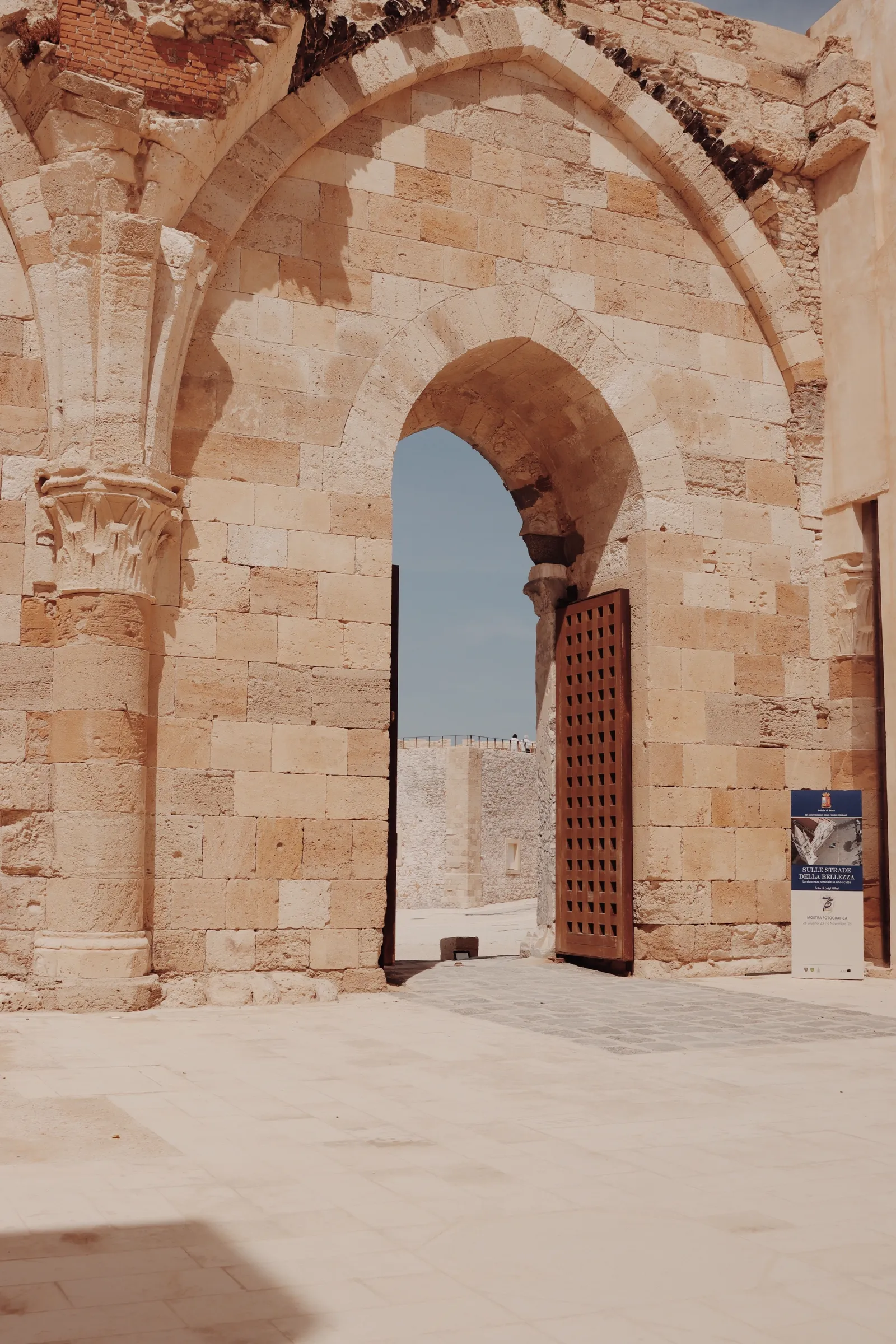
- 📍 Location: the very tip of Ortigia, Siracusa, surrounded by sea on three sides
- 🏰 Built: 1232-1239 under Emperor Frederick II, architect Riccardo da Lentini
- 💶 Cost: €6 (reduced €3, free under 18); free on the first Sunday of the month
- 🕐 Hours: daily 8:30am-4:30pm (worth double-checking locally, hours shift)
- 🌅 Best time: late afternoon — best light and sea breeze at the point of Ortigia
Castello Maniace sits at the very tip of Ortigia, sea on three sides, quieter than the Duomo square a few minutes’ walk away — and named after a general who, as far as archaeologists can tell, may never have actually built anything on this exact spot.
Named for a conquest two centuries before it was built
The fortress takes its name from George Maniakes, a Byzantine general who reconquered Siracusa from Arab rule in 1038 — two full centuries before the current castle went up. Tradition holds that Maniakes fortified this same point after retaking the city, and that Frederick II’s builders simply rebuilt on top of his foundations in the 1230s. Recent excavations complicate that story: no trace of any Maniakes-era fortification has actually turned up, and it’s likely that the deep rock-cutting done for the Swabian castle’s own foundations erased whatever, if anything, was here before. The name stuck regardless — a Byzantine general commemorated on a building he probably never touched.
What Frederick II actually built
The real construction dates to 1232-1239, commissioned by Holy Roman Emperor Frederick II and designed by the Sicilian architect Riccardo da Lentini. It’s a near-perfect square, roughly 51-58 meters per side depending on which survey you read, with a cylindrical tower at each corner — a textbook example of Swabian military architecture, built in the same era and style as Frederick’s other Sicilian fortresses. Inside, the standout space is the sala ipostila, a hypostyle hall whose rows of columns and vaulted ceiling are the closest thing the castle has to a signature interior room, alongside sweeping views over Siracusa’s natural harbor from the seaward walls.
The bronze rams that left centuries ago
Two bronze rams, believed to be Hellenistic-era spoils, once flanked the castle’s entrance portal — legend attributes them to George Maniakes himself, brought back as trophies from his 1038 campaign. Only one survives today, and it isn’t here: it’s on display at the Salinas Archaeological Museum in Palermo, a detail that catches visitors off guard when they come specifically hoping to see it at the castle itself. What’s left at the entrance now is the memory of them, not the objects.
Earthquake, gunpowder, and a fire that reshaped the castle
The building visible today isn’t quite Frederick II’s original. Spanish-era modifications changed parts of the structure, the devastating 1693 earthquake that leveled much of southeastern Sicily did real damage here too, and in 1704 an explosion in the castle’s own gunpowder magazine triggered a fire that altered it further still. What survived and was later restored is a genuine patchwork of eras rather than a single untouched 13th-century structure — worth knowing before expecting a pristine medieval time capsule.
Visiting today
The castle now doubles as a venue for cultural events and exhibitions alongside its role as a monument, so what’s on display can shift depending on when you visit. Entry runs €6 (€3 reduced, free under 18), free entirely on the first Sunday of the month — worth timing a visit around if your dates allow it. It’s open daily, roughly 8:30am to 4:30pm, though it’s worth confirming locally since hours here shift more than at Siracusa’s bigger sites.
Practical tips
- Go late afternoon, not midday — the light and sea breeze at Ortigia’s tip are noticeably better a couple of hours before sunset.
- Don’t expect to see the bronze rams here — the surviving one is in Palermo’s Salinas Museum, not on site.
- Pair it with Fonte Aretusa, a short walk away along the same stretch of Ortigia’s waterfront, for one continuous seaside loop.
- Consider a guided walk if the castle leaves you wanting context — the site itself explains very little, and a walking tour of Ortigia covers the island the castle sits on, Fonte Aretusa included.
- Check for events before you go — the castle occasionally hosts exhibitions or functions that can affect visiting hours or access to specific rooms.
More on the area in the Siracusa region guide, and see Castello Maniace on our interactive Sicily map.