Teatro Massimo: Palermo's Opera House, and the Real Story Behind That Godfather Scene
 Daniele Bellia · 6 min read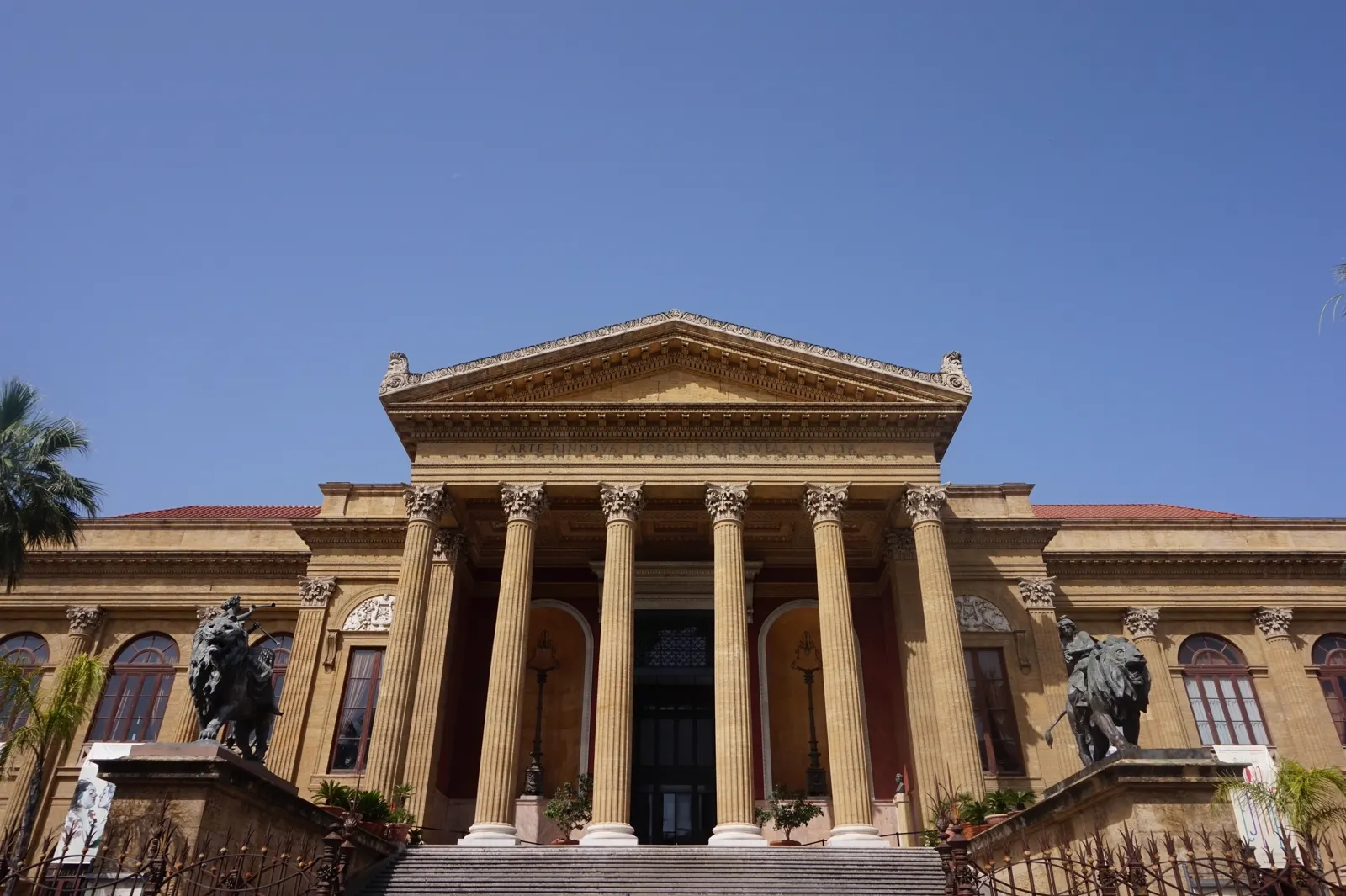
- 📍 Location: Piazza Giuseppe Verdi, historic center of Palermo
- 🏛️ Built: foundation stone 1875, opened May 16, 1897 — Italy's largest opera house
- 🎫 Guided tour: €8 adults, €5 reduced, about 40 minutes, daily 9:30am-6:00pm
- 🌇 Saturday extra: rooftop terrace access, 9:30am-8:30pm, separate €20 ticket
- ⏱️ Time needed: the tour itself is short — pair it with something else nearby
Teatro Massimo is the largest opera house in Italy, and the closing backdrop of one of the most famous final scenes in American cinema — even people who’ve never set foot in an opera house tend to recognize its front steps from Godfather Part III. The building itself took far longer to finish than anyone planned, and sat closed for over a decade before most Palermitani ever saw the inside.
A 22-year construction, with an 8-year pause in the middle
Palermo’s city council announced an international design competition for the theater in 1864, and the foundation stone was laid in January 1875. Architect Giovan Battista Filippo Basile won the commission, but died in 1891 before it was finished — his son, Ernesto Basile, took over and completed it. Construction itself was suspended entirely for eight years, from 1882 to 1890, over funding and political disputes. The theater finally opened on May 16, 1897, more than two decades after that first stone was laid, with a performance of Verdi’s Falstaff. At the time, with a surface area of over 7,700 square meters, it was the third-largest opera house in Europe, behind only Paris and Vienna.
Inside the auditorium: what actually makes it special
The main hall (Sala Grande) follows the classic horseshoe shape opera houses use for a reason — every seat gets a workable sightline to the stage, and the curved geometry does real acoustic work too. It seats around 1,380 people across the stalls, five tiers of boxes, and the gallery, with the auditorium floor sloped at a gentle 4% against the stage’s steeper 6.5%, a deliberate mismatch that helps sightlines from every level.
The ceiling is the detail most people remember afterward: eleven painted wooden panels arranged in the shape of a flower, centered on a fresco by Rocco Lentini called the Triumph of Music, showing allegorical figures of Music, Poetry, and Dance. The panels aren’t just decoration — the whole flower-shaped assembly was engineered to open, functioning as a 19th-century natural ventilation system for a packed hall in a Sicilian summer, long before air conditioning existed. Deep red and gold dominate the color scheme throughout, with velvet upholstery and heavy stucco work that’s closer to how the hall looked at its 1897 opening than most 19th-century theaters manage after a full restoration.
The Royal Box and the Echo Room
Center stage in the boxes — literally — is the Royal Box, built for the aristocracy and state dignitaries rather than a paying general public, and still pointed out as the best single vantage point in the house. Less expected: the Echo Room, a circular chamber included on most guided tours, where the room’s shape concentrates sound so precisely that a person speaking quietly at its exact center can be heard clearly by everyone standing around its edge — a small architectural party trick built into a 19th-century opera house almost as an afterthought, and one of the moments that tends to stick with visitors more than the grander rooms around it.
The Godfather Part III connection
The climactic final sequence of Godfather Part III (1990) — the assassination attempt that ends with Michael Corleone’s daughter Mary shot on the theater’s front steps — was filmed right here. What most people don’t realize: by the winter of 1989, when Coppola was filming, Teatro Massimo had already been closed for more than twelve years for restoration work. The crew could only shoot the exterior; the interior scenes were recreated on a soundstage at Cinecittà in Rome. The theater itself didn’t actually reopen to the public until 1997 — exactly a century after its original opening night.
Visiting today: the guided tour
The standard visit is a guided tour, about 40 minutes, running daily from 9:30am to 6:00pm, available in Italian, English, French, Spanish, and German. Tickets run €8 for adults and €5 reduced, with group and school rates available. It’s genuinely short as visits go — worth pairing with something else in the immediate area (Teatro Massimo sits at the edge of the Vucciria and Capo markets) rather than building a whole morning around it alone.
The Saturday rooftop terrace
On Saturdays specifically, there’s a separate ticket (€20) that adds access to the rooftop terrace, open 9:30am to 8:30pm — one of the better elevated views over Palermo’s historic center, and a genuinely different experience from the standard interior tour. If your visit happens to land on a Saturday, it’s worth the extra stop.
Getting there
Teatro Massimo sits right on Piazza Giuseppe Verdi, at the top of Via Maqueda in the historic center — close enough to Quattro Canti and the Capo and Vucciria markets that it’s realistically a walk from almost anywhere in central Palermo, not a trip that needs planning around. There’s no dedicated visitor parking at the theater itself, which is normal for this part of the city and not worth fighting; park at the edge of the historic center and walk in, the same approach that works for the rest of central Palermo.
Practical tips
- Book the guided tour a day ahead in peak season — it’s not a huge venue, and time slots do fill up in summer.
- Combine it with the Capo or Vucciria markets — both are a short walk away, and make more sense as a half-day plan than the theater alone.
- Check the actual opera and concert schedule separately — the guided day tour and an evening performance are two different things, booked through different channels.
- The Saturday terrace ticket is worth planning around if you have any flexibility in your Palermo days — it’s not available the rest of the week.
- Ask about the Echo Room on the tour — it’s easy to miss if you’re rushing between the bigger rooms, and it’s one of the parts most visitors mention afterward.
My honest verdict
Teatro Massimo earns the stop even for visitors who’d never normally go near an opera house — the flower-shaped ceiling and the Echo Room alone are worth the short guided tour, and the Godfather III connection gives the front steps a second layer of meaning most people don’t expect walking up to them. Pair it with the markets right next door and it fits naturally into a Palermo morning rather than needing one built around it.
More on the area in the Palermo region guide, and see Teatro Massimo on our interactive Sicily map.