Cappella Palatina in Palermo: What Nobody Tells You About Timing Your Visit
 Daniele Bellia · 5 min read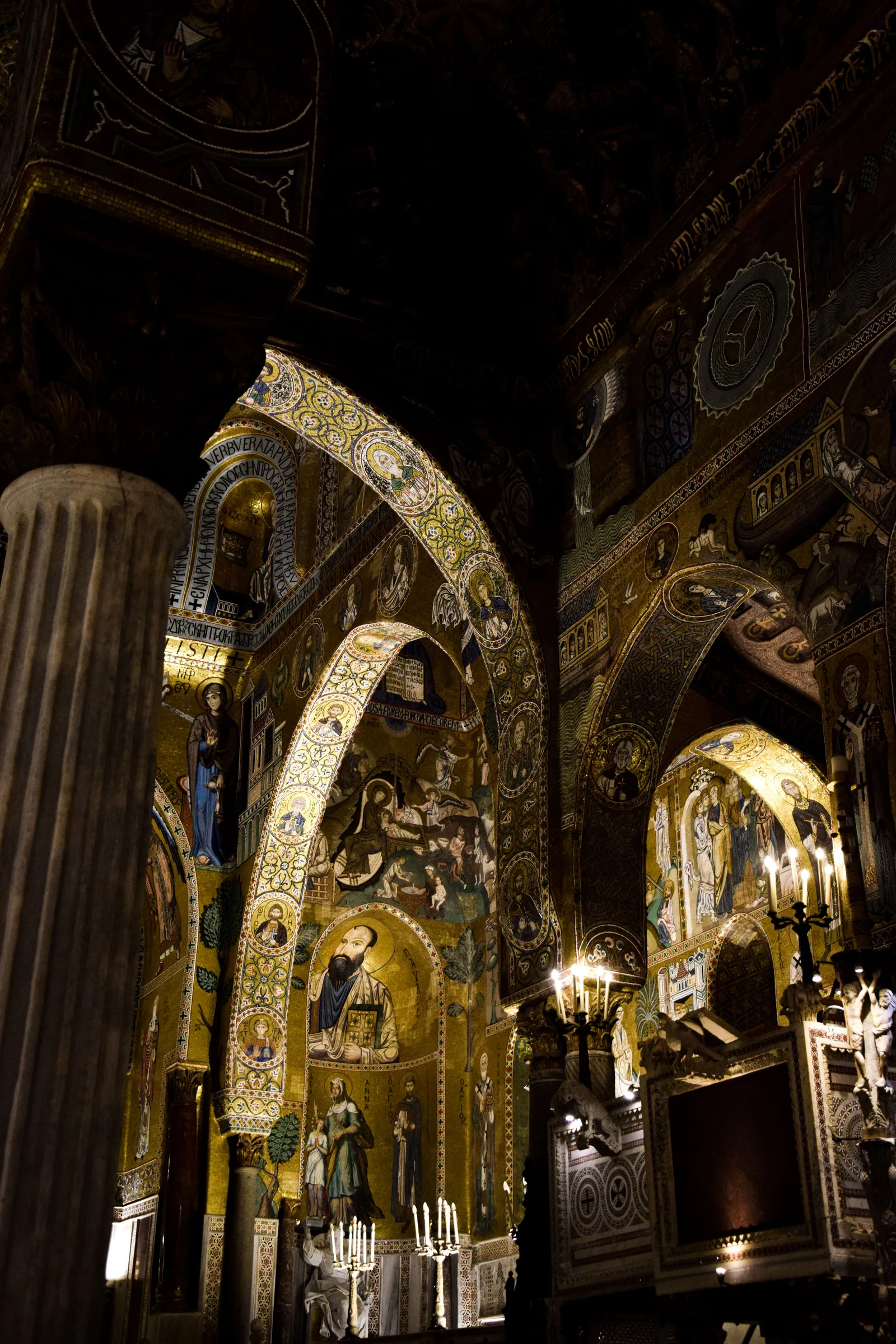
A lot of visitors get this one wrong — not because the chapel disappoints, but because they show up on the wrong day or at the wrong hour and end up facing a closed door or a queue instead. That’s a shame, because ten minutes inside this room is one of the best things you can do in Palermo. So before the history, let’s fix the part that actually goes wrong.
What makes the Cappella Palatina so special?
Roger II, the first Norman king of Sicily, had this chapel built inside his royal palace starting in 1132. What he ended up with is something that shouldn’t really exist: a Latin-rite Catholic chapel, laid out like a Byzantine church, covered floor to ceiling in gold mosaics made by artisans from Constantinople, under a wooden ceiling carved by Islamic craftsmen in the muqarnas style you’d expect to find in Cairo or Cordoba, not in a European palace. Three civilizations that rarely built anything together did, here, at the same time, for the same patron.
The mosaics themselves are the reason people travel across the city for this: scenes from Genesis and the life of Christ, done in the same gold-ground technique as Byzantine masterpieces, but installed by teams working under a Norman king who wanted his court to look like the most sophisticated place in the Mediterranean — and for a while, it was. It’s this layering, not any single element, that makes UNESCO list it together with Palermo Cathedral and Monreale as one entry: “Arab-Norman Palermo and the Cathedral Churches of Cefalù and Monreale.”
The palace around the chapel is worth a mention too, if only because it explains half of what makes visiting here unpredictable: since 1947, the building has been the seat of the Sicilian Regional Parliament (Assemblea Regionale Siciliana). You are, quite literally, visiting a working government building. That’s not a footnote — it directly affects when you can go in.
Opening hours, and the ticket detail almost nobody mentions
The Palazzo Reale and Cappella Palatina are open Monday to Saturday from 8:30am to 4:30pm (last entry), and Sundays and holidays from 8:30am to 12:30pm (last entry). Closed only on 25 December and 1 January.
Here’s the part that actually matters for your wallet: on Tuesdays and Wednesdays, the Royal Apartments are closed to visitors because that’s when Parliament is in session — so on those two days you can only see the Cappella Palatina, and the ticket is cheaper accordingly: €15.50 full price instead of €19. From Thursday to Monday (plus holidays), when the apartments are included, it’s €19 full price, €17 reduced (EU teachers, ages 18–25), €15.50 for 65+, €11 for ages 14–17. An audioguide is €5 on top either way. Under-13s (with an adult), disabled visitors and their companions, and art/history students all get in free.
In other words: if the chapel alone is what you’re after — which, honestly, is most people — go on a Tuesday or Wednesday and save €3.50 without missing anything you actually came for.
One more timing trap: on Sunday mornings the chapel closes to visitors for roughly an hour, usually between about 9:45 and 11:15am, for Mass — it’s still a functioning place of worship, not just a monument. If you’re planning a Sunday visit, go right at 8:30am opening or wait until after 11:15am, or you’ll be stuck outside during your one window before the shorter Sunday hours end at 12:30.
And because the building houses a working Parliament, sudden full or partial closures for institutional reasons do happen without much notice — rare, but worth knowing about if you’ve built your whole Palermo morning around this one stop.
Getting there
The Palazzo dei Normanni sits at Piazza del Parlamento (also called Piazza Indipendenza), at the far western end of Corso Vittorio Emanuele, in the Albergheria district — right by the Porta Nuova gate.
On foot, it’s about a 20-minute walk from Palermo Centrale station straight down Via Maqueda/Corso Vittorio Emanuele, and the walk is genuinely one of the best ways to see the old town, since you’ll pass the Quattro Canti and the Cathedral on the way. By bus, routes 104, 105 and 124 all stop at “Indipendenza,” right next to the palace. There’s also a small train station, Palermo Palazzo Reale-Orleans, a five-minute walk away, with a couple of trains an hour from Palermo Centrale.
If you’re already walking the Cathedral–Quattro Canti axis I described in my Palermo Cathedral guide, just keep going west on the same street. It’s a natural extension of that same walk, not a separate trip.
Practical tips for avoiding the crowds
This is one of the busiest single rooms in Palermo — it’s small, and every cruise-ship day-tour and coach group has it on the list. Go right at 8:30am opening if you can; by mid-morning, tour groups fill the chapel and you’ll be shuffling past mosaics rather than looking at them. Late afternoon, an hour or so before last entry, is the second-best window, once the big groups have moved on to lunch.
Budget 45 minutes to an hour for the chapel alone, longer if your ticket includes the Royal Apartments (worth adding if you’re not visiting on a Tuesday or Wednesday — the apartments’ Sala di Ruggero, with its own Norman-era mosaics of hunting scenes, is a genuine second highlight most visitors skip). It’s a working government building, not a ruin, so there’s no getting lost or wandering off-path — everything is set out clearly for you.
My honest verdict
For the ten to fifteen minutes it actually takes to properly look up at the ceiling and around at the walls, the Cappella Palatina delivers more concentrated craftsmanship per square metre than almost anywhere else I’d send you in Sicily — including places that take a full day to see. The whole difficulty here isn’t the site itself, it’s arriving on the right day, at the right hour, with the right ticket. Get that part right, and everything else about the visit takes care of itself.
More on the city in the Palermo region guide.