Aci Castello: A Norman Fortress Built on 500,000-Year-Old Lava
 Daniele Bellia · 3 min read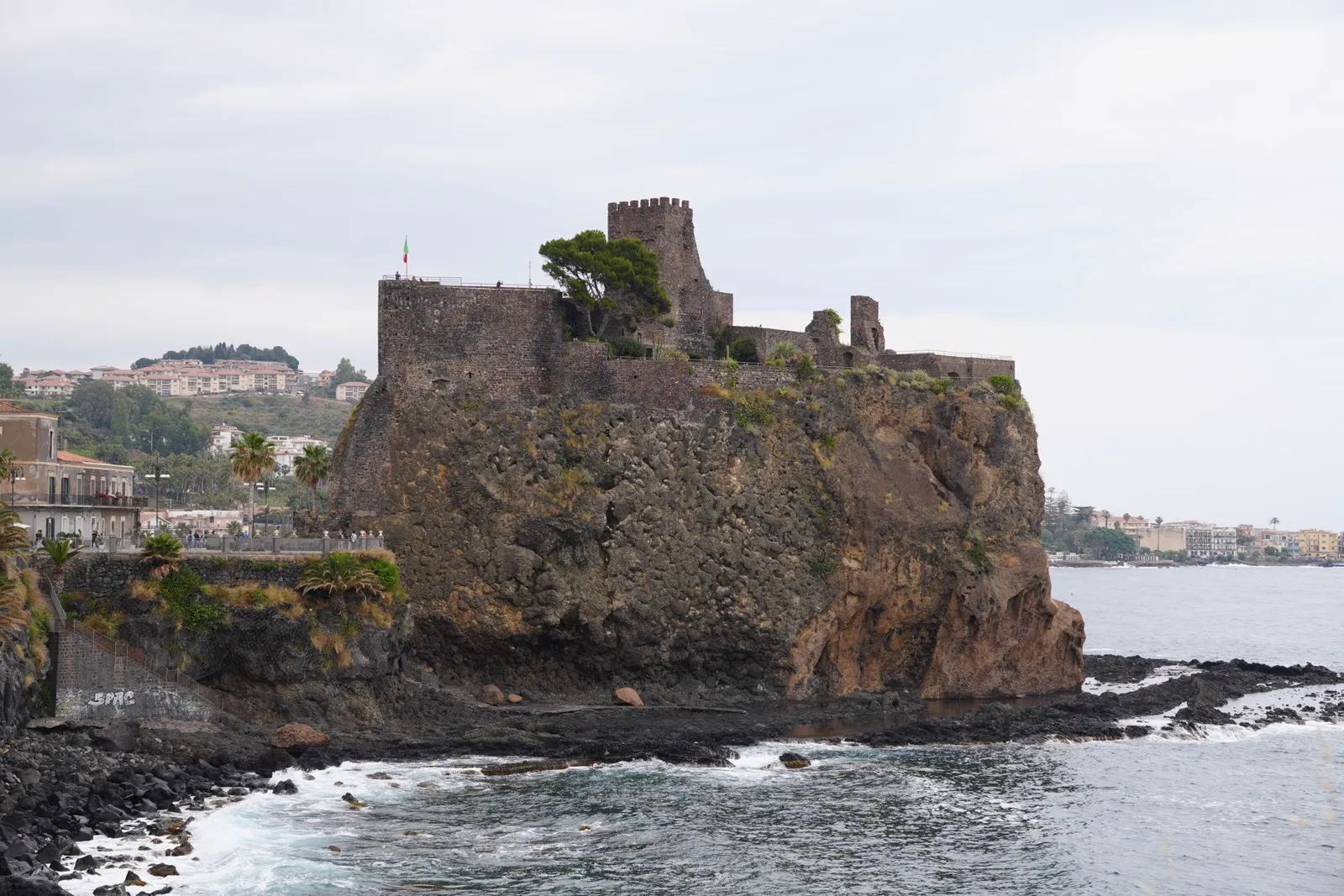
- Location: Aci Castello, ~9 km / 20 min north of Catania
- Cost: €3 full price, €2 reduced, free under 6 — includes the Museo Civico and terrace
- Hours: Tue–Sun 9:00–13:00 and 15:00–19:00 (summer afternoons often 16:00–20:00), closed Mondays
- Getting there: AMT bus or a 20-minute drive; pairs naturally with Aci Trezza, one stop further up the coast
- Good for: 1–2 hours
Most people driving the coast road toward Aci Trezza barely slow down for this one — a dark, jagged rock with a castle on top, gone in the rearview mirror before it registers. That’s a mistake. The rock itself predates the castle by half a million years, the fortress has been besieged twice, and the small museum inside is a genuinely worthwhile stop, not a formality tacked onto the ticket price.
A castle built on 500,000-year-old lava
The promontory the castle stands on isn’t ordinary rock — it’s submarine pillow lava, formed roughly 500,000 years ago when volcanic flows met the sea and cooled into the rounded, radiating basalt formations geologists call pillow lava. It’s the same volcanic basement that produced the Faraglioni dei Ciclopi at Aci Trezza just up the coast, predating Etna itself. The pillow-lava structure is genuinely easier to read from the water than from the castle walls, which is the main argument for a boat trip around the Cyclops’ stacks from Aci Trezza (affiliate link — booking through it costs you nothing extra and helps support this site) if you’re doing both towns in one go. The Normans didn’t choose this spot for the geology, though — they chose it because a sheer black rock rising straight out of the sea makes a fortress that’s nearly impossible to approach from three sides.
Built in 1076, and fought over more than once
Roger I — the Great Count who led the Norman conquest of Sicily — had the castle built in 1076 on top of an earlier settlement, using it to control the coast and watch for incursions from the sea. It didn’t stay quiet for long. In 1297 it passed to Frederick II of Aragon after belonging to the admiral Ruggero di Lauria, and in 1396 it became the site of a real siege: the baron Artale II Alagona rebelled against King Martin the Young and barricaded himself inside. The siege dragged on until the king found the castle’s water supply and cut it off — that, more than any assault, is what ended it. A few years later, in 1402, the castle briefly became a royal residence when Martin the Young moved in with his young wife, Bianca di Navarra.
What’s actually inside today
The castle now houses Aci Castello’s Museo Civico, established in 1985, with a small but genuinely varied collection: mineralogical and paleontological specimens, an archaeological section, and a display on the region’s volcanic rock (vulcaniti) — a nice, tangible follow-up to standing on 500,000-year-old lava a few minutes earlier. Admission also includes the upper terrace, which is the real payoff: an open, panoramic view up and down the Riviera dei Ciclopi coastline that you don’t get from the road below.
Practical tips
- When to go: any time of year — this isn’t a beach stop, so it doesn’t have the same summer crush as Aci Trezza next door.
- Hours: Tuesday to Sunday, roughly 9:00–13:00 and 15:00–19:00 (later in summer afternoons), closed Mondays — check the comune’s site before a special trip, hours shift seasonally.
- Time needed: an hour is enough for the museum and terrace; add time if you’re combining it with Aci Trezza.
- Combine it with: Aci Trezza is one stop down the coast — see our Aci Trezza guide for the Faraglioni, boat trips, and where to eat.
More on the area in the Catania & Etna region guide.