Valle dei Templi in Agrigento: What You Actually Need to Know
 Daniele Bellia · 6 min read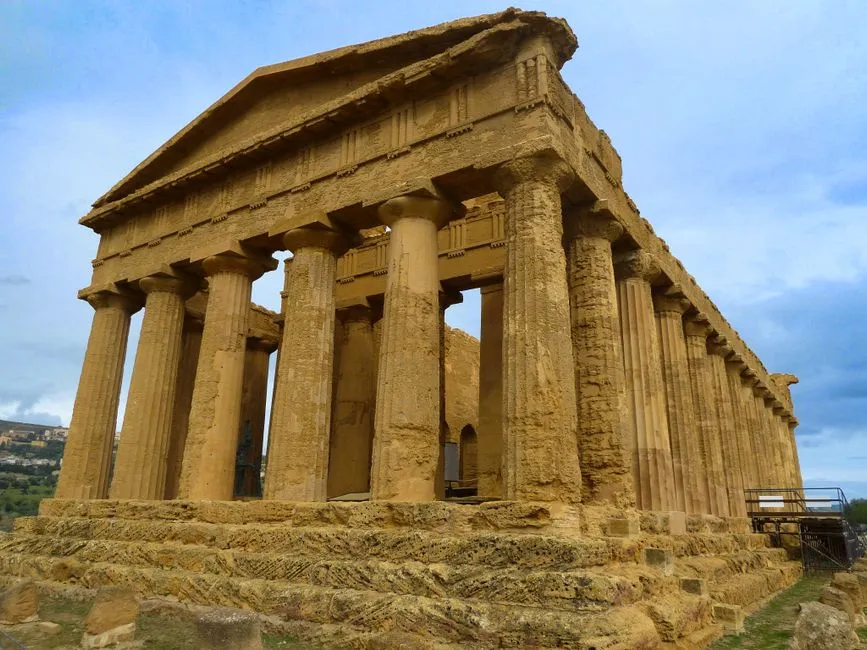
Say “Sicily” and “Greek temples” in the same sentence and you land on the Valle dei Templi almost automatically. Fair enough: with eight Doric temples strung along a single ridge, it’s the largest surviving cluster of Greek sacred architecture outside Greece, a UNESCO World Heritage site since 1997. What most short write-ups skip are the numbers that actually make a visit plannable — and a few facts that even printed guidebooks routinely get wrong.
Akragas: a city that was “the most beautiful built by mortals”
The city was founded around 580 BC by Greek colonists from Gela, joined by settlers from Crete and Rhodes, and named Akragas after the river that still carries that name today. The poet Pindar called it “the most beautiful city built by mortals.” Under the tyrant Theron in the 5th century BC, the temple complex you see today went up within a few decades, financed in part by the spoils of the victory over Carthage at Himera in 480 BC.
The Temple of Concordia: why it survived so well
The Temple of Concordia (built around 440–430 BC) is considered the best-preserved Doric temple in Sicily, and one of the best-preserved anywhere in the Greek world — six columns on the short sides, thirteen on the long sides, all still standing in their original positions. The reason is more mundane than most captions let on: it wasn’t luck, it was conversion into a Christian basilica in the 6th century under Bishop Gregory of Girgenti. It was only re-exposed as an ancient temple in 1748. And here’s a detail most brochures leave out entirely: we don’t actually know which god it was originally dedicated to. The name “Concordia” comes from a Latin inscription found nearby that has nothing to do with the temple itself — an attribution made by 16th-century historian Tommaso Fazello.
Temple of Juno: the same mistranslation as Concordia
The Temple of Juno (Tempio di Giunone, c. 450 BC), perched on the highest point of the site, also carries a name that’s probably wrong: it stems from a misreading of a passage by Pliny the Elder that actually refers to a Hera temple near Crotone in Calabria. Of its original 34 columns, 30 still stand, and visible scorch marks date from the Carthaginian destruction of Akragas in 406 BC.
The Temple of Zeus and its 8-meter stone giant
The Olympeion (Temple of Olympian Zeus) measured 113 by 56 meters, making it the largest Doric temple ever attempted — never finished, and today a field of toppled blocks. Its design was the spectacular part: instead of freestanding columns, up to 38 colossal stone giants, or telamons, held up the entablature, each roughly 7.7 meters tall. One was re-erected in 2024 after 20 years of restoration and now stands within the site itself; a second, original one is on display in the Archaeological Museum.
The museum and the Kolymbethra garden aren’t optional
The Museo Archeologico Regionale “Pietro Griffo” sits right inside the park grounds, in a former Cistercian abbey, and holds over 5,600 artifacts, including a second telamon and the “Ephebe of Agrigento,” a youth carved in the severe style considered one of Sicily’s most important pieces of Greek sculpture. Hours: daily 9:00 am–7:30 pm (last entry 7:00 pm), admission €10 (reduced €5). Skip the museum and you miss the one chance to see a telamon up close — the reconstruction out in the park is held together by a steel support frame.
The Giardino della Kolymbethra, managed by FAI (Italy’s National Trust equivalent), sits in a deep gorge between the temples — originally an ancient water reservoir, now a citrus and almond grove riddled with underground Greek-Roman channels (the ipogei) you can tour on a 40-minute guided walk. Entry is separate: €6 (children 6–17: €2), only available combined with the park ticket. Visitors who photograph two or three temples and leave often never see this part — the shadiest, quietest stretch of the whole site.
Opening hours and prices for 2026
The park is open daily from 8:30 am to 7:00 pm (visitors must exit by 8:00 pm). Ticket prices: park only €14 (reduced €7), combined park + museum ticket €19.60 (reduced €9.60), combined park + Kolymbethra ticket €20 (reduced €12). EU citizens aged 18–25 pay half price, and entry is free under 18. On the first Sunday of every month, admission is free until 7 pm — expect noticeably larger crowds on those days.
From June through September (in 2026: June 20 to September 20), the park adds evening and night openings: on weekdays until 10 pm (exit by 11 pm), and on holidays even until 11 pm. Seeing the temples at sunset and under artificial lighting, without tour buses and without the heat, is, in my experience, a considerably better option than the mid-morning visit most tourists default to.
What guidebooks get wrong
One common myth: that you can “do” the temples in an hour. The main path runs about 3 kilometers, mostly without shade. Realistically, budget 3 to 4 hours for the park, plus 1 to 2 hours for the museum. The second myth concerns the temple names themselves — as covered above, “Concordia” and “Juno” are modern attributions, not their original ancient names. Knowing that changes how you read the info panels on site — which is exactly the kind of context a good guide fills in on the spot; if you’d rather have someone walk you through it in person than read it off a plaque, here’s a private guided tour of the park (park ticket booked separately) (affiliate link — costs you nothing extra and helps support this site).
Getting there from Catania
There’s no direct train from Catania to Agrigento — the rail route runs via Messina and Termini Imerese and takes over seven hours. The practical option is the long-distance bus: SAIS Trasporti runs several times daily from Catania (Via D’Amico) to Agrigento (Piazzale Rosselli), taking about 2 hours 50 minutes, from roughly €13–18. From Agrigento’s bus station, city TUA lines 1, 2, and 3 run directly to the park entrance, or it’s about a ten-minute taxi ride. By rental car, the route via the A19 motorway and SS 640 (“Strada degli Scrittori”) takes around two hours and gives you more flexibility, especially for the evening openings. If you’re factoring this into your Sicily trip cost planning, budget roughly 1.5 to 2 hours of pure driving time each way for a day trip from Catania.
Best time to visit
Spring (March to May) is the nicest season: mild weather, and in late February/early March the town holds its traditional Almond Blossom Festival (Sagra del Mandorlo in Fiore) — though a common misconception is that you need to time your trip around it to see blossoming almond trees; depending on the year’s weather, the actual bloom is often already over by the time the festival starts. In peak summer (July/August), I’d specifically recommend the evening openings: with zero shade on the ridge during the day, temperatures easily climb to 35–40°C. Sturdy shoes, sun protection, and at least 1.5 liters of water per person absolutely belong on your packing list for this trip, and it’s worth considering whether staying overnight in Agrigento makes more sense than driving back the same day — see our guide to where to stay in Sicily for more, or go straight to.