Noto: the Baroque Town That Had to Rebuild Itself Twice
 Daniele Bellia · 6 min read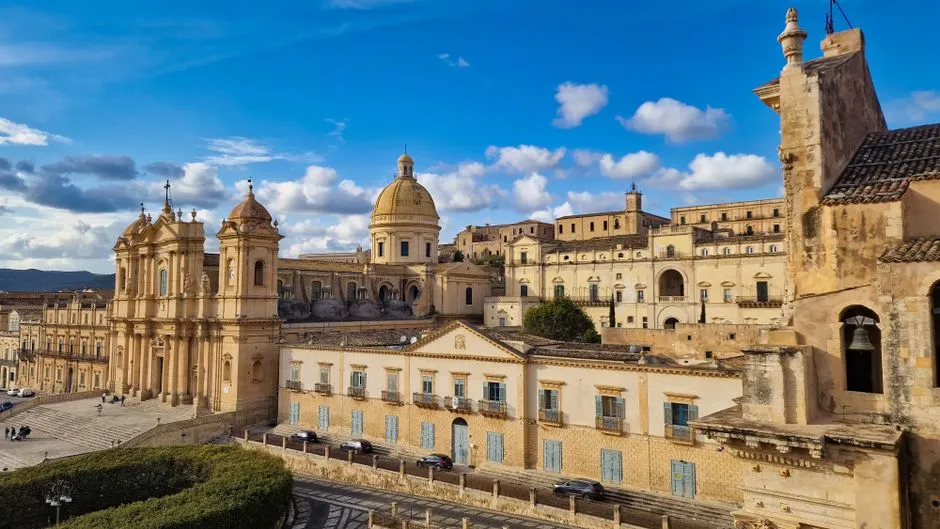
When I bring visitors from Germany through Noto, almost everyone stops in the same spot: on the cathedral steps, where the honey-colored limestone shifts from gold to pink depending on the hour. What most people don’t know is that this staircase and the façade behind it essentially didn’t exist for eleven years, starting in 1996. Noto isn’t just another Baroque town in the Val di Noto — it’s the town that shows what happens when an entire community starts completely over after a disaster, and what happens when someone cuts corners on structural engineering decades later. Neither story makes it into the brochure.
A town built on a blank slate
Modern Noto doesn’t stand where the original Noto stood. After the devastating earthquake of January 11, 1693, which flattened much of eastern Sicily, the people of Noto decided not to rebuild on the ruins of the old hilltop town, Noto Antica, but to start fresh about 8 kilometers away, closer to the coast, on a gentler slope. That decision gave the architects — chiefly Rosario Gagliardi, Vincenzo Sinatra, and Paolo Labisi — something Ragusa and Modica never had: a completely blank building site, with no old lanes to work around. Giovanni Battista Landolina laid out a regular street grid anchored by one clear main axis, Corso Vittorio Emanuele, along which churches, palazzi, and terraces line up like beads on a string.
The result is a coherence you won’t find in Ragusa Ibla or Modica: there, Baroque architecture grew on top of a medieval street plan; here, it was designed on a blank drawing board. Once you’ve seen all three towns, the difference is obvious — Ragusa feels organically grown, Modica dramatically squeezed into its river valley, and Noto reads almost like an architectural manifesto. That’s exactly why Noto isn’t a substitute for a day trip to Ragusa and Modica — it’s a complement. Three towns, three different answers to the same catastrophe.
The cathedral that collapsed in 1996
The Cattedrale di San Nicolò, perched atop its wide flight of steps, is the town’s emblem — and its recent history is more dramatic than most guidebooks let on. Construction began in the early 1700s to designs by Rosario Gagliardi, though the building wasn’t actually finished until 1776, under Bernardo Labisi. During a 1950s restoration, workers replaced the original lightweight pitched roof over the nave with a heavy structure of brick and concrete — a decision that quietly overloaded the structure for decades without anyone noticing.
On March 13, 1996, a large part of the cathedral came down: four piers along the south aisle, one of the four piers supporting the dome, the entire roof and vault of the nave, and three-quarters of the dome itself, lantern included. The likely trigger was a 1990 earthquake that had already weakened the structure, combined with that same overly heavy 1950s roof finally giving way. Restoration took eleven years — Bishop Giuseppe Malandrino formally reconsecrated the rebuilt cathedral on June 15, 2007, with a new dome built to modern structural standards. Stand under it today and you’re technically standing inside a building younger than plenty of the people visiting it.
Practical info: admission runs around €2, or about €2.50 with the small diocesan museum included. Open daily, roughly 9am to 7pm with a midday break — budget 15 to 20 minutes for the interior itself; the real showstopper is the façade from outside.
Photo: Daciana Cristina Visan, via Pexels
Palazzo Nicolaci and the balconies everyone photographs
A short walk up Via Corrado Nicolaci is Palazzo Nicolaci di Villadorata, completed in 1737 for the aristocratic Nicolaci family. What sets it apart from every other Baroque palazzo in Sicily is its six wrought-iron balconies: each rests on carved stone brackets whose figures change from balcony to balcony — griffins, horses’ heads, mermaids, bare-bottomed cherubs, lions. No two brackets are quite alike, almost like a quiet competition among the stonemasons of the time.
Inside, for around €4, you can tour nine furnished rooms of the Piano Nobile, including the family’s original furniture and ceiling frescoes. A combined ticket with the town hall, Palazzo Ducezio, and the small Teatro Comunale usually runs around €10. Budget 30 to 45 minutes for the palazzo. This same street transforms once a year into an actual work of art: the Infiorata di Noto, held every year in mid-May, when flower artists carpet the length of Via Nicolaci with temporary images made from millions of petals. In 2026 it runs May 15 to 19, theme “La Cultura Pop si racconta” — the designs go down on the Friday, viewable Saturday morning through Tuesday evening, admission around €5. If you’re in Sicily during that window, it’s worth the detour; the petals get swept away right after, until the following year.
What you can realistically see in a day
Noto is entirely walkable — the old town runs along Corso Vittorio Emanuele, a bit over a kilometer long, flanked by the cathedral, the town hall Palazzo Ducezio with its elegant mirrored hall, the oval-shaped church of Santa Chiara (rooftop terrace, one of the best views over town), and Palazzo Nicolaci. Realistically, the cathedral, Palazzo Nicolaci, and a wander down the Corso take about 3 to 4 hours; add a coffee break on Piazza XVI Maggio and it fills closer to half a day. If you have extra time, Noto Antica — the abandoned ruins of the original hilltop town — sits about 10 kilometers away and is only reachable by car or organized tour, more of a “next trip” stop than a must-see.
How to get there without a car
From Siracusa, Noto is by far the easiest day trip: AST buses run several times a day (around 4 connections), taking just under 55 minutes, from about €3.60 one way, departing from Corso Umberto near the train station. That makes the Siracusa region a much better base for a Noto day trip than Catania. From Catania, the direct Interbus service takes around 2 hours and costs roughly €11–13, with a faster AST alternative closer to 1 hour 15 minutes when it skips intermediate stops. Skip the train — with no direct connection, you’d change in Syracuse and end up spending around 2.5 hours: slower and pricier than the bus.
You won’t need a car within the town itself; vehicles don’t really belong in the narrow Baroque lanes anyway, and the handful of parking areas on the outskirts are clearly signposted. If you’re folding Noto into a longer Sicily trip, you’ll find realistic budget ranges for accommodation, food, and transport in our trip cost guide.
My final piece of advice
Most day tours pair Noto with Ragusa or Modica — which works, but only if you don’t squeeze Noto down to a rushed two hours. Come early, before the coach tours from Catania roll in around 11am, and stay until late afternoon, when the light on that honey-colored stone is at its warmest. And if you take away just one thing: don’t just pose for a photo on the cathedral steps — remember you’re standing on a building that had to be built twice, once in 1776, once in 2007. That’s precisely why Noto never feels like a museum piece despite its uniformity: this is a town that knows exactly how fragile beauty can be, and rebuilt just as beautifully anyway.