Enna: The Highest Provincial Capital in Italy, and Where the Seasons Were Invented
 Daniele Bellia · 7 min read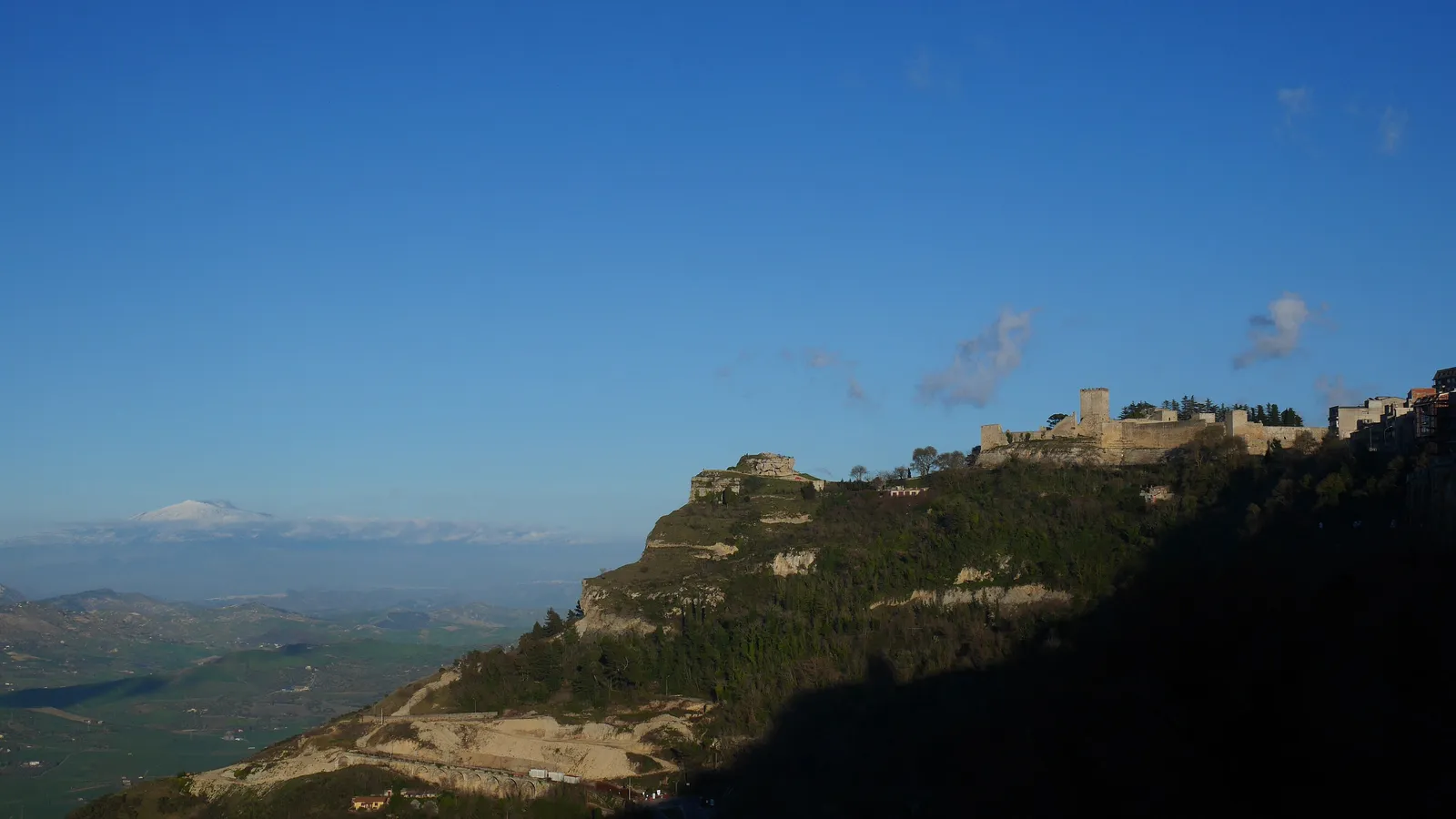
- Location: Enna, dead centre of Sicily, 970m above sea level
- Why it matters: the highest provincial capital in Italy — and the only place you can see both sides of the island from one wall
- The main sight: Castello di Lombardia, one of the largest medieval castles in Italy
- Castle hours: roughly 10:00–19:00 April to September, 9:00–17:00 October to March
- Critical detail: the railway station is at Enna Bassa, 5km below and 400m down from the old town
- How long you need: half a day, or a full day with Piazza Armerina
Sicily’s tourism runs along its coasts. Almost every visitor traces the same ring — Palermo, Trapani, Agrigento, Siracusa, Taormina — and the middle of the island stays a blank they drive through on the motorway.
Enna is what is in that blank, and it is not a village. It is a provincial capital sitting at 970 metres, the highest in Italy, on a ridge so commanding that every power that ever wanted Sicily had to take it first: Sicani, Greeks, Romans, Byzantines, Arabs, Normans, Swabians.
On a clear day you can see the Tyrrhenian in one direction and Etna in the other, from the same set of walls.
The castle that held the first Sicilian parliament
The Castello di Lombardia is the reason to come. It is one of the largest medieval castles in Italy — a sprawling fortress spread along the ridge rather than a single compact keep — and it is among the best preserved on the island.
It once had twenty towers. Six survive. The one to climb is the Torre Pisana, also called the Tower of the Eagles, because the view from the top is the thing Enna is actually famous for locally: the Belvedere di Sicilia, the balcony of Sicily, from which sentries could watch a huge share of the island at once.
Its real historical weight is quieter than its size. Frederick II convened the first Sicilian parliament here — a fact that gets a sentence in guidebooks and deserves more, given that it happened in a castle most visitors to Sicily have never heard of.
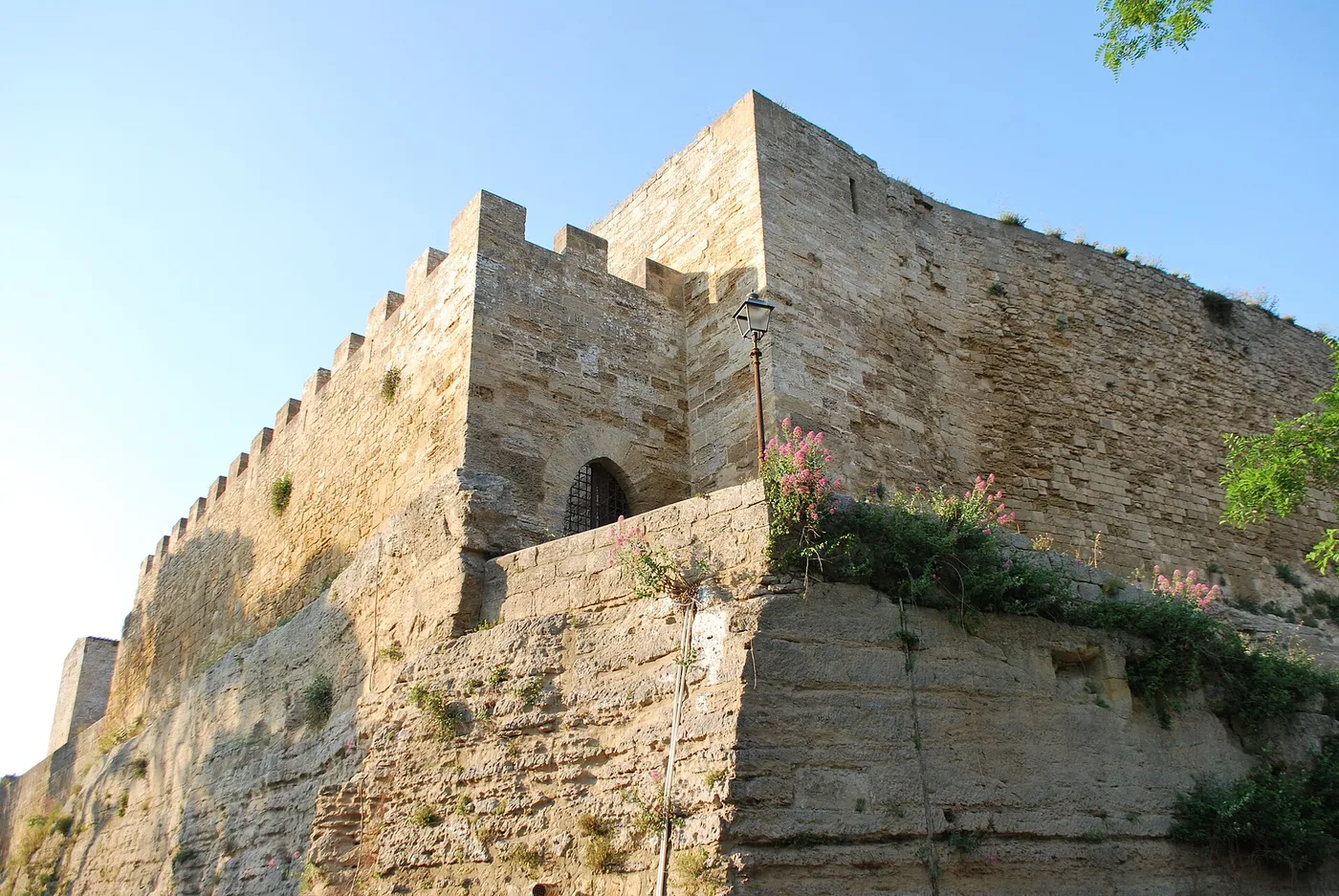 Photo: Sweetie candykim, via Wikimedia Commons (CC0)
The altar that never stopped being used
Facing the castle across the highest point of the ridge are the remains of the Rocca di Cerere — Ceres’ Rock, named for the Roman form of Demeter.
What is up there is a rock-cut sacrificial altar, and the remarkable thing about it is the continuity: it was used for over a thousand years, by Sicani, then Greeks, then Romans, in the cult of the same goddess under changing names. Not a site that was built, abandoned and excavated — a site that was simply used, without a break, longer than most European countries have existed.
Enna was the centre of Demeter’s cult in the ancient Mediterranean. There is a reason for that, and it is a few kilometres downhill.
Where the seasons come from
Just south of town lies Lago di Pergusa, and according to Ovid this is the spot.
Persephone — Proserpina to the Romans — was gathering flowers by this lake with the daughters of Oceanus when the ground split open, and Hades came up through it in a golden chariot and took her. Demeter, her mother, searched the earth for her and let everything die while she grieved. The bargain that ended it gave Persephone back for part of the year and left her underground for the rest.
That is the myth the ancient world used to explain why there is winter. And it is set here, at a small lake in the middle of Sicily, which is why the goddess of the harvest had her greatest sanctuary on the ridge above it.
Be realistic about visiting, though. Pergusa is a natural lake that has struggled badly with drought, and it is ringed by a motor-racing circuit — the Autodromo di Pergusa runs right around the water. Go for the idea and the setting, not expecting an unspoiled mythological pool.
Enna Alta and Enna Bassa: get this wrong and your day is ruined
This is the single most important practical thing on this page.
Enna is two places. Enna Alta is the historic city on top of the ridge — the castle, the cathedral, the views, everything you came for. Enna Bassa is the modern town at the bottom.
The railway station is at Enna Bassa. It is around 5km away and roughly 400 metres lower, up a series of hairpins. Arriving by train and expecting to walk into the old town is a mistake that costs you either a long uphill hike or a taxi you did not budget for. There are local buses and taxis at the station — check times before you travel, because service is not frequent, and this is not a place where one turns up every ten minutes.
If you are driving, ignore all of the above and go straight up. That is what nearly everyone does, and it is genuinely the easier way to see central Sicily.
The rest of the old town
The Duomo is worth thirty minutes: founded in the fourteenth century, rebuilt after a fire, with a heavy dark-wood ceiling and columns whose bases are carved with strange serpent-and-human figures that nobody fully explains.
The Torre di Federico II stands alone in a public garden at the other end of town — an octagonal tower, unusual and slightly mysterious, echoing the geometry of Castel del Monte in Puglia. It is a short walk and a good counterweight to the castle at the opposite end of the ridge.
Beyond that, Enna is a working provincial capital rather than a tourist town. There is no polished old-town circuit. That is precisely why it is quiet.
Practical tips before you go
- Check castle hours before driving up. Broadly 10:00–19:00 in summer, 9:00–17:00 in winter, but sources disagree on the ticket — some list free entry, others around €3. Carry a few euros and do not be surprised either way.
- Dress for altitude. At 970m Enna is genuinely cooler than the coast, often by several degrees, and can sit inside cloud when Catania is baking. In winter it is cold, and it snows. That is not a figure of speech.
- The view is weather-dependent. The whole point is the panorama, so a hazy day costs you the main attraction. Clear, dry days after rain are best.
- Combine it with Piazza Armerina. The Villa Romana del Casale and its mosaics are about 35km south, and the two together make a proper day in the interior — the reason most people finally leave the coast road.
- Do not plan on dinner. This is a small capital, not a nightlife town; eat lunch here and sleep somewhere larger unless you specifically want the quiet.
My honest verdict
Enna will not compete with Taormina or Ortigia on charm, and it does not try to. It has no seafront, no baroque parade of terraces, no scene.
What it has is position — the single most defensible, most commanding spot on the island, held for three thousand years by everyone who ever ruled Sicily — plus a castle big enough to have hosted a parliament, and an altar to a goddess used continuously from prehistory to Rome. And almost nobody goes.
If your Sicily trip is entirely coastal, one day inland here changes the shape of the island in your head. It stops being a ring road and becomes a place with a middle.
Planning central Sicily? Our interactive map of Sicily has Enna pinned alongside Piazza Armerina, Villa Romana del Casale and Morgantina — more at sicily-insider.com.