Savoca: The Godfather Village Locals Call "The Town with Seven Faces"
 Daniele Bellia · 6 min read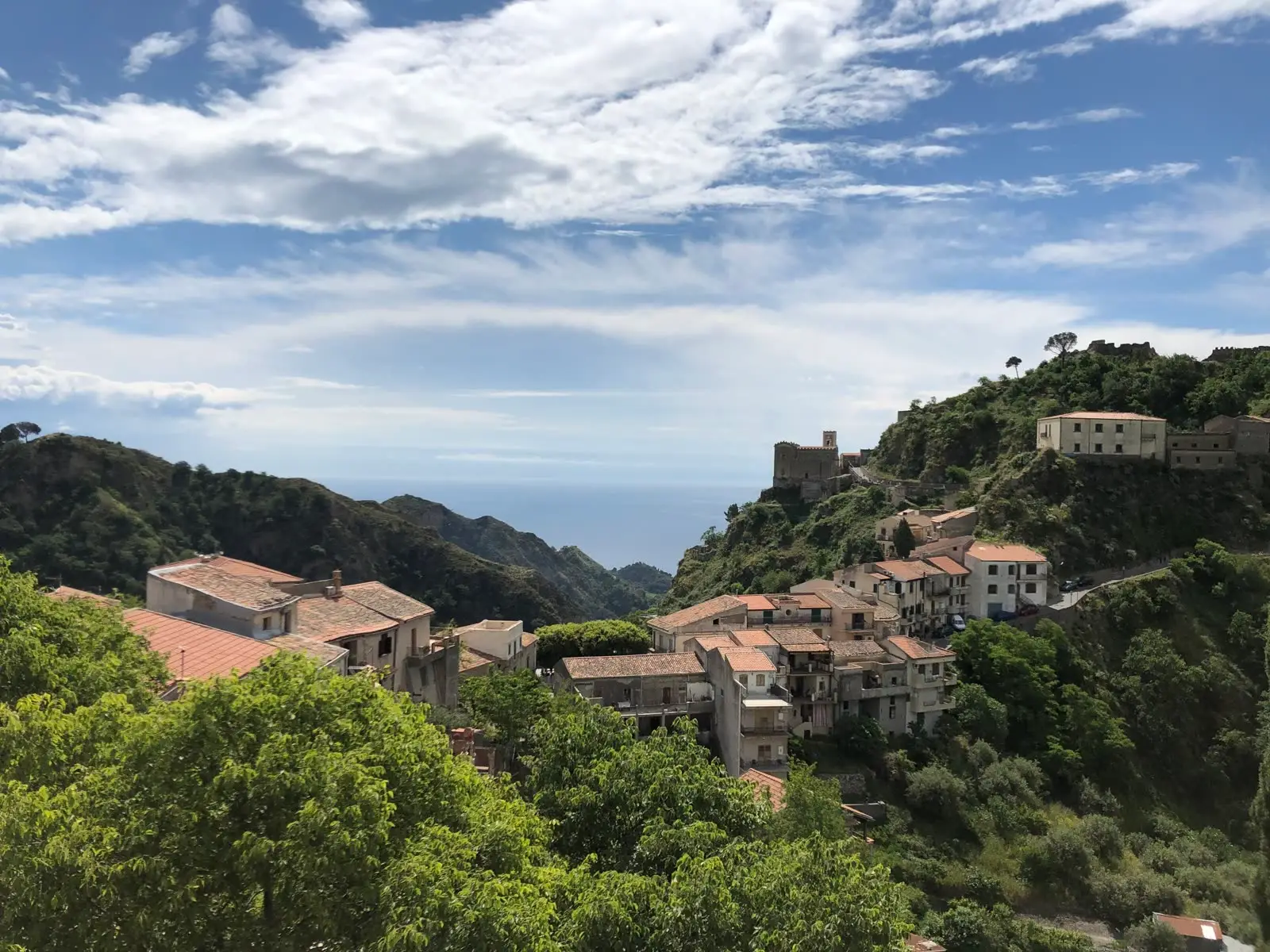
- Location: hilltop village in the Valle d’Agrò, about 4km inland from the Ionian coast, 30-45 minutes from Taormina
- Getting there: Interbus runs from Taormina roughly 3 times a day (~45 min, from €2); driving takes about 30 minutes
- Cost: the Capuchin crypt is free (donations welcome); Bar Vitelli and the churches cost nothing to look at, only to eat or drink
- Time needed: 2-3 hours covers the whole village on foot
- Good for: Godfather fans, but also anyone who wants a genuinely quiet medieval hill town without the Taormina crowds
When Francis Ford Coppola scouted Corleone for The Godfather in 1971, he found a town that had already modernized — paved roads, newer buildings, nothing that looked like 1945 Sicily anymore. So the production moved east, to a cluster of villages in the Valle d’Agrò that had barely changed at all. Savoca got the wedding. Its church steps, its bar, and its silence are the reason Michael Corleone’s Sicilian exile looks the way it does on screen — and unlike a lot of film-tourism spots, what you see when you visit is still essentially the same place Coppola pointed a camera at in August 1970.
The town with seven faces
Locals call Savoca “u paisi dî setti facci” — the town with seven faces — because it’s built across a jagged ridge where the view genuinely changes with every turn: sea on one side, the Valle d’Agrò’s terraced hills on the other, church towers and a ruined castle popping in and out of view depending on which street you’re on. The name Savoca itself most likely comes from the dialect word sauca, from the medieval Latin sabucu — elderberry, a plant that apparently grew thickly on the hillside long before anyone built on it.
The site has been inhabited since Roman times, but what actually shaped the town was the Byzantine period, when the original settlement was organized into five distinct districts. Arab rule reinforced the hilltop fortifications in the 9th century, and when the Normans took Sicily, Roger II turned the town’s castle into a summer residence around the 12th century — the same era that gave Savoca its finest church. Under the Kingdom of Sicily, Savoca became the administrative center of the whole Valle d’Agrò and the surrounding Ionian coast, and its wealth peaked between the 15th and 18th centuries: churches, noble palazzi, and a level of political and religious prestige well beyond what its size today suggests. The 19th century reversed all of it — economic decline sent the population trickling down to the coastal towns below or abroad entirely, leaving the hill largely as it was, which is exactly what Coppola’s crews found waiting for them two centuries later.
Castello di Pentefur: a Norman summer palace, dismantled by its own town
At the top of Savoca’s ridge sit the ruins of the Castello di Pentefur. The name comes from Greek — pente (five) and fulè (district) — a direct reference to the five Byzantine-era quarters the castle once anchored. Historians place its origins in the late Byzantine period, with a major rebuild under Arab rule in the 9th century and a second one under the Normans in the 12th, when Roger II converted it into a summer residence. It didn’t survive Sicily’s two worst earthquakes: badly damaged in 1693, then finished off by the 1783 quake, which collapsed what was left for good. What happened next is the part most visitors never hear — for decades afterward, Savocesi literally dismantled the ruins stone by stone to build their own houses, which is why so little of the original structure survives today. What remains is still worth the climb for the view alone: the same ridge-and-sea panorama that makes the whole “seven faces” name make sense.
Bar Vitelli: where Michael Corleone asked for Apollonia’s hand
The single most-photographed spot in Savoca is Bar Vitelli, an 18th-century building in the town center that Coppola used almost unaltered for one of the film’s most quoted scenes: Michael, hiding out in Sicily, walks in and asks the bar’s owner for permission to court his daughter Apollonia. The beaded curtain across the doorway is still there. So is a small wall of production photos and memorabilia inside. It’s a real, working bar — order something (a granita or a coffee is the easy move) and the staff are used to fans lingering for photos at the same tables used in the film. It’s not a museum charging admission; it survives as an actual bar that happens to be famous, which is part of why it hasn’t been over-polished into a theme-park version of itself.
The church steps from the wedding scene
A short walk from Bar Vitelli is the Chiesa di San Nicolò, whose front steps and churchyard were used for the wedding-related scenes filmed in August 1970. It’s easy to miss if you don’t know what you’re looking at — there’s no plaque shouting about it — which is honestly part of the appeal. Savoca’s real showpiece church, though, is a different one: Santa Maria in Cielo Assunta, built by the Normans around 1130, predating the Godfather connection by eight centuries and worth a look on its own merits regardless of what’s filmed where.
The Capuchin crypt: 37 mummified Savocesi, on display since the 1700s
Beneath the small square in front of the Capuchin convent — founded in 1574, rebuilt in its current form in 1614 — sits Savoca’s strangest attraction: a crypt containing the mummified remains of 37 people, created in the early 18th century as a burial place for the town’s aristocracy. The bodies belong to lawyers, notaries, priests, monks, landowners, a noblewoman, and three children — the wealthy and powerful of 18th-century Savoca, preserved rather than buried in the ground. The process, called natural desiccation, took about sixty days: the body was first immersed for two days in a salt-and-vinegar solution, then moved to a putridarium in the mother church where air currents drained the remaining moisture over weeks. Entry is free, though a donation toward the crypt’s upkeep is expected and appropriate. Photography is not allowed, and it’s visited in silence — this isn’t a curiosity display, it’s still, technically, a burial site for people whose descendants may well still live in town.
Getting there from Taormina
Interbus runs a direct line from Taormina to Savoca roughly three times a day, taking about 45 minutes, with tickets from around €2 if booked ahead — genuinely one of the easier hill-town day trips in the region if you don’t have a car. Driving takes about 30 minutes and gives you more flexibility, particularly useful if you want to pair Savoca with the neighboring village of Forza d’Agrò, another Godfather filming location a short drive further into the hills.
Planning your visit
Two to three hours covers Savoca on foot at an unhurried pace: the walk up to Castello di Pentefur, Bar Vitelli, San Nicolò’s steps, Santa Maria in Cielo Assunta, and the Capuchin crypt, with a granita break worked in somewhere along the way. There’s no real off-season crush here the way there is in Taormina — Savoca stays quiet even in August, which after a few days of Sicily’s busier coastal towns is honestly the main reason to come, Godfather connection or not. Wear real shoes; the streets are cobbled and the climb to the castle ruins is uneven underfoot.
See Savoca plotted against the rest of the Taormina area on our interactive Sicily map, and pair it with a trip to Taormina itself or Castelmola if you’re basing yourself on the coast.