Catania Without a Car: Etna, Beaches & Taormina by Bus
Every time friends visiting from Germany ask whether they absolutely need a rental car for a few days in Catania, I tell them the same thing: no, unless you want to head into the inland areas or reach the more remote beaches in the south. For Etna, the sea, and Taormina, buses and trains work perfectly well — you just need to understand how the system here actually functions, because it’s fundamentally different from what you’re used to on German public transport. There’s no live Google Maps tracking, no service every fifteen minutes, but the buses are more punctual than you’d expect, as long as you know the one trick: show up early.
To Etna: the AST bus from Piazza Giovanni XXIII
The only public bus that actually takes you up the volcano is the AST (Azienda Siciliana Trasporti) line. It departs from Piazza Giovanni XXIII in Catania at 8:15 am, and the return bus leaves Etna (Rifugio Sapienza) for Catania at 4:30 pm . That’s the same square where the main train station is located, so finding it isn’t a problem.
The ride takes about two hours , and a round-trip ticket costs around 6.60 euros , paid directly to the driver. Here’s something nobody tells you until you’ve experienced it yourself: there’s only this one departure per day — no second run, no afternoon bus back except the 4:30 pm one. Miss it, and you’re either stuck or paying a small fortune for a taxi down the mountain. During peak season in July and August, the bus genuinely fills up — I’d recommend being at the stop by 7:45 am at the latest, not just before 8:15. If you try to board at a later stop than the main terminal, you risk finding an entire scout troop has already taken every seat.
Once you arrive at Rifugio Sapienza (1,910 meters), you can either walk to the Silvestri craters (about ten minutes) or take the cable car further up. If you’re hoping to reach Etna’s north side, public transport won’t really get you there — that genuinely requires a car or an organized tour.
Alternative: the Circumetnea — but with a detour
The Circumetnea, the old narrow-gauge railway that loops almost all the way around the volcano, is popular among Sicily connoisseurs because it passes through towns like Adrano, Bronte, and Randazzo. What a lot of blogs haven’t updated, though: since June 17, 2024, train service on the Catania Borgo–Paternò stretch has been suspended due to construction work for the metro extension. So from Catania, you first need to take a replacement bus to Paternò before switching to the actual Circumetnea line toward Riposto. This isn’t a casual half-day trip — it’s a full day’s project — but it’s absolutely worth it for the scenery, as long as you’re not expecting a direct train ride up Etna but rather a scenic loop through the villages at its base.
To the sea: Playa, Ognina, and the Faraglioni of Aci Trezza
If you don’t want to go all the way to Taormina, there are perfectly good beaches right on the city’s doorstep — you just need to know which bus goes where, since the route numbers seem to change almost every season.
For the Playa, the long sandy beach south of the city, take lines D and 534 from Piazza Borsellino . For the rocky coastline heading north — Ognina, San Giovanni li Cuti with its black lava-sand beach right in the city — lines 421, 534, or 935 will get you there, depending on that day’s schedule.
And for Aci Trezza, home of the famous Faraglioni, the rock stacks legend attributes to Odysseus and the Cyclops: line 534 also runs there from Piazza Borsellino, and the ride takes about 40 minutes . Here’s something nobody mentions unless they’ve stuck around longer than a week: in summer, buses run roughly once an hour, though on public holidays that can shift considerably — in practice, that means you don’t plan down to the minute, you bring a book to the bus stop instead.
To Taormina: train beats bus, except for one thing
Here I’ll deliberately disagree with what almost every German Sicily blog says — that the bus is the only sensible option. That’s no longer true. A train ticket from Catania to Taormina costs around 6 euros, the ride takes about 38 to 44 minutes, and there are roughly 29 connections a day — a frequency that regional trains in Germany can often only dream of.
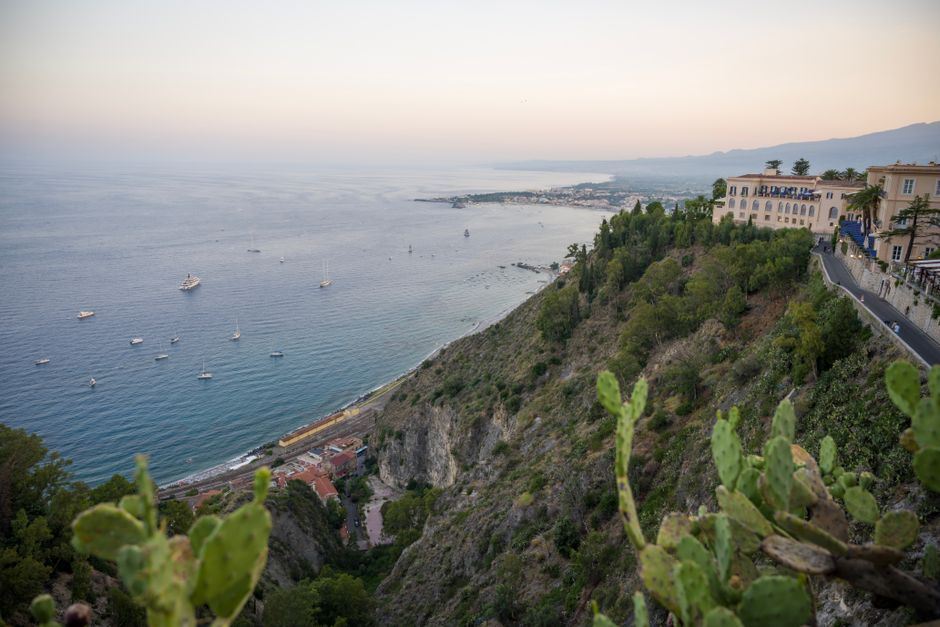
The one catch: the Taormina-Giardini station sits down by the sea, not up in the old town. From there, you can either walk up the steep hill (not ideal at 95°F in August), take the local bus, or use what’s called the Taormina Link, a combined connection where the ticket for the stretch from the station into the center of Taormina costs 2 euros , on top of your train ticket.
The bus (Interbus, usually departing from around Via D’Amico/Via Sturzo near the main train station) does have one advantage the train lacks: it goes all the way up into Taormina’s old town, so there’s no need to transfer once you’re up there. That said, it’s often not faster than the train, especially given heavy summer traffic along the coast road. My honest recommendation: take the train if you’re fit enough for the climb or traveling light; take the bus if you want to arrive directly up top or you’re hauling a suitcase.
Practical things that actually help
A few habits worth picking up quickly as a newcomer, so your day doesn’t fall apart:
- Carry cash. Buses in Sicily often sell tickets only through the driver, cash only, and having exact change isn’t something you can count on. Show up with a 50-euro note and you might just get an annoyed head-shake instead of your change.
- Sundays and holidays are a different world. Many lines, including the Circumetnea, run less frequently on Sundays and holidays, or not at all. If you’re planning an Etna trip or a hike for a Sunday, actually check ahead rather than assuming it’ll run like a weekday.
- Don’t blindly trust live-tracking apps. Moovit and similar apps show the routes, but actual departure times at smaller stops often don’t match up. The timetable posted at the stop itself (if there is one) or a quick word with a local is more reliable than your phone.
- Factor in the heat. Between June and September, it’s worth starting Etna trips or walks from train stations as early in the morning as possible — not for the romance of it, but because buses and platforms without air conditioning get genuinely unpleasant in the midday heat.
With these routes, you can get remarkably far without a car: the volcano, the sea, and Taormina are all doable — you just have to accept that the rhythm here runs differently than a German timetable would suggest. And honestly, that’s part of what Sicily is all about for me.