Etna Closed Due to Rain? Plan B for Catania
It happens more often than most travel blogs let on: you get up at seven, the sky over Catania is grey, and the weather app shows 50 km/h winds and rain up on Etna. Or you’re already at Rifugio Sapienza and the man at the counter simply says “chiusa per vento” — closed for wind. That’s not a disaster, it’s just how things go on the volcano — the cable car is a piece of machinery, not a hiking trail, and it’s sensitive to wind. The operators themselves point out that the system can be shut down for safety reasons in strong wind, thunderstorms, heavy rain, or volcanic activity , and that an automatic safety system halts operations if the wind gets too strong. If you’ve booked online, keep in mind: the cable car runs every day year-round, but service can change depending on weather or technical requirements .
Here’s something a lot of people don’t know: there’s a backup plan right on site. If the cable car is closed, replacement buses cover the first stretch — 4x4 buses take over and run from 1,920 m up to 2,500 m and back , as was the case during maintenance work in spring 2026. In other words: even if “the cable car isn’t running,” you might still make it up — just by bus instead of gondola, and with a bit more waiting around. Worth asking on site before you turn around and give up.
But if truly nothing is running — heavy rain, thunderstorms, the SP92 fully closed — then you need a day in Catania that doesn’t feel like a wasted day. Here it is.
When the Etna trip falls through: check the situation first
Before you rearrange your entire day, it’s always worth checking the live conditions, since wind and rain in the mountains often shift faster than down in the city. Rifugio Sapienza sits at over 1,900 metres, so it can be raining there while the sun’s out in Catania — or the other way round. If you’re already in Nicolosi or at the Rifugio and the cable car isn’t running, ask directly at the ticket counter whether the replacement buses are operating before you commit to the whole drive back to Catania.
Going underground: Catania has its own basement level
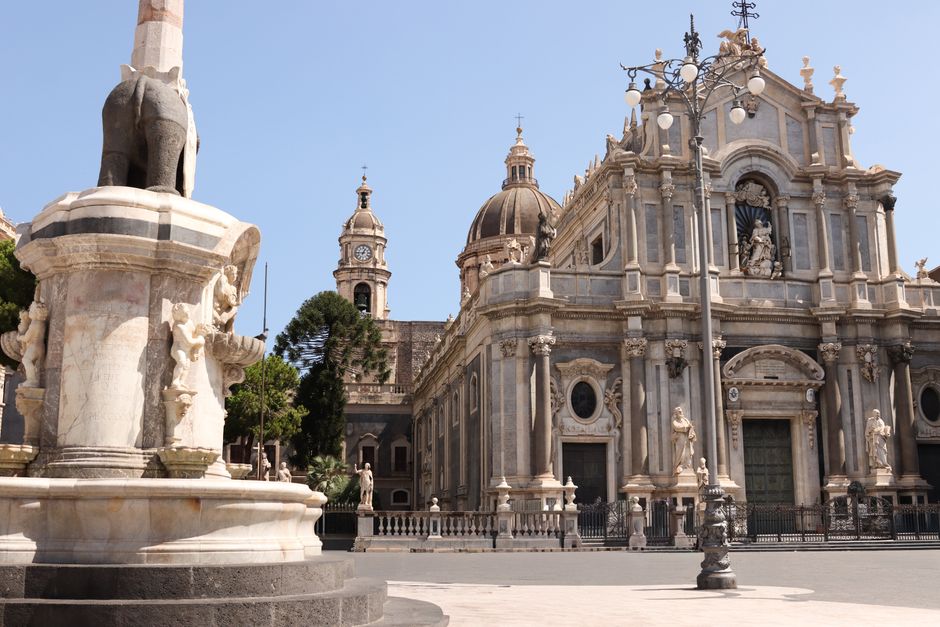
Here’s something barely any German-language blog mentions, probably because it doesn’t photograph well enough for Instagram: Catania has a fascinating underground side that’s perfect for a rainy day — you’re indoors either way. Beneath Piazza Duomo, right next to the cathedral, lie the Terme Achilliane, Roman baths from the 4th/5th century. You enter the baths through a barrel-vaulted passage built in the gap between the Roman structures and the cathedral’s foundations, with the entrance just to the right of the façade . Admission is modest: €5.00 full price, €3.00 reduced , and there are combination tickets with the Diocesan Museum. The rooms are cool and quiet — a nice contrast to the bustle up on the piazza.
A short walk away, and equally weatherproof, is Castello Ursino, the city’s only surviving Norman-Swabian castle and now home to the Museo Civico. The museum is open Monday to Sunday from 9:00 am to 7:00 pm, last entry at 6:00 pm . Inside you’ll find, among other things, sarcophagi, various sculptures, the head of a youth (ephebe) from the 6th century BC, a Hercules statue from the 3rd century, and a collection of Greek kraters . Something many travellers find surprising: the castle originally stood right on the sea — it was only the lava flow from the 1669 eruption that pushed the coastline back so far that the castle now sits inland. That fact alone tells you more about Catania’s relationship with Etna than any hike could.
The Benedictine monastery: the biggest Baroque building barely any tourist knows about
If you only have time for one indoor stop, make it the Monastery of San Nicolò l’Arena on Piazza Dante — reportedly one of the largest monasteries in Europe, and now home to the humanities faculty of the University of Catania. Guided tours last around 90 minutes and run Monday to Sunday, hourly between 10 am and 12 pm and again between 2 pm and 5 pm , with English-language tours on weekdays at 1 pm and, on weekends, additionally at 3:30 pm. Admission is €10 standard, with various discounts from €7.50 for over-65s, groups, or students . The tour takes you through two cloisters, a 16th-century cellar (now a library), visible Roman houses, and Vaccarini’s Baroque kitchen and cellar complex. One thing to note if it’s raining: part of the tour passes through courtyards, so you won’t stay completely dry everywhere, but the main halls are covered.
What if you still want the volcano — just without the hiking boots
If museums feel too “indoors” for you and you still want something volcanic, consider this: Catania itself is, strictly speaking, a city built on lava. The black stones in the street paving, the cathedral’s façade, parts of the city walls — almost all of it comes from the 1669 lava flow, which reached almost all the way to the sea. Walking through the old town with that in mind changes how you see every corner: you suddenly notice just how much black stone was actually used as building material. It’s no substitute for the crater landscape, but it shows the volcano from a different angle — as a building material, not just a destination.
Practical advice: don’t try to cram it all into one afternoon
Here’s an honest tip that generic blogs tend to leave out: the Terme Achilliane, Castello Ursino, and the monastery are all within the historic centre and reachable on foot in 10–20 minutes of each other, but on a rainy afternoon with tired legs (maybe after an early start toward Etna that got cancelled), two stops plus a coffee break in between is realistically enough. The baths are the most compact option and least weather-dependent, since they’re entirely underground. The monastery takes the most time because of the guided tour. The castle is easy to fit in on short notice, since it’s open continuously and needs no advance booking.
And if the wind has died down by the next day? Just head back up to Rifugio Sapienza and see if the cable car’s running again. Etna isn’t going anywhere — except, of course, in the literal, geological sense.